

60
3.2 In Vitro Exposure of Sperm and Other Cells
of the Male Gonad
The male gonad contains epithelial cells developing into gametes, supportive cells,
and stromal cells. The precursor of gametes and the mature gametes are particularly
sensitive to toxicants, because they lack highly efficient systems to counteract the
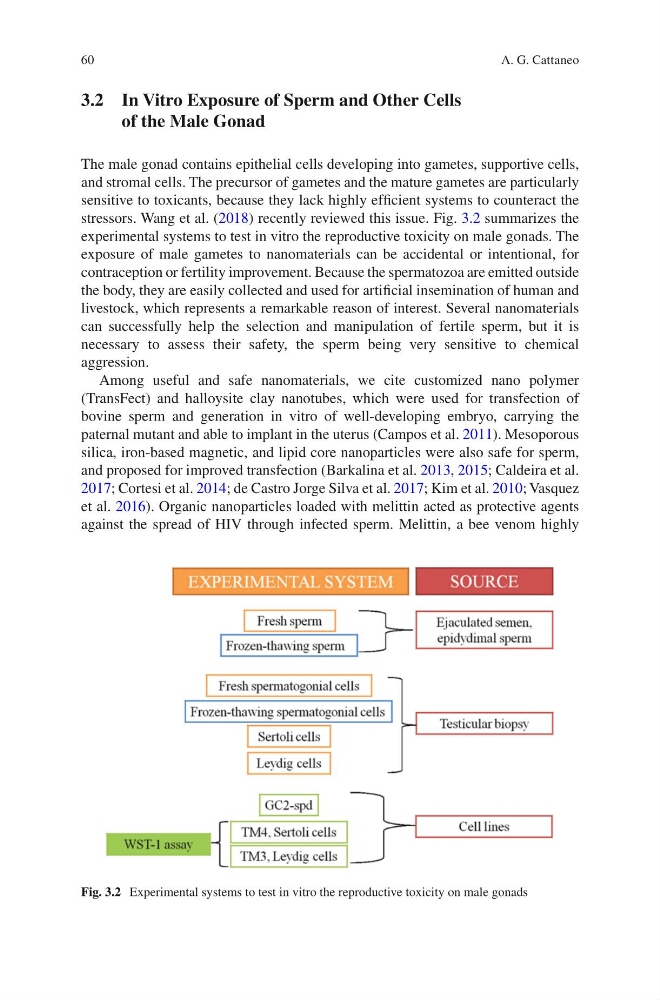
stressors. Wang et al. (2018) recently reviewed this issue. Fig. 3.2 summarizes the
experimental systems to test in vitro the reproductive toxicity on male gonads. The
exposure of male gametes to nanomaterials can be accidental or intentional, for
contraception or fertility improvement. Because the spermatozoa are emitted outside
the body, they are easily collected and used for artificial insemination of human and
livestock, which represents a remarkable reason of interest. Several nanomaterials
can successfully help the selection and manipulation of fertile sperm, but it is
necessary to assess their safety, the sperm being very sensitive to chemical
aggression.
Among useful and safe nanomaterials, we cite customized nano polymer
(TransFect) and halloysite clay nanotubes, which were used for transfection of
bovine sperm and generation in vitro of well-developing embryo, carrying the
paternal mutant and able to implant in the uterus (Campos et al. 2011). Mesoporous
silica, iron-based magnetic, and lipid core nanoparticles were also safe for sperm,
and proposed for improved transfection (Barkalina et al. 2013, 2015; Caldeira et al.
2017; Cortesi et al. 2014; de Castro Jorge Silva et al. 2017; Kim et al. 2010; Vasquez
et al. 2016). Organic nanoparticles loaded with melittin acted as protective agents
against the spread of HIV through infected sperm. Melittin, a bee venom highly
Fig. 3.2 Experimental systems to test in vitro the reproductive toxicity on male gonads
A. G. Cattaneo
3.2 In Vitro Exposure of Sperm and Other Cells
of the Male Gonad
The male gonad contains epithelial cells developing into gametes, supportive cells,
and stromal cells. The precursor of gametes and the mature gametes are particularly
sensitive to toxicants, because they lack highly efficient systems to counteract the
stressors. Wang et al. (2018) recently reviewed this issue. Fig. 3.2 summarizes the
experimental systems to test in vitro the reproductive toxicity on male gonads. The
exposure of male gametes to nanomaterials can be accidental or intentional, for
contraception or fertility improvement. Because the spermatozoa are emitted outside
the body, they are easily collected and used for artificial insemination of human and
livestock, which represents a remarkable reason of interest. Several nanomaterials
can successfully help the selection and manipulation of fertile sperm, but it is
necessary to assess their safety, the sperm being very sensitive to chemical
aggression.
Among useful and safe nanomaterials, we cite customized nano polymer
(TransFect) and halloysite clay nanotubes, which were used for transfection of
bovine sperm and generation in vitro of well-developing embryo, carrying the
paternal mutant and able to implant in the uterus (Campos et al. 2011). Mesoporous
silica, iron-based magnetic, and lipid core nanoparticles were also safe for sperm,
and proposed for improved transfection (Barkalina et al. 2013, 2015; Caldeira et al.
2017; Cortesi et al. 2014; de Castro Jorge Silva et al. 2017; Kim et al. 2010; Vasquez
et al. 2016). Organic nanoparticles loaded with melittin acted as protective agents
against the spread of HIV through infected sperm. Melittin, a bee venom highly
Fig. 3.2 Experimental systems to test in vitro the reproductive toxicity on male gonads
A. G. Cattaneo