

13
various zones. As such, car engines can discharge gases and emissions to the environment, so car manufacturers in turn create environmental problems since there is
a lack of waste-disposal programs.
Nanotechnology is a booming business, providing considerable income to the
United States; however, very little effort has been given to environmental and health
concerns regarding nanomaterials (Nanogloss 2010).
1.6 Potential Exposure Pathway
According to Vance et al. (2015), the Project on Emerging Nanotechnologies’ consumer product inventory has very little information in terms of nanomaterial size
and concentration; thus, the real health risks of these products remain virtually
unknown. Among all things considered, the consumer product inventory might be
valuable for understanding potential introduction pathways from the normal typical
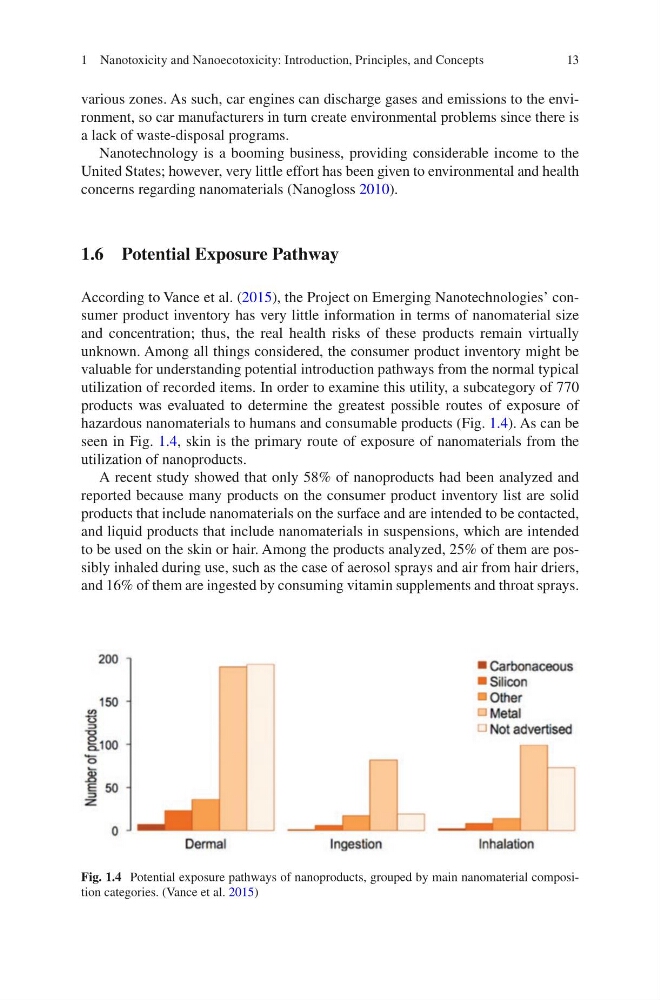
utilization of recorded items. In order to examine this utility, a subcategory of 770
products was evaluated to determine the greatest possible routes of exposure of
hazardous nanomaterials to humans and consumable products (Fig. 1.4). As can be
seen in Fig. 1.4, skin is the primary route of exposure of nanomaterials from the
utilization of nanoproducts.
A recent study showed that only 58% of nanoproducts had been analyzed and
reported because many products on the consumer product inventory list are solid
products that include nanomaterials on the surface and are intended to be contacted,
and liquid products that include nanomaterials in suspensions, which are intended
to be used on the skin or hair. Among the products analyzed, 25% of them are possibly inhaled during use, such as the case of aerosol sprays and air from hair driers,
and 16% of them are ingested by consuming vitamin supplements and throat sprays.
Fig. 1.4 Potential exposure pathways of nanoproducts, grouped by main nanomaterial composition categories. (Vance et al. 2015)
1 Nanotoxicity and Nanoecotoxicity: Introduction, Principles, and Concepts
various zones. As such, car engines can discharge gases and emissions to the environment, so car manufacturers in turn create environmental problems since there is
a lack of waste-disposal programs.
Nanotechnology is a booming business, providing considerable income to the
United States; however, very little effort has been given to environmental and health
concerns regarding nanomaterials (Nanogloss 2010).
1.6 Potential Exposure Pathway
According to Vance et al. (2015), the Project on Emerging Nanotechnologies’ consumer product inventory has very little information in terms of nanomaterial size
and concentration; thus, the real health risks of these products remain virtually
unknown. Among all things considered, the consumer product inventory might be
valuable for understanding potential introduction pathways from the normal typical
utilization of recorded items. In order to examine this utility, a subcategory of 770
products was evaluated to determine the greatest possible routes of exposure of
hazardous nanomaterials to humans and consumable products (Fig. 1.4). As can be
seen in Fig. 1.4, skin is the primary route of exposure of nanomaterials from the
utilization of nanoproducts.
A recent study showed that only 58% of nanoproducts had been analyzed and
reported because many products on the consumer product inventory list are solid
products that include nanomaterials on the surface and are intended to be contacted,
and liquid products that include nanomaterials in suspensions, which are intended
to be used on the skin or hair. Among the products analyzed, 25% of them are possibly inhaled during use, such as the case of aerosol sprays and air from hair driers,
and 16% of them are ingested by consuming vitamin supplements and throat sprays.
Fig. 1.4 Potential exposure pathways of nanoproducts, grouped by main nanomaterial composition categories. (Vance et al. 2015)
1 Nanotoxicity and Nanoecotoxicity: Introduction, Principles, and Concepts