

14
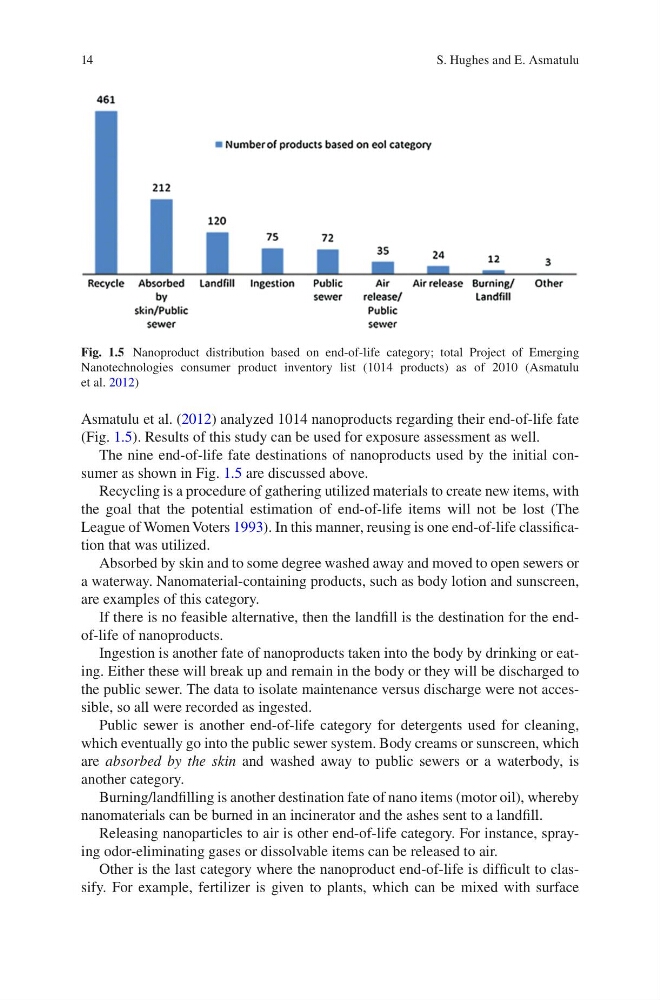
Asmatulu et al. (2012) analyzed 1014 nanoproducts regarding their end-of-life fate
(Fig. 1.5). Results of this study can be used for exposure assessment as well.
The nine end-of-life fate destinations of nanoproducts used by the initial consumer as shown in Fig. 1.5 are discussed above.
Recycling is a procedure of gathering utilized materials to create new items, with
the goal that the potential estimation of end-of-life items will not be lost (The
League of Women Voters 1993). In this manner, reusing is one end-of-life classification that was utilized.
Absorbed by skin and to some degree washed away and moved to open sewers or
a waterway. Nanomaterial-containing products, such as body lotion and sunscreen,
are examples of this category.
If there is no feasible alternative, then the landfill is the destination for the endof- life of nanoproducts.
Ingestion is another fate of nanoproducts taken into the body by drinking or eating. Either these will break up and remain in the body or they will be discharged to
the public sewer. The data to isolate maintenance versus discharge were not accessible, so all were recorded as ingested.
Public sewer is another end-of-life category for detergents used for cleaning,
which eventually go into the public sewer system. Body creams or sunscreen, which
are absorbed by the skin and washed away to public sewers or a waterbody, is
another category.
Burning/landfilling is another destination fate of nano items (motor oil), whereby
nanomaterials can be burned in an incinerator and the ashes sent to a landfill.
Releasing nanoparticles to air is other end-of-life category. For instance, spraying odor-eliminating gases or dissolvable items can be released to air.
Other is the last category where the nanoproduct end-of-life is difficult to classify. For example, fertilizer is given to plants, which can be mixed with surface
Fig. 1.5 Nanoproduct distribution based on end-of-life category; total Project of Emerging
Nanotechnologies consumer product inventory list (1014 products) as of 2010 (Asmatulu
et al. 2012)
S. Hughes and E. Asmatulu
Asmatulu et al. (2012) analyzed 1014 nanoproducts regarding their end-of-life fate
(Fig. 1.5). Results of this study can be used for exposure assessment as well.
The nine end-of-life fate destinations of nanoproducts used by the initial consumer as shown in Fig. 1.5 are discussed above.
Recycling is a procedure of gathering utilized materials to create new items, with
the goal that the potential estimation of end-of-life items will not be lost (The
League of Women Voters 1993). In this manner, reusing is one end-of-life classification that was utilized.
Absorbed by skin and to some degree washed away and moved to open sewers or
a waterway. Nanomaterial-containing products, such as body lotion and sunscreen,
are examples of this category.
If there is no feasible alternative, then the landfill is the destination for the endof- life of nanoproducts.
Ingestion is another fate of nanoproducts taken into the body by drinking or eating. Either these will break up and remain in the body or they will be discharged to
the public sewer. The data to isolate maintenance versus discharge were not accessible, so all were recorded as ingested.
Public sewer is another end-of-life category for detergents used for cleaning,
which eventually go into the public sewer system. Body creams or sunscreen, which
are absorbed by the skin and washed away to public sewers or a waterbody, is
another category.
Burning/landfilling is another destination fate of nano items (motor oil), whereby
nanomaterials can be burned in an incinerator and the ashes sent to a landfill.
Releasing nanoparticles to air is other end-of-life category. For instance, spraying odor-eliminating gases or dissolvable items can be released to air.
Other is the last category where the nanoproduct end-of-life is difficult to classify. For example, fertilizer is given to plants, which can be mixed with surface
Fig. 1.5 Nanoproduct distribution based on end-of-life category; total Project of Emerging
Nanotechnologies consumer product inventory list (1014 products) as of 2010 (Asmatulu
et al. 2012)
S. Hughes and E. Asmatulu