

12
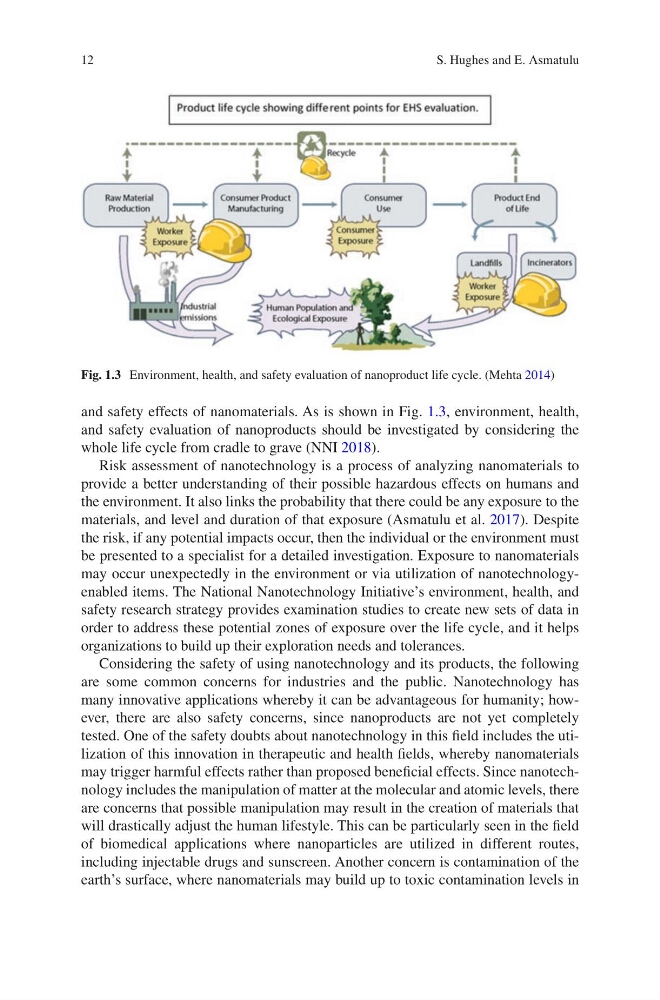
and safety effects of nanomaterials. As is shown in Fig. 1.3, environment, health,
and safety evaluation of nanoproducts should be investigated by considering the
whole life cycle from cradle to grave (NNI 2018).
Risk assessment of nanotechnology is a process of analyzing nanomaterials to
provide a better understanding of their possible hazardous effects on humans and
the environment. It also links the probability that there could be any exposure to the
materials, and level and duration of that exposure (Asmatulu et al. 2017). Despite
the risk, if any potential impacts occur, then the individual or the environment must
be presented to a specialist for a detailed investigation. Exposure to nanomaterials
may occur unexpectedly in the environment or via utilization of nanotechnologyenabled items. The National Nanotechnology Initiative’s environment, health, and
safety research strategy provides examination studies to create new sets of data in
order to address these potential zones of exposure over the life cycle, and it helps
organizations to build up their exploration needs and tolerances.
Considering the safety of using nanotechnology and its products, the following
are some common concerns for industries and the public. Nanotechnology has
many innovative applications whereby it can be advantageous for humanity; however, there are also safety concerns, since nanoproducts are not yet completely
tested. One of the safety doubts about nanotechnology in this field includes the utilization of this innovation in therapeutic and health fields, whereby nanomaterials
may trigger harmful effects rather than proposed beneficial effects. Since nanotechnology includes the manipulation of matter at the molecular and atomic levels, there
are concerns that possible manipulation may result in the creation of materials that
will drastically adjust the human lifestyle. This can be particularly seen in the field
of biomedical applications where nanoparticles are utilized in different routes,
including injectable drugs and sunscreen. Another concern is contamination of the
earth’s surface, where nanomaterials may build up to toxic contamination levels in
Fig. 1.3 Environment, health, and safety evaluation of nanoproduct life cycle. (Mehta 2014)
S. Hughes and E. Asmatulu
and safety effects of nanomaterials. As is shown in Fig. 1.3, environment, health,
and safety evaluation of nanoproducts should be investigated by considering the
whole life cycle from cradle to grave (NNI 2018).
Risk assessment of nanotechnology is a process of analyzing nanomaterials to
provide a better understanding of their possible hazardous effects on humans and
the environment. It also links the probability that there could be any exposure to the
materials, and level and duration of that exposure (Asmatulu et al. 2017). Despite
the risk, if any potential impacts occur, then the individual or the environment must
be presented to a specialist for a detailed investigation. Exposure to nanomaterials
may occur unexpectedly in the environment or via utilization of nanotechnologyenabled items. The National Nanotechnology Initiative’s environment, health, and
safety research strategy provides examination studies to create new sets of data in
order to address these potential zones of exposure over the life cycle, and it helps
organizations to build up their exploration needs and tolerances.
Considering the safety of using nanotechnology and its products, the following
are some common concerns for industries and the public. Nanotechnology has
many innovative applications whereby it can be advantageous for humanity; however, there are also safety concerns, since nanoproducts are not yet completely
tested. One of the safety doubts about nanotechnology in this field includes the utilization of this innovation in therapeutic and health fields, whereby nanomaterials
may trigger harmful effects rather than proposed beneficial effects. Since nanotechnology includes the manipulation of matter at the molecular and atomic levels, there
are concerns that possible manipulation may result in the creation of materials that
will drastically adjust the human lifestyle. This can be particularly seen in the field
of biomedical applications where nanoparticles are utilized in different routes,
including injectable drugs and sunscreen. Another concern is contamination of the
earth’s surface, where nanomaterials may build up to toxic contamination levels in
Fig. 1.3 Environment, health, and safety evaluation of nanoproduct life cycle. (Mehta 2014)
S. Hughes and E. Asmatulu