

11
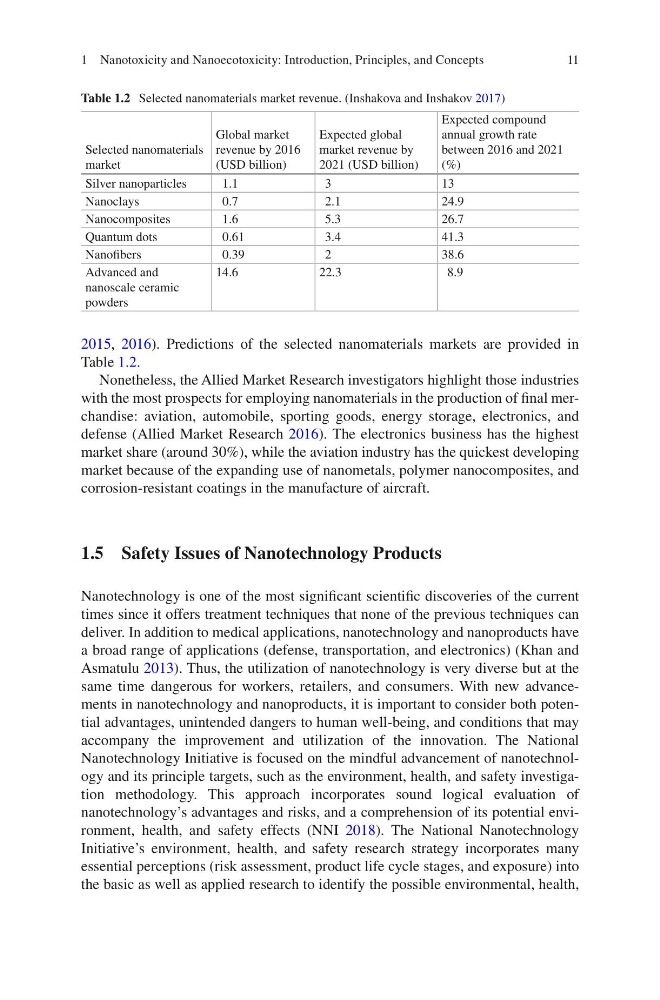
2015, 2016). Predictions of the selected nanomaterials markets are provided in
Table 1.2.
Nonetheless, the Allied Market Research investigators highlight those industries
with the most prospects for employing nanomaterials in the production of final merchandise: aviation, automobile, sporting goods, energy storage, electronics, and
defense (Allied Market Research 2016). The electronics business has the highest
market share (around 30%), while the aviation industry has the quickest developing
market because of the expanding use of nanometals, polymer nanocomposites, and
corrosion-resistant coatings in the manufacture of aircraft.
1.5 Safety Issues of Nanotechnology Products
Nanotechnology is one of the most significant scientific discoveries of the current
times since it offers treatment techniques that none of the previous techniques can
deliver. In addition to medical applications, nanotechnology and nanoproducts have
a broad range of applications (defense, transportation, and electronics) (Khan and
Asmatulu 2013). Thus, the utilization of nanotechnology is very diverse but at the
same time dangerous for workers, retailers, and consumers. With new advancements in nanotechnology and nanoproducts, it is important to consider both potential advantages, unintended dangers to human well-being, and conditions that may
accompany the improvement and utilization of the innovation. The National
Nanotechnology Initiative is focused on the mindful advancement of nanotechnology and its principle targets, such as the environment, health, and safety investigation methodology. This approach incorporates sound logical evaluation of
nanotechnology’s advantages and risks, and a comprehension of its potential environment, health, and safety effects (NNI 2018). The National Nanotechnology
Initiative’s environment, health, and safety research strategy incorporates many
essential perceptions (risk assessment, product life cycle stages, and exposure) into
the basic as well as applied research to identify the possible environmental, health,
Table 1.2 Selected nanomaterials market revenue. (Inshakova and Inshakov 2017)
Selected nanomaterials
market
Global market
revenue by 2016
(USD billion)
Expected global
market revenue by
2021 (USD billion)
Expected compound
annual growth rate
between 2016 and 2021
(%)
Silver nanoparticles
1.1
3
13
Nanoclays
0.7
2.1
24.9
Nanocomposites
1.6
5.3
26.7
Quantum dots
0.61
3.4
41.3
Nanofibers
0.39
2
38.6
Advanced and
nanoscale ceramic
powders
14.6
22.3
8.9
1 Nanotoxicity and Nanoecotoxicity: Introduction, Principles, and Concepts
2015, 2016). Predictions of the selected nanomaterials markets are provided in
Table 1.2.
Nonetheless, the Allied Market Research investigators highlight those industries
with the most prospects for employing nanomaterials in the production of final merchandise: aviation, automobile, sporting goods, energy storage, electronics, and
defense (Allied Market Research 2016). The electronics business has the highest
market share (around 30%), while the aviation industry has the quickest developing
market because of the expanding use of nanometals, polymer nanocomposites, and
corrosion-resistant coatings in the manufacture of aircraft.
1.5 Safety Issues of Nanotechnology Products
Nanotechnology is one of the most significant scientific discoveries of the current
times since it offers treatment techniques that none of the previous techniques can
deliver. In addition to medical applications, nanotechnology and nanoproducts have
a broad range of applications (defense, transportation, and electronics) (Khan and
Asmatulu 2013). Thus, the utilization of nanotechnology is very diverse but at the
same time dangerous for workers, retailers, and consumers. With new advancements in nanotechnology and nanoproducts, it is important to consider both potential advantages, unintended dangers to human well-being, and conditions that may
accompany the improvement and utilization of the innovation. The National
Nanotechnology Initiative is focused on the mindful advancement of nanotechnology and its principle targets, such as the environment, health, and safety investigation methodology. This approach incorporates sound logical evaluation of
nanotechnology’s advantages and risks, and a comprehension of its potential environment, health, and safety effects (NNI 2018). The National Nanotechnology
Initiative’s environment, health, and safety research strategy incorporates many
essential perceptions (risk assessment, product life cycle stages, and exposure) into
the basic as well as applied research to identify the possible environmental, health,
Table 1.2 Selected nanomaterials market revenue. (Inshakova and Inshakov 2017)
Selected nanomaterials
market
Global market
revenue by 2016
(USD billion)
Expected global
market revenue by
2021 (USD billion)
Expected compound
annual growth rate
between 2016 and 2021
(%)
Silver nanoparticles
1.1
3
13
Nanoclays
0.7
2.1
24.9
Nanocomposites
1.6
5.3
26.7
Quantum dots
0.61
3.4
41.3
Nanofibers
0.39
2
38.6
Advanced and
nanoscale ceramic
powders
14.6
22.3
8.9
1 Nanotoxicity and Nanoecotoxicity: Introduction, Principles, and Concepts