

146
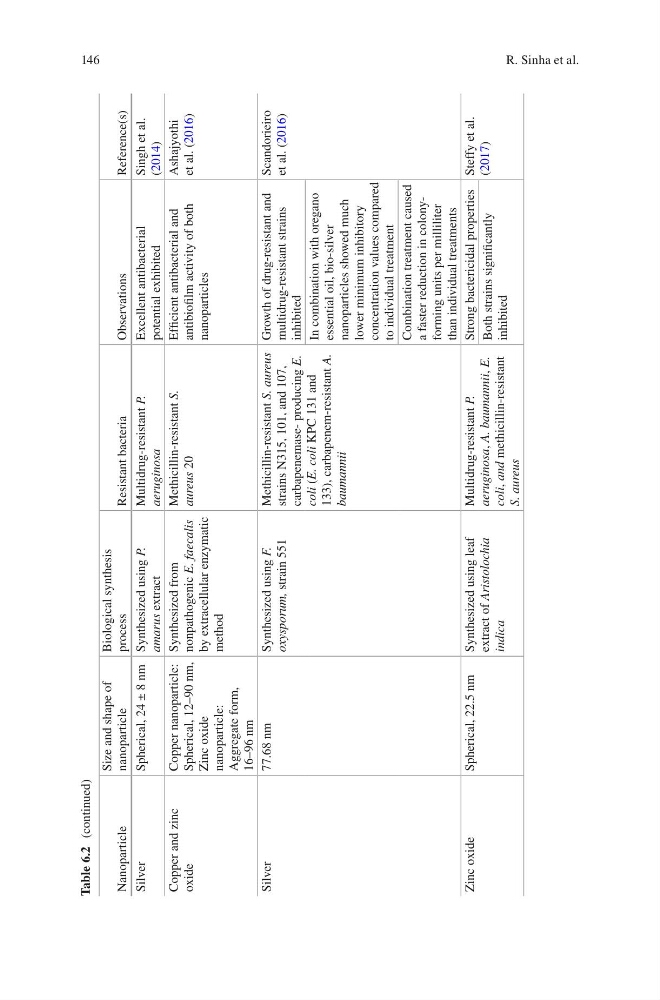
Table 6.2 (continued)
Nanoparticle
Size and shape of
nanoparticle
Biological synthesis
process
Resistant bacteria
Observations
Reference(s)
Silver
Spherical, 24 ± 8 nm Synthesized using P.
amarus
extract
Multidrug-resistant P.
aeruginosa
Excellent antibacterial
potential exhibited
Singh et al.
(2014)
Copper and zinc
oxide
Copper nanoparticle:
Spherical, 12–90 nm,
Zinc oxide
nanoparticle:
Aggregate form,
16–96 nm
Synthesized from
nonpathogenic E. faecalis
by extracellular enzymatic
method
Methicillin-resistant S.
aureus
20
Efficient antibacterial and
antibiofilm activity of both
nanoparticles
Ashajyothi
et al. (2016)
Silver
77.68 nm
Synthesized using F.
oxysporum,
strain 551
Methicillin-resistant S. aureus
strains N315, 101, and 107,
carbapenemase- producing E.
coli
(E. coli
KPC 131 and
133), carbapenem-resistant A.
baumannii
Growth of drug-resistant and
multidrug-resistant strains
inhibited
Scandorieiro
et al. (2016)
In combination with oregano
essential oil, bio-silver
nanoparticles showed much
lower minimum inhibitory
concentration values compared
to individual treatment
Combination treatment caused
a faster reduction in colonyforming units per milliliter
than individual treatments
Zinc oxide
Spherical, 22.5 nm
Synthesized using leaf
extract of Aristolochia
indica
Multidrug-resistant P.
aeruginosa, A. baumannii, E.
coli, and
methicillin-resistant
S. aureus
Strong bactericidal properties Steffy et al.
(2017)
Both strains significantly
inhibited
R. Sinha et al.
Table 6.2 (continued)
Nanoparticle
Size and shape of
nanoparticle
Biological synthesis
process
Resistant bacteria
Observations
Reference(s)
Silver
Spherical, 24 ± 8 nm Synthesized using P.
amarus
extract
Multidrug-resistant P.
aeruginosa
Excellent antibacterial
potential exhibited
Singh et al.
(2014)
Copper and zinc
oxide
Copper nanoparticle:
Spherical, 12–90 nm,
Zinc oxide
nanoparticle:
Aggregate form,
16–96 nm
Synthesized from
nonpathogenic E. faecalis
by extracellular enzymatic
method
Methicillin-resistant S.
aureus
20
Efficient antibacterial and
antibiofilm activity of both
nanoparticles
Ashajyothi
et al. (2016)
Silver
77.68 nm
Synthesized using F.
oxysporum,
strain 551
Methicillin-resistant S. aureus
strains N315, 101, and 107,
carbapenemase- producing E.
coli
(E. coli
KPC 131 and
133), carbapenem-resistant A.
baumannii
Growth of drug-resistant and
multidrug-resistant strains
inhibited
Scandorieiro
et al. (2016)
In combination with oregano
essential oil, bio-silver
nanoparticles showed much
lower minimum inhibitory
concentration values compared
to individual treatment
Combination treatment caused
a faster reduction in colonyforming units per milliliter
than individual treatments
Zinc oxide
Spherical, 22.5 nm
Synthesized using leaf
extract of Aristolochia
indica
Multidrug-resistant P.
aeruginosa, A. baumannii, E.
coli, and
methicillin-resistant
S. aureus
Strong bactericidal properties Steffy et al.
(2017)
Both strains significantly
inhibited
R. Sinha et al.