

5 Analyzing the Problem of a Spherical Cavity Expansion …
73
˜
u = A
1
3α
2
ξ
2
− 1
+ Bαξ,
(5.10)
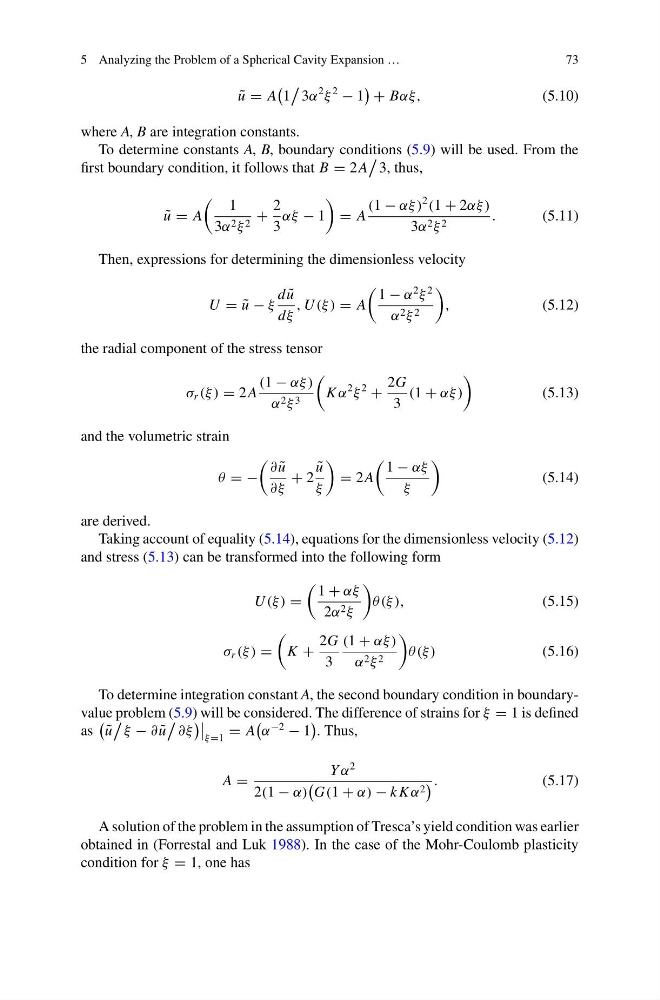
where A, B are integration constants.
To determine constants A, B, boundary conditions (5.9) will be used. From the
first boundary condition, it follows that B = 2 A
3, thus,
˜
u = A
1
3α 2 ξ 2 +
2
3
αξ − 1
= A
(1 − αξ )
2
(1 + 2αξ )
3α 2 ξ 2
.
(5.11)
Then, expressions for determining the dimensionless velocity
U = ˜
u − ξ
d ˜
u
dξ
, U (ξ ) = A
1 − α
2
ξ
2
α 2 ξ 2
,
(5.12)
the radial component of the stress tensor
σ r (ξ ) = 2 A
(1 − αξ )
α 2 ξ 3
K α
2
ξ
2
+
2G
3
(1 + αξ )
(5.13)
and the volumetric strain
θ = −
∂ ˜
u
∂ξ
+ 2
˜
u
ξ
= 2 A
1 − αξ
ξ
(5.14)
are derived.
Taking account of equality (5.14), equations for the dimensionless velocity (5.12)
and stress (5.13) can be transformed into the following form
U (ξ ) =
1 + αξ
2α 2 ξ
θ (ξ ),
(5.15)
σ r (ξ ) =
K +
2G
3
(1 + αξ )
α 2 ξ 2
θ (ξ )
(5.16)
To determine integration constant A, the second boundary condition in boundaryvalue problem (5.9) will be considered. The difference of strains for ξ = 1 is defined
as
˜
u
ξ − ∂ ˜
u
∂ξ
ξ =1
= A
α
−2
− 1
. Thus,
A =
Y α
2
2(1 − α)
G(1 + α) − k K α 2
.
(5.17)
A solution of the problem in the assumption of Tresca’s yield condition was earlier
obtained in (Forrestal and Luk 1988). In the case of the Mohr-Coulomb plasticity
condition for ξ = 1, one has
73
˜
u = A
1
3α
2
ξ
2
− 1
+ Bαξ,
(5.10)
where A, B are integration constants.
To determine constants A, B, boundary conditions (5.9) will be used. From the
first boundary condition, it follows that B = 2 A
3, thus,
˜
u = A
1
3α 2 ξ 2 +
2
3
αξ − 1
= A
(1 − αξ )
2
(1 + 2αξ )
3α 2 ξ 2
.
(5.11)
Then, expressions for determining the dimensionless velocity
U = ˜
u − ξ
d ˜
u
dξ
, U (ξ ) = A
1 − α
2
ξ
2
α 2 ξ 2
,
(5.12)
the radial component of the stress tensor
σ r (ξ ) = 2 A
(1 − αξ )
α 2 ξ 3
K α
2
ξ
2
+
2G
3
(1 + αξ )
(5.13)
and the volumetric strain
θ = −
∂ ˜
u
∂ξ
+ 2
˜
u
ξ
= 2 A
1 − αξ
ξ
(5.14)
are derived.
Taking account of equality (5.14), equations for the dimensionless velocity (5.12)
and stress (5.13) can be transformed into the following form
U (ξ ) =
1 + αξ
2α 2 ξ
θ (ξ ),
(5.15)
σ r (ξ ) =
K +
2G
3
(1 + αξ )
α 2 ξ 2
θ (ξ )
(5.16)
To determine integration constant A, the second boundary condition in boundaryvalue problem (5.9) will be considered. The difference of strains for ξ = 1 is defined
as
˜
u
ξ − ∂ ˜
u
∂ξ
ξ =1
= A
α
−2
− 1
. Thus,
A =
Y α
2
2(1 − α)
G(1 + α) − k K α 2
.
(5.17)
A solution of the problem in the assumption of Tresca’s yield condition was earlier
obtained in (Forrestal and Luk 1988). In the case of the Mohr-Coulomb plasticity
condition for ξ = 1, one has