

72
V. L. Kotov et al.
∂σ r
∂r
+ 2
(σ r − σ θ )
r
= −ρ
∂υ
∂t
, υ =
∂u
∂t
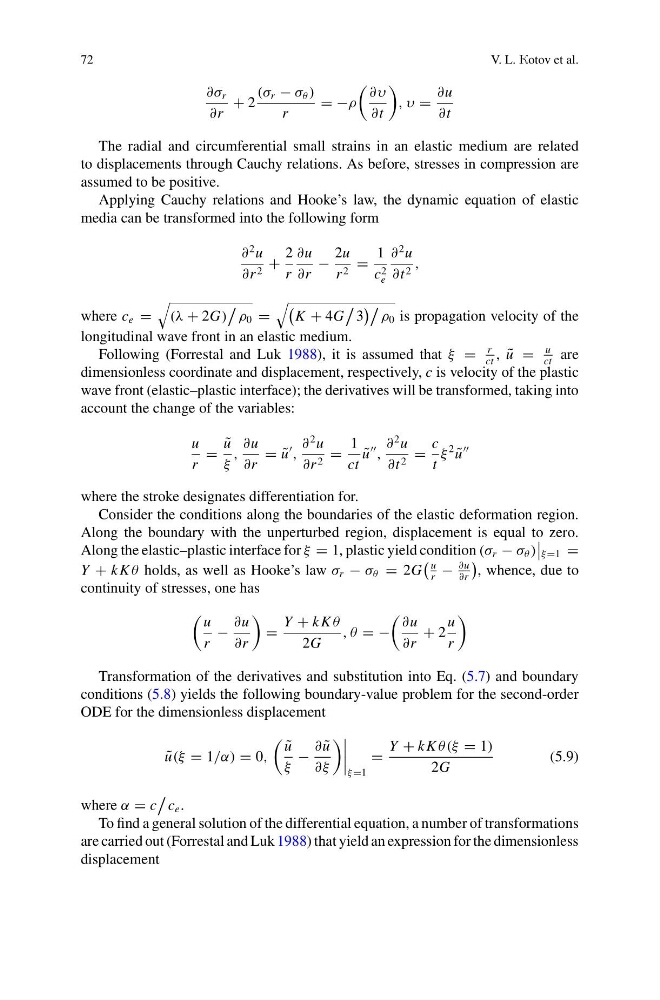
The radial and circumferential small strains in an elastic medium are related
to displacements through Cauchy relations. As before, stresses in compression are
assumed to be positive.
Applying Cauchy relations and Hooke’s law, the dynamic equation of elastic
media can be transformed into the following form
∂
2 u
∂r 2 +
2
r
∂u
∂r
−
2u
r 2 =
1
c 2
e
∂
2 u
∂t 2 ,
where c e =
(λ + 2G)
ρ 0 =
K + 4G
3
ρ 0 is propagation velocity of the
longitudinal wave front in an elastic medium.
Following (Forrestal and Luk 1988), it is assumed that ξ =
r
ct
, ˜
u =
u
ct
are
dimensionless coordinate and displacement, respectively, c is velocity of the plastic
wave front (elastic–plastic interface); the derivatives will be transformed, taking into
account the change of the variables:
u
r
=
˜
u
ξ
,
∂u
∂r
= ˜
u
,
∂
2 u
∂r 2 =
1
ct
˜
u
,
∂
2 u
∂t 2 =
c
t
ξ
2
˜
u
where the stroke designates differentiation for.
Consider the conditions along the boundaries of the elastic deformation region.
Along the boundary with the unperturbed region, displacement is equal to zero.
Along the elastic–plastic interface for ξ = 1, plastic yield condition (σ r − σ θ )
ξ =1 =
Y + k K θ holds, as well as Hooke’s law σ r − σ θ = 2G
u
r
−
∂u
∂r
, whence, due to
continuity of stresses, one has
u
r
−
∂u
∂r
=
Y + k K θ
2G
, θ = −
∂u
∂r
+ 2
u
r
Transformation of the derivatives and substitution into Eq. (5.7) and boundary
conditions (5.8) yields the following boundary-value problem for the second-order
ODE for the dimensionless displacement
˜
u(ξ = 1/α) = 0,
˜
u
ξ
−
∂ ˜
u
∂ξ
ξ =1
=
Y + k K θ (ξ = 1)
2G
(5.9)
where α = c
c e .
To find a general solution of the differential equation, a number of transformations
are carried out (Forrestal and Luk 1988) that yield an expression for the dimensionless
displacement
V. L. Kotov et al.
∂σ r
∂r
+ 2
(σ r − σ θ )
r
= −ρ
∂υ
∂t
, υ =
∂u
∂t
The radial and circumferential small strains in an elastic medium are related
to displacements through Cauchy relations. As before, stresses in compression are
assumed to be positive.
Applying Cauchy relations and Hooke’s law, the dynamic equation of elastic
media can be transformed into the following form
∂
2 u
∂r 2 +
2
r
∂u
∂r
−
2u
r 2 =
1
c 2
e
∂
2 u
∂t 2 ,
where c e =
(λ + 2G)
ρ 0 =
K + 4G
3
ρ 0 is propagation velocity of the
longitudinal wave front in an elastic medium.
Following (Forrestal and Luk 1988), it is assumed that ξ =
r
ct
, ˜
u =
u
ct
are
dimensionless coordinate and displacement, respectively, c is velocity of the plastic
wave front (elastic–plastic interface); the derivatives will be transformed, taking into
account the change of the variables:
u
r
=
˜
u
ξ
,
∂u
∂r
= ˜
u
,
∂
2 u
∂r 2 =
1
ct
˜
u
,
∂
2 u
∂t 2 =
c
t
ξ
2
˜
u
where the stroke designates differentiation for.
Consider the conditions along the boundaries of the elastic deformation region.
Along the boundary with the unperturbed region, displacement is equal to zero.
Along the elastic–plastic interface for ξ = 1, plastic yield condition (σ r − σ θ )
ξ =1 =
Y + k K θ holds, as well as Hooke’s law σ r − σ θ = 2G
u
r
−
∂u
∂r
, whence, due to
continuity of stresses, one has
u
r
−
∂u
∂r
=
Y + k K θ
2G
, θ = −
∂u
∂r
+ 2
u
r
Transformation of the derivatives and substitution into Eq. (5.7) and boundary
conditions (5.8) yields the following boundary-value problem for the second-order
ODE for the dimensionless displacement
˜
u(ξ = 1/α) = 0,
˜
u
ξ
−
∂ ˜
u
∂ξ
ξ =1
=
Y + k K θ (ξ = 1)
2G
(5.9)
where α = c
c e .
To find a general solution of the differential equation, a number of transformations
are carried out (Forrestal and Luk 1988) that yield an expression for the dimensionless
displacement