

74
V. L. Kotov et al.
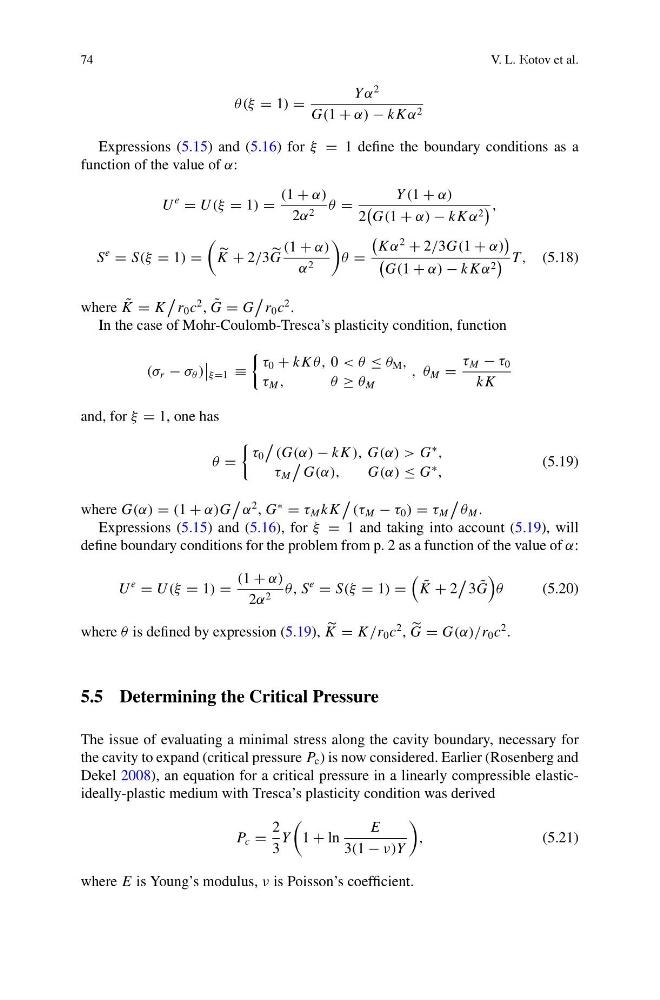
θ (ξ = 1) =
Y α
2
G(1 + α) − k K α 2
Expressions (5.15) and (5.16) for ξ = 1 define the boundary conditions as a
function of the value of α:
U
e
= U (ξ = 1) =
(1 + α)
2α 2 θ =
Y (1 + α)
2
G(1 + α) − k K α 2
,
S
e
= S(ξ = 1) =
K + 2/3
G
(1 + α)
α 2
θ =
K α
2
+ 2/3G(1 + α)
G(1 + α) − k K α 2
T, (5.18)
where ˜
K = K
r 0 c
2 , ˜
G = G
r 0 c
2 .
In the case of Mohr-Coulomb-Tresca’s plasticity condition, function
(σ r − σ θ )
ξ =1 ≡
τ 0 + k K θ, 0 < θ ≤ θ M ,
τ M ,
θ≥ θ M
, θ M =
τ M − τ 0
k K
and, for ξ = 1, one has
θ =
τ 0
(G(α) − k K ), G(α) > G
∗
,
τ M
G(α),
G(α) ≤ G
∗
,
(5.19)
where G(α) = (1 + α)G
α
2 , G
∗
= τ M k K
(τ M − τ 0 ) = τ M
θ M .
Expressions (5.15) and (5.16), for ξ = 1 and taking into account (5.19), will
define boundary conditions for the problem from p. 2 as a function of the value of α:
U
e
= U (ξ = 1) =
(1 + α)
2α 2 θ, S
e
= S(ξ = 1) =
˜
K + 2
3 ˜
G
θ
(5.20)
where θ is defined by expression (5.19),
K = K /r 0 c
2 ,
G = G(α)/r 0 c
2 .
5.5 Determining the Critical Pressure
The issue of evaluating a minimal stress along the cavity boundary, necessary for
the cavity to expand (critical pressure P c ) is now considered. Earlier (Rosenberg and
Dekel 2008), an equation for a critical pressure in a linearly compressible elasticideally-plastic medium with Tresca’s plasticity condition was derived
P c =
2
3
Y
1 + ln
E
3(1 − ν)Y
,
(5.21)
where E is Young’s modulus, ν is Poisson’s coefficient.
V. L. Kotov et al.
θ (ξ = 1) =
Y α
2
G(1 + α) − k K α 2
Expressions (5.15) and (5.16) for ξ = 1 define the boundary conditions as a
function of the value of α:
U
e
= U (ξ = 1) =
(1 + α)
2α 2 θ =
Y (1 + α)
2
G(1 + α) − k K α 2
,
S
e
= S(ξ = 1) =
K + 2/3
G
(1 + α)
α 2
θ =
K α
2
+ 2/3G(1 + α)
G(1 + α) − k K α 2
T, (5.18)
where ˜
K = K
r 0 c
2 , ˜
G = G
r 0 c
2 .
In the case of Mohr-Coulomb-Tresca’s plasticity condition, function
(σ r − σ θ )
ξ =1 ≡
τ 0 + k K θ, 0 < θ ≤ θ M ,
τ M ,
θ≥ θ M
, θ M =
τ M − τ 0
k K
and, for ξ = 1, one has
θ =
τ 0
(G(α) − k K ), G(α) > G
∗
,
τ M
G(α),
G(α) ≤ G
∗
,
(5.19)
where G(α) = (1 + α)G
α
2 , G
∗
= τ M k K
(τ M − τ 0 ) = τ M
θ M .
Expressions (5.15) and (5.16), for ξ = 1 and taking into account (5.19), will
define boundary conditions for the problem from p. 2 as a function of the value of α:
U
e
= U (ξ = 1) =
(1 + α)
2α 2 θ, S
e
= S(ξ = 1) =
˜
K + 2
3 ˜
G
θ
(5.20)
where θ is defined by expression (5.19),
K = K /r 0 c
2 ,
G = G(α)/r 0 c
2 .
5.5 Determining the Critical Pressure
The issue of evaluating a minimal stress along the cavity boundary, necessary for
the cavity to expand (critical pressure P c ) is now considered. Earlier (Rosenberg and
Dekel 2008), an equation for a critical pressure in a linearly compressible elasticideally-plastic medium with Tresca’s plasticity condition was derived
P c =
2
3
Y
1 + ln
E
3(1 − ν)Y
,
(5.21)
where E is Young’s modulus, ν is Poisson’s coefficient.