

44
D. Dudin and I. Keller
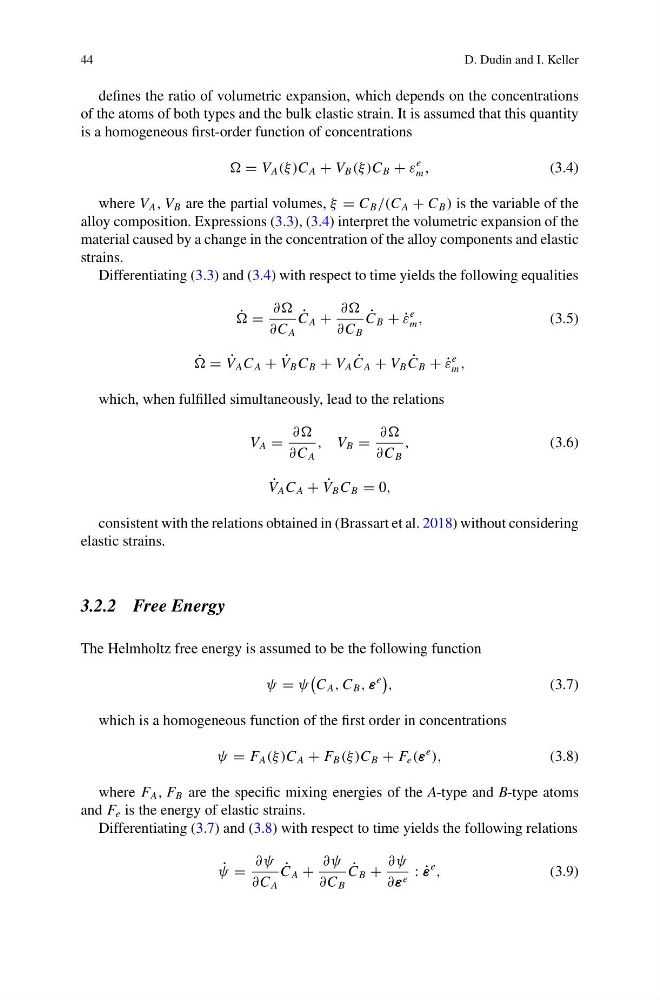
defines the ratio of volumetric expansion, which depends on the concentrations
of the atoms of both types and the bulk elastic strain. It is assumed that this quantity
is a homogeneous first-order function of concentrations
= V A (ξ )C A + V B (ξ )C B + ε
e
m ,
(3.4)
where V A , V B are the partial volumes, ξ = C B /(C A + C B ) is the variable of the
alloy composition. Expressions (3.3), (3.4) interpret the volumetric expansion of the
material caused by a change in the concentration of the alloy components and elastic
strains.
Differentiating (3.3) and (3.4) with respect to time yields the following equalities
˙
=
∂∂
∂C A
˙
C A +
∂∂
∂C B
˙
C B + ˙
ε
e
m ,
(3.5)
˙
= ˙
V A C A + ˙
V B C B + V A ˙
C A + V B ˙
C B + ˙
ε
e
m ,
which, when fulfilled simultaneously, lead to the relations
V A =
∂∂
∂C A
, V B =
∂∂
∂C B
,
(3.6)
˙
V A C A + ˙
V B C B = 0,
consistent with the relations obtained in (Brassart et al. 2018) without considering
elastic strains.
3.2.2 Free Energy
The Helmholtz free energy is assumed to be the following function
ψ = ψ
C A , C B , ε
e
,
(3.7)
which is a homogeneous function of the first order in concentrations
ψ = F A (ξ )C A + F B (ξ )C B + F e (ε
e
),
(3.8)
where F A , F B are the specific mixing energies of the A-type and B-type atoms
and F e is the energy of elastic strains.
Differentiating (3.7) and (3.8) with respect to time yields the following relations
˙
ψ =
∂ψ
∂C A
˙
C A +
∂ψ
∂C B
˙
C B +
∂ψ
∂ε e : ˙
ε
e
,
(3.9)
D. Dudin and I. Keller
defines the ratio of volumetric expansion, which depends on the concentrations
of the atoms of both types and the bulk elastic strain. It is assumed that this quantity
is a homogeneous first-order function of concentrations
= V A (ξ )C A + V B (ξ )C B + ε
e
m ,
(3.4)
where V A , V B are the partial volumes, ξ = C B /(C A + C B ) is the variable of the
alloy composition. Expressions (3.3), (3.4) interpret the volumetric expansion of the
material caused by a change in the concentration of the alloy components and elastic
strains.
Differentiating (3.3) and (3.4) with respect to time yields the following equalities
˙
=
∂∂
∂C A
˙
C A +
∂∂
∂C B
˙
C B + ˙
ε
e
m ,
(3.5)
˙
= ˙
V A C A + ˙
V B C B + V A ˙
C A + V B ˙
C B + ˙
ε
e
m ,
which, when fulfilled simultaneously, lead to the relations
V A =
∂∂
∂C A
, V B =
∂∂
∂C B
,
(3.6)
˙
V A C A + ˙
V B C B = 0,
consistent with the relations obtained in (Brassart et al. 2018) without considering
elastic strains.
3.2.2 Free Energy
The Helmholtz free energy is assumed to be the following function
ψ = ψ
C A , C B , ε
e
,
(3.7)
which is a homogeneous function of the first order in concentrations
ψ = F A (ξ )C A + F B (ξ )C B + F e (ε
e
),
(3.8)
where F A , F B are the specific mixing energies of the A-type and B-type atoms
and F e is the energy of elastic strains.
Differentiating (3.7) and (3.8) with respect to time yields the following relations
˙
ψ =
∂ψ
∂C A
˙
C A +
∂ψ
∂C B
˙
C B +
∂ψ
∂ε e : ˙
ε
e
,
(3.9)