

3 On the Spectrum of Relaxation Times in Coupled Diffusion …
43
the perturbations and their wavelength in a closed form and investigate in great depth
the relaxation mechanisms in the asymtotic cases. The method is equally applicable
for both the linear and nonlinear models allowing linearization in the vicinity of a
homogeneous stationary solution.
The focus of this study is the phenomenological model, proposed by Brassart
et al (2018), describing the interdiffusion of the components of a binary metal alloy
accompanied by the bulk and shear viscous flows, supplemented in this study by
the bulk and shear elastic strains. Here, consideration is given to a geometrically
and physically linear version of the formulation, which is justified by the purpose of
the successive studies into relaxation of small perturbations of a uniform stationary
state with zero stresses. The subject of research is the qualitative effects, which
introduced by elastic stresses into the system of coupled processes of interdiffusion
and viscous flow. The processes are considered isothermal and occur in the absence
of bulk sources of the component substance and the kinetic moment.
3.2 The Brassart’s Model Supplemented with Elastic
Strains
Consider a binary metal alloy characterized by concentrations C A , C B of the atoms
of type A and B per a unit volume of the material in the reference frame.
3.2.1 Deformation and Volumetric Expansion
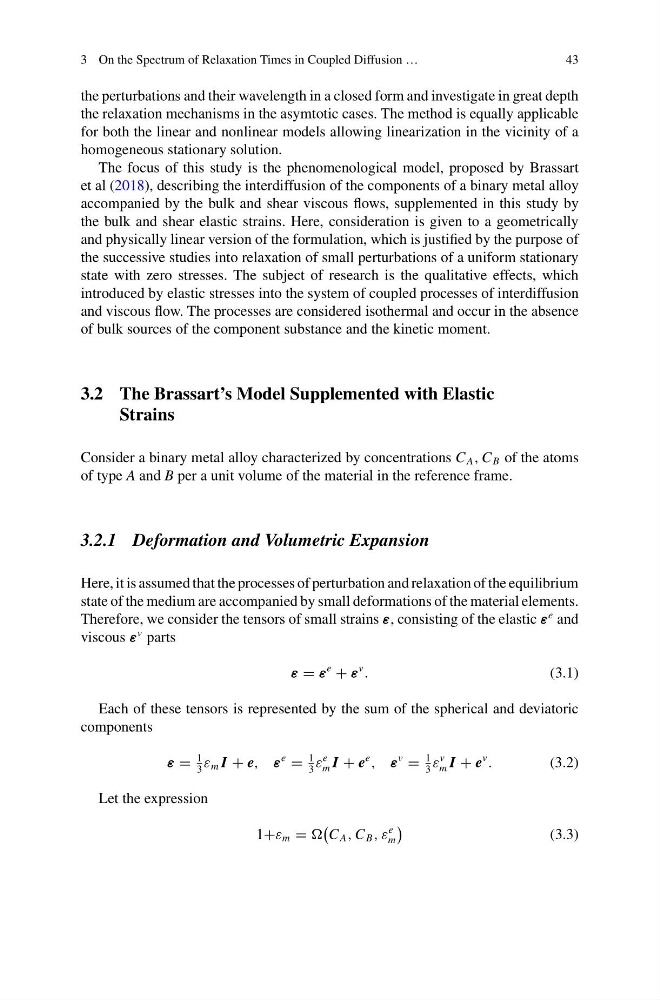
Here, it is assumed that the processes of perturbation and relaxation of the equilibrium
state of the medium are accompanied by small deformations of the material elements.
Therefore, we consider the tensors of small strains ε, consisting of the elastic ε
e and
viscous ε
v parts
ε = ε
e
+ ε
v
.
(3.1)
Each of these tensors is represented by the sum of the spherical and deviatoric
components
ε =
1
3
ε m I + e, ε
e
=
1
3
ε
e
m I + e
e
, ε
v
=
1
3
ε
v
m I + e
v
.
(3.2)
Let the expression
1+ε m =
C A , C B , ε
e
m
(3.3)
43
the perturbations and their wavelength in a closed form and investigate in great depth
the relaxation mechanisms in the asymtotic cases. The method is equally applicable
for both the linear and nonlinear models allowing linearization in the vicinity of a
homogeneous stationary solution.
The focus of this study is the phenomenological model, proposed by Brassart
et al (2018), describing the interdiffusion of the components of a binary metal alloy
accompanied by the bulk and shear viscous flows, supplemented in this study by
the bulk and shear elastic strains. Here, consideration is given to a geometrically
and physically linear version of the formulation, which is justified by the purpose of
the successive studies into relaxation of small perturbations of a uniform stationary
state with zero stresses. The subject of research is the qualitative effects, which
introduced by elastic stresses into the system of coupled processes of interdiffusion
and viscous flow. The processes are considered isothermal and occur in the absence
of bulk sources of the component substance and the kinetic moment.
3.2 The Brassart’s Model Supplemented with Elastic
Strains
Consider a binary metal alloy characterized by concentrations C A , C B of the atoms
of type A and B per a unit volume of the material in the reference frame.
3.2.1 Deformation and Volumetric Expansion
Here, it is assumed that the processes of perturbation and relaxation of the equilibrium
state of the medium are accompanied by small deformations of the material elements.
Therefore, we consider the tensors of small strains ε, consisting of the elastic ε
e and
viscous ε
v parts
ε = ε
e
+ ε
v
.
(3.1)
Each of these tensors is represented by the sum of the spherical and deviatoric
components
ε =
1
3
ε m I + e, ε
e
=
1
3
ε
e
m I + e
e
, ε
v
=
1
3
ε
v
m I + e
v
.
(3.2)
Let the expression
1+ε m =
C A , C B , ε
e
m
(3.3)