

3 On the Spectrum of Relaxation Times in Coupled Diffusion …
45
˙
ψ = ˙
F A C A + ˙
F B C B + F A ˙
C A + F B ˙
C B +
∂ F e
∂ε e : ˙
ε
e
,
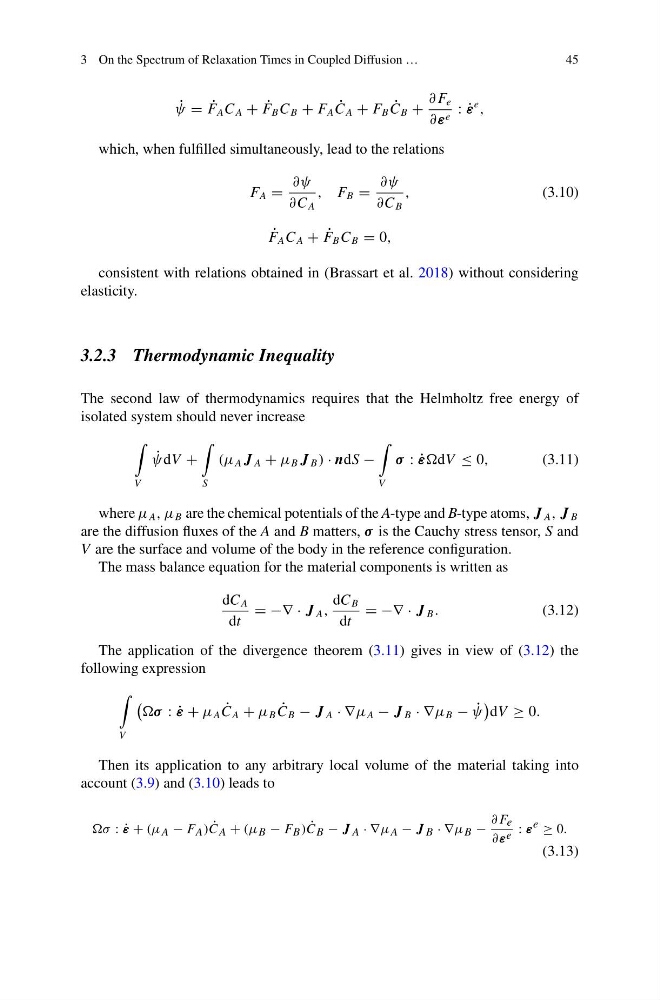
which, when fulfilled simultaneously, lead to the relations
F A =
∂ψ
∂C A
, F B =
∂ψ
∂C B
,
(3.10)
˙
F A C A + ˙
F B C B = 0,
consistent with relations obtained in (Brassart et al. 2018) without considering
elasticity.
3.2.3 Thermodynamic Inequality
The second law of thermodynamics requires that the Helmholtz free energy of
isolated system should never increase
V
˙
ψdV +
S
(μ A J A + μ B J B ) · ndS −
V
σ : ˙
εdV ≤ 0,
(3.11)
where μ A , μ B are the chemical potentials of the A-type and B-type atoms, J A , J B
are the diffusion fluxes of the A and B matters, σ is the Cauchy stress tensor, S and
V are the surface and volume of the body in the reference configuration.
The mass balance equation for the material components is written as
dC A
dt
= −∇ · J A ,
dC B
dt
= −∇ · J B .
(3.12)
The application of the divergence theorem (3.11) gives in view of (3.12) the
following expression
V
σ : ˙
ε + μ A ˙
C A + μ B ˙
C B − J A · ∇μ A − J B · ∇μ B − ˙
ψ
dV ≥ 0.
Then its application to any arbitrary local volume of the material taking into
account (3.9) and (3.10) leads to
σ : ˙
ε + (μ A − F A ) ˙
C A + (μ B − F B ) ˙
C B − J A · ∇μ A − J B · ∇μ B −
∂ F e
∂ε e : ε e ≥ 0.
(3.13)
45
˙
ψ = ˙
F A C A + ˙
F B C B + F A ˙
C A + F B ˙
C B +
∂ F e
∂ε e : ˙
ε
e
,
which, when fulfilled simultaneously, lead to the relations
F A =
∂ψ
∂C A
, F B =
∂ψ
∂C B
,
(3.10)
˙
F A C A + ˙
F B C B = 0,
consistent with relations obtained in (Brassart et al. 2018) without considering
elasticity.
3.2.3 Thermodynamic Inequality
The second law of thermodynamics requires that the Helmholtz free energy of
isolated system should never increase
V
˙
ψdV +
S
(μ A J A + μ B J B ) · ndS −
V
σ : ˙
εdV ≤ 0,
(3.11)
where μ A , μ B are the chemical potentials of the A-type and B-type atoms, J A , J B
are the diffusion fluxes of the A and B matters, σ is the Cauchy stress tensor, S and
V are the surface and volume of the body in the reference configuration.
The mass balance equation for the material components is written as
dC A
dt
= −∇ · J A ,
dC B
dt
= −∇ · J B .
(3.12)
The application of the divergence theorem (3.11) gives in view of (3.12) the
following expression
V
σ : ˙
ε + μ A ˙
C A + μ B ˙
C B − J A · ∇μ A − J B · ∇μ B − ˙
ψ
dV ≥ 0.
Then its application to any arbitrary local volume of the material taking into
account (3.9) and (3.10) leads to
σ : ˙
ε + (μ A − F A ) ˙
C A + (μ B − F B ) ˙
C B − J A · ∇μ A − J B · ∇μ B −
∂ F e
∂ε e : ε e ≥ 0.
(3.13)