

36
A. M. Antonov et al.
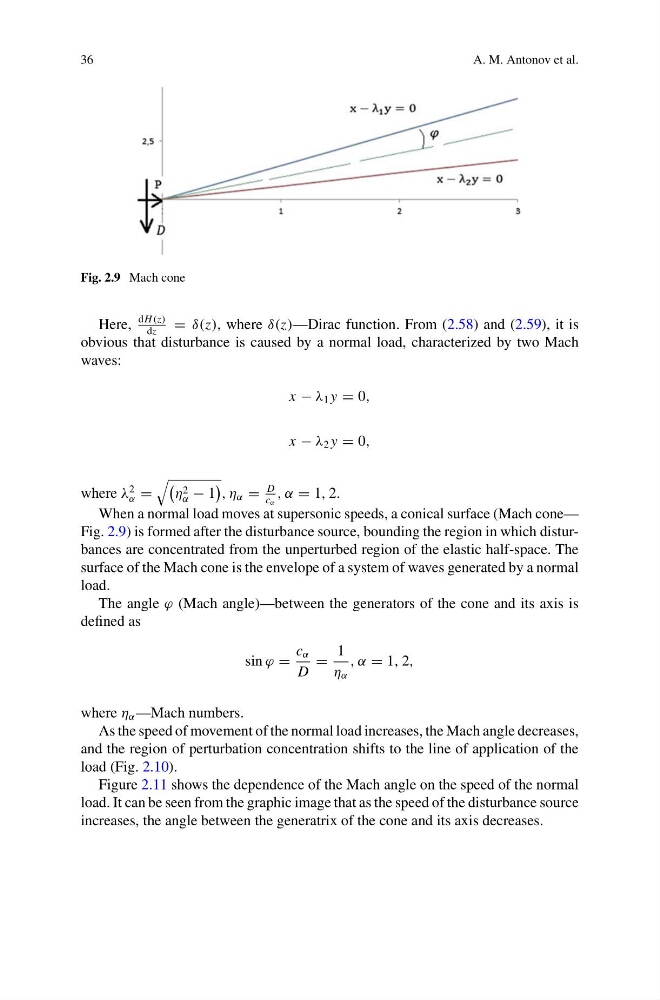
Fig. 2.9 Mach cone
Here,
dH (z)
dz
= δ(z), where δ(z)—Dirac function. From (2.58) and (2.59), it is
obvious that disturbance is caused by a normal load, characterized by two Mach
waves:
x − λ 1 y = 0,
x − λ 2 y = 0,
where λ
2
α =
η 2
α − 1
, η α =
D
c α
, α = 1, 2.
When a normal load moves at supersonic speeds, a conical surface (Mach cone—
Fig. 2.9) is formed after the disturbance source, bounding the region in which disturbances are concentrated from the unperturbed region of the elastic half-space. The
surface of the Mach cone is the envelope of a system of waves generated by a normal
load.
The angle ϕ (Mach angle)—between the generators of the cone and its axis is
defined as
sin ϕ =
c α
D
=
1
η α
, α = 1, 2,
where η α —Mach numbers.
As the speed of movement of the normal load increases, the Mach angle decreases,
and the region of perturbation concentration shifts to the line of application of the
load (Fig. 2.10).
Figure 2.11 shows the dependence of the Mach angle on the speed of the normal
load. It can be seen from the graphic image that as the speed of the disturbance source
increases, the angle between the generatrix of the cone and its axis decreases.
A. M. Antonov et al.
Fig. 2.9 Mach cone
Here,
dH (z)
dz
= δ(z), where δ(z)—Dirac function. From (2.58) and (2.59), it is
obvious that disturbance is caused by a normal load, characterized by two Mach
waves:
x − λ 1 y = 0,
x − λ 2 y = 0,
where λ
2
α =
η 2
α − 1
, η α =
D
c α
, α = 1, 2.
When a normal load moves at supersonic speeds, a conical surface (Mach cone—
Fig. 2.9) is formed after the disturbance source, bounding the region in which disturbances are concentrated from the unperturbed region of the elastic half-space. The
surface of the Mach cone is the envelope of a system of waves generated by a normal
load.
The angle ϕ (Mach angle)—between the generators of the cone and its axis is
defined as
sin ϕ =
c α
D
=
1
η α
, α = 1, 2,
where η α —Mach numbers.
As the speed of movement of the normal load increases, the Mach angle decreases,
and the region of perturbation concentration shifts to the line of application of the
load (Fig. 2.10).
Figure 2.11 shows the dependence of the Mach angle on the speed of the normal
load. It can be seen from the graphic image that as the speed of the disturbance source
increases, the angle between the generatrix of the cone and its axis decreases.