

2 Excitation of the Waves with a Focused Source …
35
v = −
P
μμ
γ λ 1 H (x − λ 1 y) + 2λ 1 H (x − λ 2 y)
+ const
.
(2.58)
Here const—constant value which does not affect stresses distribution.
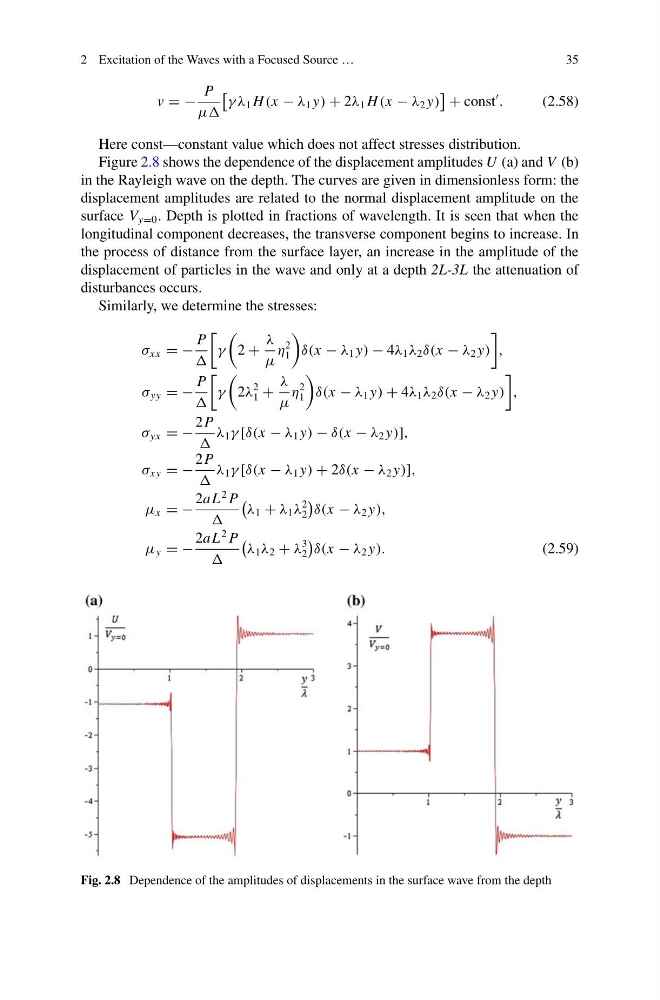
Figure 2.8 shows the dependence of the displacement amplitudes U (a) and V (b)
in the Rayleigh wave on the depth. The curves are given in dimensionless form: the
displacement amplitudes are related to the normal displacement amplitude on the
surface V y=0 . Depth is plotted in fractions of wavelength. It is seen that when the
longitudinal component decreases, the transverse component begins to increase. In
the process of distance from the surface layer, an increase in the amplitude of the
displacement of particles in the wave and only at a depth 2L-3L the attenuation of
disturbances occurs.
Similarly, we determine the stresses:
σ xx = −
P
γ
2 +
λ
μ
η
2
1
δ(x − λ 1 y) − 4λ 1 λ 2 δ(x − λ 2 y)
,
σ yy = −
P
γ
2λ
2
1 +
λ
μ
η
2
1
δ(x − λ 1 y) + 4λ 1 λ 2 δ(x − λ 2 y)
,
σ yx = −
2P
λ 1 γ [δ(x − λ 1 y) − δ(x − λ 2 y)],
σ xy = −
2P
λ 1 γ [δ(x − λ 1 y) + 2δ(x − λ 2 y)],
μ x = −
2aL
2 P
λ 1 + λ 1 λ
2
2
δ(x − λ 2 y),
μ y = −
2aL
2 P
λ 1 λ 2 + λ
3
2
δ(x − λ 2 y).
(2.59)
Fig. 2.8 Dependence of the amplitudes of displacements in the surface wave from the depth
35
v = −
P
μμ
γ λ 1 H (x − λ 1 y) + 2λ 1 H (x − λ 2 y)
+ const
.
(2.58)
Here const—constant value which does not affect stresses distribution.
Figure 2.8 shows the dependence of the displacement amplitudes U (a) and V (b)
in the Rayleigh wave on the depth. The curves are given in dimensionless form: the
displacement amplitudes are related to the normal displacement amplitude on the
surface V y=0 . Depth is plotted in fractions of wavelength. It is seen that when the
longitudinal component decreases, the transverse component begins to increase. In
the process of distance from the surface layer, an increase in the amplitude of the
displacement of particles in the wave and only at a depth 2L-3L the attenuation of
disturbances occurs.
Similarly, we determine the stresses:
σ xx = −
P
γ
2 +
λ
μ
η
2
1
δ(x − λ 1 y) − 4λ 1 λ 2 δ(x − λ 2 y)
,
σ yy = −
P
γ
2λ
2
1 +
λ
μ
η
2
1
δ(x − λ 1 y) + 4λ 1 λ 2 δ(x − λ 2 y)
,
σ yx = −
2P
λ 1 γ [δ(x − λ 1 y) − δ(x − λ 2 y)],
σ xy = −
2P
λ 1 γ [δ(x − λ 1 y) + 2δ(x − λ 2 y)],
μ x = −
2aL
2 P
λ 1 + λ 1 λ
2
2
δ(x − λ 2 y),
μ y = −
2aL
2 P
λ 1 λ 2 + λ
3
2
δ(x − λ 2 y).
(2.59)
Fig. 2.8 Dependence of the amplitudes of displacements in the surface wave from the depth