

34
A. M. Antonov et al.
A =
η
2
2 − 2
P
μa 2
√
2π
η
2
2 + 2
η
2
2 − 2
+ 4λ 1 λ 2
,
B =
2λ 1 P
μa 2
√
2π
η
2
2 + 2
η
2
2 − 2
+ 4λ 1 λ 2
.
(2.53)
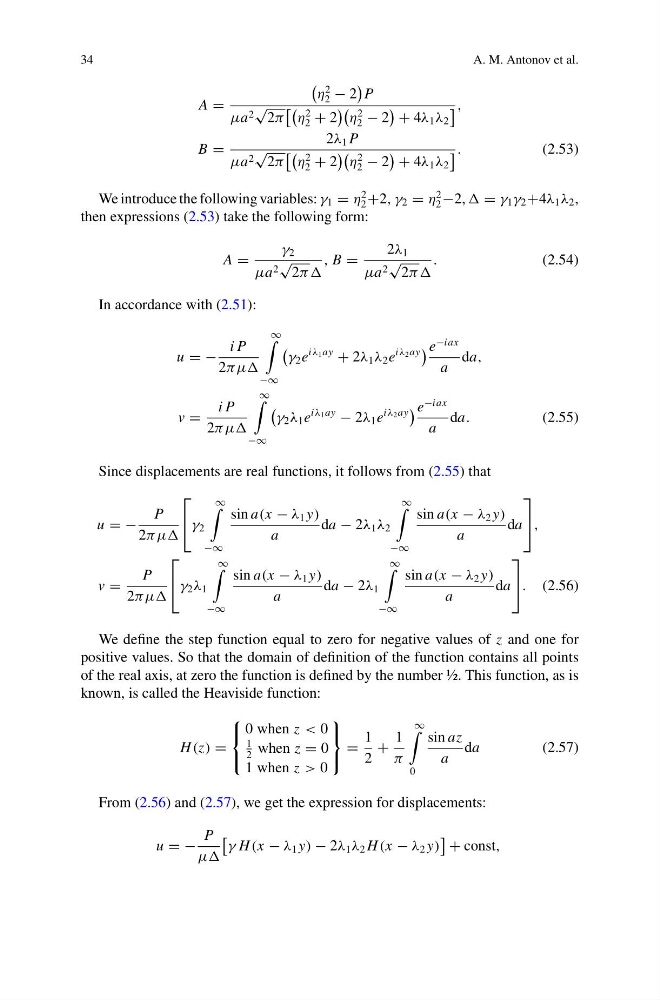
We introduce the following variables: γ 1 = η
2
2 +2, γ 2 = η
2
2 −2, = γ 1 γ 2 +4λ 1 λ 2 ,
then expressions (2.53) take the following form:
A =
γ 2
μa 2
√
2ππ
, B =
2λ 1
μa 2
√
2ππ
.
(2.54)
In accordance with (2.51):
u = −
i P
2πμμ
∞
−∞
γ 2 e
iλ 1 ay
+ 2λ 1 λ 2 e
iλ 2 ay
e
−iax
a
da,
v =
i P
2πμμ
∞
−∞
γ 2 λ 1 e
iλ 1 ay
− 2λ 1 e
iλ 2 ay
e
−iax
a
da.
(2.55)
Since displacements are real functions, it follows from (2.55) that
u = −
P
2πμμ
⎡
⎣ γ 2
∞
−∞
sin a(x − λ 1 y)
a
da − 2λ 1 λ 2
∞
−∞
sin a(x − λ 2 y)
a
da
⎤
⎦ ,
v =
P
2πμμ
⎡
⎣ γ 2 λ 1
∞
−∞
sin a(x − λ 1 y)
a
da − 2λ 1
∞
−∞
sin a(x − λ 2 y)
a
da
⎤
⎦ . (2.56)
We define the step function equal to zero for negative values of z and one for
positive values. So that the domain of definition of the function contains all points
of the real axis, at zero the function is defined by the number ½. This function, as is
known, is called the Heaviside function:
H (z) =
⎧
⎨
⎩
0 when z < 0
1
2
when z = 0
1 when z > 0
⎫
⎬
⎭
=
1
2
+
1
π
∞
0
sin az
a
da
(2.57)
From (2.56) and (2.57), we get the expression for displacements:
u = −
P
μμ
γ H (x − λ 1 y) − 2λ 1 λ 2 H (x − λ 2 y)
+ const,
A. M. Antonov et al.
A =
η
2
2 − 2
P
μa 2
√
2π
η
2
2 + 2
η
2
2 − 2
+ 4λ 1 λ 2
,
B =
2λ 1 P
μa 2
√
2π
η
2
2 + 2
η
2
2 − 2
+ 4λ 1 λ 2
.
(2.53)
We introduce the following variables: γ 1 = η
2
2 +2, γ 2 = η
2
2 −2, = γ 1 γ 2 +4λ 1 λ 2 ,
then expressions (2.53) take the following form:
A =
γ 2
μa 2
√
2ππ
, B =
2λ 1
μa 2
√
2ππ
.
(2.54)
In accordance with (2.51):
u = −
i P
2πμμ
∞
−∞
γ 2 e
iλ 1 ay
+ 2λ 1 λ 2 e
iλ 2 ay
e
−iax
a
da,
v =
i P
2πμμ
∞
−∞
γ 2 λ 1 e
iλ 1 ay
− 2λ 1 e
iλ 2 ay
e
−iax
a
da.
(2.55)
Since displacements are real functions, it follows from (2.55) that
u = −
P
2πμμ
⎡
⎣ γ 2
∞
−∞
sin a(x − λ 1 y)
a
da − 2λ 1 λ 2
∞
−∞
sin a(x − λ 2 y)
a
da
⎤
⎦ ,
v =
P
2πμμ
⎡
⎣ γ 2 λ 1
∞
−∞
sin a(x − λ 1 y)
a
da − 2λ 1
∞
−∞
sin a(x − λ 2 y)
a
da
⎤
⎦ . (2.56)
We define the step function equal to zero for negative values of z and one for
positive values. So that the domain of definition of the function contains all points
of the real axis, at zero the function is defined by the number ½. This function, as is
known, is called the Heaviside function:
H (z) =
⎧
⎨
⎩
0 when z < 0
1
2
when z = 0
1 when z > 0
⎫
⎬
⎭
=
1
2
+
1
π
∞
0
sin az
a
da
(2.57)
From (2.56) and (2.57), we get the expression for displacements:
u = −
P
μμ
γ H (x − λ 1 y) − 2λ 1 λ 2 H (x − λ 2 y)
+ const,