

2 Excitation of the Waves with a Focused Source …
37
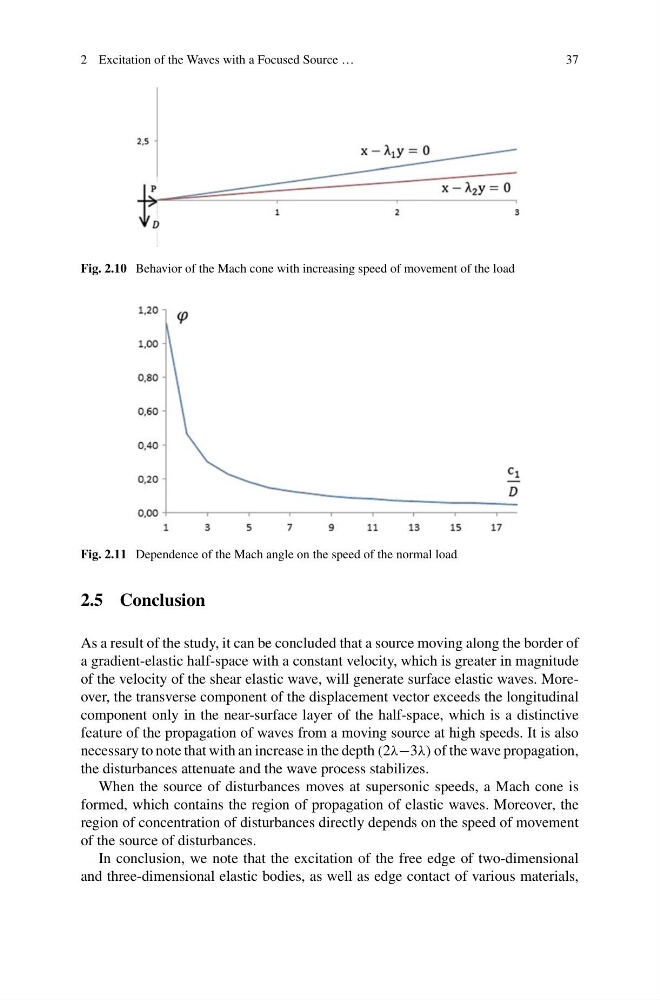
Fig. 2.10 Behavior of the Mach cone with increasing speed of movement of the load
Fig. 2.11 Dependence of the Mach angle on the speed of the normal load
2.5 Conclusion
As a result of the study, it can be concluded that a source moving along the border of
a gradient-elastic half-space with a constant velocity, which is greater in magnitude
of the velocity of the shear elastic wave, will generate surface elastic waves. Moreover, the transverse component of the displacement vector exceeds the longitudinal
component only in the near-surface layer of the half-space, which is a distinctive
feature of the propagation of waves from a moving source at high speeds. It is also
necessary to note that with an increase in the depth (2λ−3λ) of the wave propagation,
the disturbances attenuate and the wave process stabilizes.
When the source of disturbances moves at supersonic speeds, a Mach cone is
formed, which contains the region of propagation of elastic waves. Moreover, the
region of concentration of disturbances directly depends on the speed of movement
of the source of disturbances.
In conclusion, we note that the excitation of the free edge of two-dimensional
and three-dimensional elastic bodies, as well as edge contact of various materials,
37
Fig. 2.10 Behavior of the Mach cone with increasing speed of movement of the load
Fig. 2.11 Dependence of the Mach angle on the speed of the normal load
2.5 Conclusion
As a result of the study, it can be concluded that a source moving along the border of
a gradient-elastic half-space with a constant velocity, which is greater in magnitude
of the velocity of the shear elastic wave, will generate surface elastic waves. Moreover, the transverse component of the displacement vector exceeds the longitudinal
component only in the near-surface layer of the half-space, which is a distinctive
feature of the propagation of waves from a moving source at high speeds. It is also
necessary to note that with an increase in the depth (2λ−3λ) of the wave propagation,
the disturbances attenuate and the wave process stabilizes.
When the source of disturbances moves at supersonic speeds, a Mach cone is
formed, which contains the region of propagation of elastic waves. Moreover, the
region of concentration of disturbances directly depends on the speed of movement
of the source of disturbances.
In conclusion, we note that the excitation of the free edge of two-dimensional
and three-dimensional elastic bodies, as well as edge contact of various materials,