

18 A Plausible Description of Continuum …
335
similar algorithm could adapt to describing PBD problems, because the movement
was quite similar to deformation of a viscoelastic body. Therefore, starting from
the flocking rules governing the behavior of single elements in underwater robotic
swarm to reach an assigned geometric configuration, we have adapted the control
algorithm in PBD problems (dell’Erba 2018a, c). Like the robot swarm behavior
(dell’Erba 2015; Dell’Erba and Moriconi 2014), it does not determine forces and
solve differential equations but use a position-based approach, where the new position
of a particle is determined by its neighbor’s positions and can be easily be used to
describe complex objects.
18.3 The Algorithm
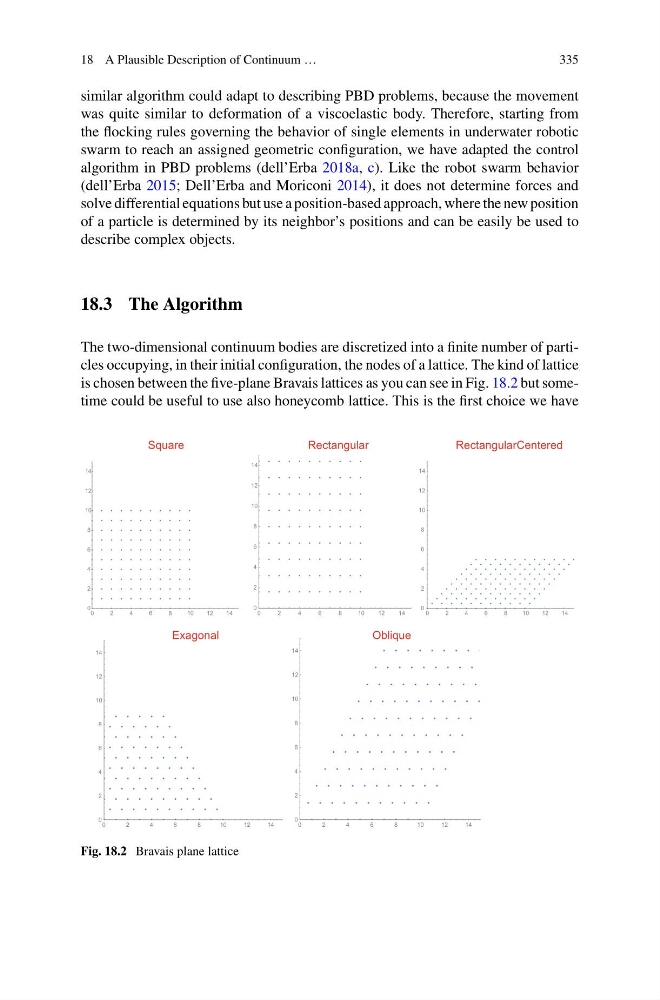
The two-dimensional continuum bodies are discretized into a finite number of particles occupying, in their initial configuration, the nodes of a lattice. The kind of lattice
is chosen between the five-plane Bravais lattices as you can see in Fig. 18.2 but sometime could be useful to use also honeycomb lattice. This is the first choice we have
0
2
4
6
8
10
12
14
0
2
4
6
8
10
12
14
Square
0
2
4
6
8
10
12
14
0
2
4
6
8
10
12
14
Rectangular
0
2
4
6
8
10
12
14
0
2
4
6
8
10
12
14
RectangularCentered
0
2
4
6
8
10
12
14
0
2
4
6
8
10
12
14
Exagonal
0
2
4
6
8
10
12
14
0
2
4
6
8
10
12
14
Oblique
Fig. 18.2 Bravais plane lattice
335
similar algorithm could adapt to describing PBD problems, because the movement
was quite similar to deformation of a viscoelastic body. Therefore, starting from
the flocking rules governing the behavior of single elements in underwater robotic
swarm to reach an assigned geometric configuration, we have adapted the control
algorithm in PBD problems (dell’Erba 2018a, c). Like the robot swarm behavior
(dell’Erba 2015; Dell’Erba and Moriconi 2014), it does not determine forces and
solve differential equations but use a position-based approach, where the new position
of a particle is determined by its neighbor’s positions and can be easily be used to
describe complex objects.
18.3 The Algorithm
The two-dimensional continuum bodies are discretized into a finite number of particles occupying, in their initial configuration, the nodes of a lattice. The kind of lattice
is chosen between the five-plane Bravais lattices as you can see in Fig. 18.2 but sometime could be useful to use also honeycomb lattice. This is the first choice we have
0
2
4
6
8
10
12
14
0
2
4
6
8
10
12
14
Square
0
2
4
6
8
10
12
14
0
2
4
6
8
10
12
14
Rectangular
0
2
4
6
8
10
12
14
0
2
4
6
8
10
12
14
RectangularCentered
0
2
4
6
8
10
12
14
0
2
4
6
8
10
12
14
Exagonal
0
2
4
6
8
10
12
14
0
2
4
6
8
10
12
14
Oblique
Fig. 18.2 Bravais plane lattice