

16 Strain Gradient Models for Growing Solid Bodies
297
˙
ε g =
∂∂(σ, S, R)
∂σ
, ˙
K g =
∂∂(σ, S, R)
∂S
, ˙
γ = −
∂∂(σ, S, R)
∂ R
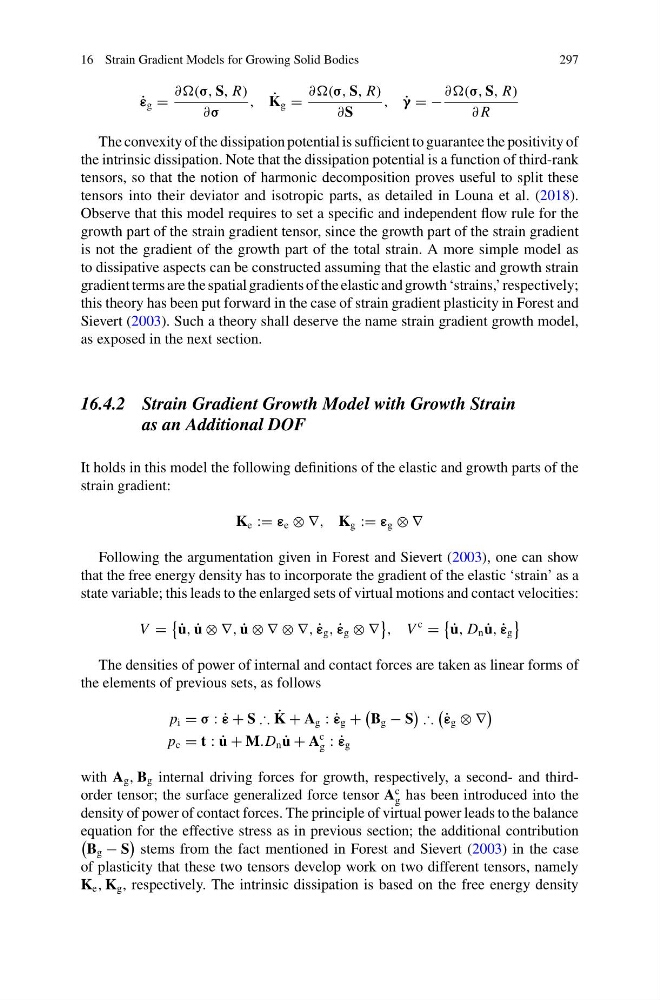
The convexity of the dissipation potential is sufficient to guarantee the positivity of
the intrinsic dissipation. Note that the dissipation potential is a function of third-rank
tensors, so that the notion of harmonic decomposition proves useful to split these
tensors into their deviator and isotropic parts, as detailed in Louna et al. (2018).
Observe that this model requires to set a specific and independent flow rule for the
growth part of the strain gradient tensor, since the growth part of the strain gradient
is not the gradient of the growth part of the total strain. A more simple model as
to dissipative aspects can be constructed assuming that the elastic and growth strain
gradient terms are the spatial gradients of the elastic and growth ‘strains,’ respectively;
this theory has been put forward in the case of strain gradient plasticity in Forest and
Sievert (2003). Such a theory shall deserve the name strain gradient growth model,
as exposed in the next section.
16.4.2 Strain Gradient Growth Model with Growth Strain
as an Additional DOF
It holds in this model the following definitions of the elastic and growth parts of the
strain gradient:
K e := ε e ⊗ ∇, K g := ε g ⊗ ∇
Following the argumentation given in Forest and Sievert (2003), one can show
that the free energy density has to incorporate the gradient of the elastic ‘strain’ as a
state variable; this leads to the enlarged sets of virtual motions and contact velocities:
V =
˙
u, ˙
u ⊗ ∇, ˙
u ⊗ ∇ ⊗ ∇, ˙
ε g , ˙
ε g ⊗ ∇
, V
c
=
˙
u, D n ˙
u, ˙
ε g
The densities of power of internal and contact forces are taken as linear forms of
the elements of previous sets, as follows
p i = σ : ˙
ε + S ∴ ˙
K + A g : ˙
ε g +
B g − S
∴
˙
ε g ⊗ ∇
p c = t : ˙
u + M.D n ˙
u + A
c
g : ˙
ε g
with A g , B g internal driving forces for growth, respectively, a second- and thirdorder tensor; the surface generalized force tensor A
c
g has been introduced into the
density of power of contact forces. The principle of virtual power leads to the balance
equation for the effective stress as in previous section; the additional contribution
B g − S
stems from the fact mentioned in Forest and Sievert (2003) in the case
of plasticity that these two tensors develop work on two different tensors, namely
K e , K g , respectively. The intrinsic dissipation is based on the free energy density
297
˙
ε g =
∂∂(σ, S, R)
∂σ
, ˙
K g =
∂∂(σ, S, R)
∂S
, ˙
γ = −
∂∂(σ, S, R)
∂ R
The convexity of the dissipation potential is sufficient to guarantee the positivity of
the intrinsic dissipation. Note that the dissipation potential is a function of third-rank
tensors, so that the notion of harmonic decomposition proves useful to split these
tensors into their deviator and isotropic parts, as detailed in Louna et al. (2018).
Observe that this model requires to set a specific and independent flow rule for the
growth part of the strain gradient tensor, since the growth part of the strain gradient
is not the gradient of the growth part of the total strain. A more simple model as
to dissipative aspects can be constructed assuming that the elastic and growth strain
gradient terms are the spatial gradients of the elastic and growth ‘strains,’ respectively;
this theory has been put forward in the case of strain gradient plasticity in Forest and
Sievert (2003). Such a theory shall deserve the name strain gradient growth model,
as exposed in the next section.
16.4.2 Strain Gradient Growth Model with Growth Strain
as an Additional DOF
It holds in this model the following definitions of the elastic and growth parts of the
strain gradient:
K e := ε e ⊗ ∇, K g := ε g ⊗ ∇
Following the argumentation given in Forest and Sievert (2003), one can show
that the free energy density has to incorporate the gradient of the elastic ‘strain’ as a
state variable; this leads to the enlarged sets of virtual motions and contact velocities:
V =
˙
u, ˙
u ⊗ ∇, ˙
u ⊗ ∇ ⊗ ∇, ˙
ε g , ˙
ε g ⊗ ∇
, V
c
=
˙
u, D n ˙
u, ˙
ε g
The densities of power of internal and contact forces are taken as linear forms of
the elements of previous sets, as follows
p i = σ : ˙
ε + S ∴ ˙
K + A g : ˙
ε g +
B g − S
∴
˙
ε g ⊗ ∇
p c = t : ˙
u + M.D n ˙
u + A
c
g : ˙
ε g
with A g , B g internal driving forces for growth, respectively, a second- and thirdorder tensor; the surface generalized force tensor A
c
g has been introduced into the
density of power of contact forces. The principle of virtual power leads to the balance
equation for the effective stress as in previous section; the additional contribution
B g − S
stems from the fact mentioned in Forest and Sievert (2003) in the case
of plasticity that these two tensors develop work on two different tensors, namely
K e , K g , respectively. The intrinsic dissipation is based on the free energy density