

296
Z. Louna et al.
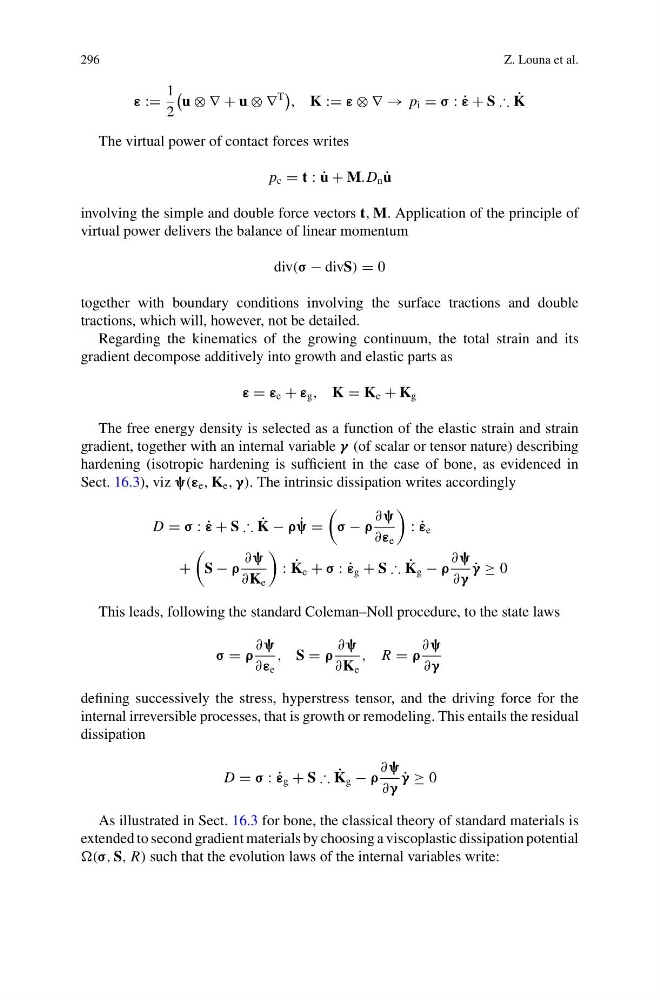
ε :=
1
2
u ⊗ ∇ + u ⊗ ∇
T
, K := ε ⊗ ∇ → p i = σ : ˙
ε + S ∴ ˙
K
The virtual power of contact forces writes
p c = t : ˙
u + M.D n ˙
u
involving the simple and double force vectors t, M. Application of the principle of
virtual power delivers the balance of linear momentum
div(σ − divS) = 0
together with boundary conditions involving the surface tractions and double
tractions, which will, however, not be detailed.
Regarding the kinematics of the growing continuum, the total strain and its
gradient decompose additively into growth and elastic parts as
ε = ε e + ε g , K = K e + K g
The free energy density is selected as a function of the elastic strain and strain
gradient, together with an internal variable γ (of scalar or tensor nature) describing
hardening (isotropic hardening is sufficient in the case of bone, as evidenced in
Sect. 16.3), viz ψ(ε e , K e , γ). The intrinsic dissipation writes accordingly
D = σ : ˙
ε + S ∴ ˙
K − ρ ˙
ψ =
σ − ρ
∂ψ
∂ε e
: ˙
ε e
+
S − ρ
∂ψ
∂K e
: ˙
K e + σ : ˙
ε g + S ∴ ˙
K g − ρ
∂ψ
∂γ
˙
γ ≥ 0
This leads, following the standard Coleman–Noll procedure, to the state laws
σ = ρ
∂ψ
∂ε e
, S = ρ
∂ψ
∂K e
, R = ρ
∂ψ
∂γ
defining successively the stress, hyperstress tensor, and the driving force for the
internal irreversible processes, that is growth or remodeling. This entails the residual
dissipation
D = σ : ˙
ε g + S ∴ ˙
K g − ρ
∂ψ
∂γ
˙
γ ≥ 0
As illustrated in Sect. 16.3 for bone, the classical theory of standard materials is
extended to second gradient materials by choosing a viscoplastic dissipation potential
(σ, S, R) such that the evolution laws of the internal variables write:
Z. Louna et al.
ε :=
1
2
u ⊗ ∇ + u ⊗ ∇
T
, K := ε ⊗ ∇ → p i = σ : ˙
ε + S ∴ ˙
K
The virtual power of contact forces writes
p c = t : ˙
u + M.D n ˙
u
involving the simple and double force vectors t, M. Application of the principle of
virtual power delivers the balance of linear momentum
div(σ − divS) = 0
together with boundary conditions involving the surface tractions and double
tractions, which will, however, not be detailed.
Regarding the kinematics of the growing continuum, the total strain and its
gradient decompose additively into growth and elastic parts as
ε = ε e + ε g , K = K e + K g
The free energy density is selected as a function of the elastic strain and strain
gradient, together with an internal variable γ (of scalar or tensor nature) describing
hardening (isotropic hardening is sufficient in the case of bone, as evidenced in
Sect. 16.3), viz ψ(ε e , K e , γ). The intrinsic dissipation writes accordingly
D = σ : ˙
ε + S ∴ ˙
K − ρ ˙
ψ =
σ − ρ
∂ψ
∂ε e
: ˙
ε e
+
S − ρ
∂ψ
∂K e
: ˙
K e + σ : ˙
ε g + S ∴ ˙
K g − ρ
∂ψ
∂γ
˙
γ ≥ 0
This leads, following the standard Coleman–Noll procedure, to the state laws
σ = ρ
∂ψ
∂ε e
, S = ρ
∂ψ
∂K e
, R = ρ
∂ψ
∂γ
defining successively the stress, hyperstress tensor, and the driving force for the
internal irreversible processes, that is growth or remodeling. This entails the residual
dissipation
D = σ : ˙
ε g + S ∴ ˙
K g − ρ
∂ψ
∂γ
˙
γ ≥ 0
As illustrated in Sect. 16.3 for bone, the classical theory of standard materials is
extended to second gradient materials by choosing a viscoplastic dissipation potential
(σ, S, R) such that the evolution laws of the internal variables write: