

292
Z. Louna et al.
0
1 0
2 0
3 0
4 0
5 0
6 0
0,58
0,59
0,60
0,61
0,62
0,63
0,64
0,65
Remodeling time steps
l
αβ
/L
l 11 /L
l 12 /L
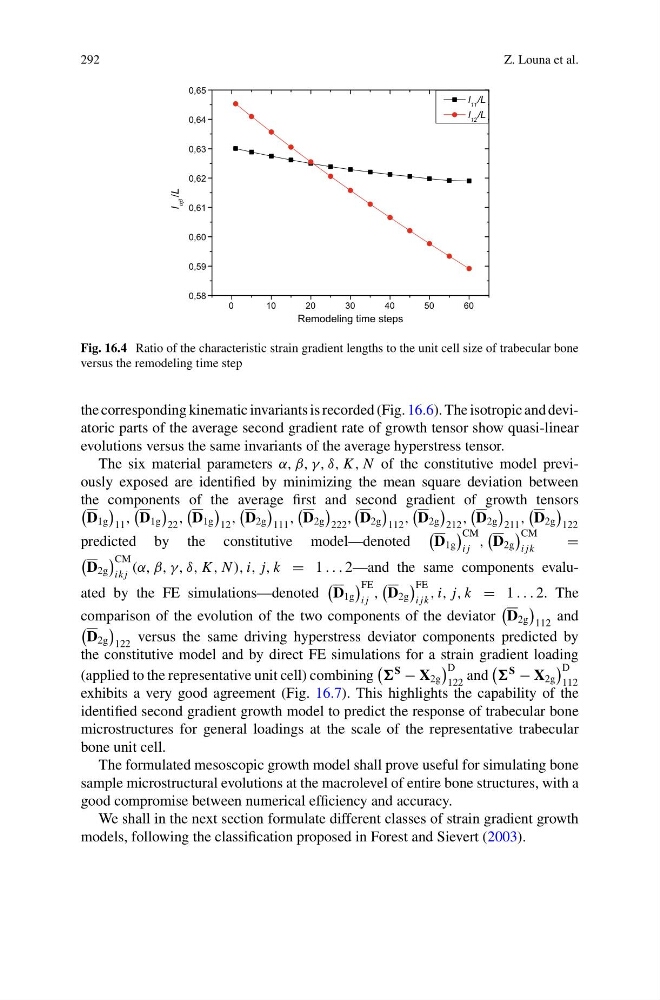
Fig. 16.4 Ratio of the characteristic strain gradient lengths to the unit cell size of trabecular bone
versus the remodeling time step
the corresponding kinematic invariants is recorded (Fig. 16.6). The isotropic and deviatoric parts of the average second gradient rate of growth tensor show quasi-linear
evolutions versus the same invariants of the average hyperstress tensor.
The six material parameters α, β, γ , δ, K , N of the constitutive model previously exposed are identified by minimizing the mean square deviation between
the components of the average first and second gradient of growth tensors
D 1g
11
,
D 1g
22
,
D 1g
12
,
D 2g
111
,
D 2g
222
,
D 2g
112
,
D 2g
212
,
D 2g
211
,
D 2g
122
predicted by the constitutive model—denoted
D 1g
CM
i j
,
D 2g
CM
i jk
=
D 2g
CM
ik j
(α, β, γ , δ, K , N ), i, j, k = 1 . . . 2—and the same components evaluated by the FE simulations—denoted
D 1g
FE
i j
,
D 2g
FE
i jk
, i, j, k = 1 . . . 2. The
comparison of the evolution of the two components of the deviator
D 2g
112
and
D 2g
122
versus the same driving hyperstress deviator components predicted by
the constitutive model and by direct FE simulations for a strain gradient loading
(applied to the representative unit cell) combining
S
− X 2g
D
122
and
S
− X 2g
D
112
exhibits a very good agreement (Fig. 16.7). This highlights the capability of the
identified second gradient growth model to predict the response of trabecular bone
microstructures for general loadings at the scale of the representative trabecular
bone unit cell.
The formulated mesoscopic growth model shall prove useful for simulating bone
sample microstructural evolutions at the macrolevel of entire bone structures, with a
good compromise between numerical efficiency and accuracy.
We shall in the next section formulate different classes of strain gradient growth
models, following the classification proposed in Forest and Sievert (2003).
Z. Louna et al.
0
1 0
2 0
3 0
4 0
5 0
6 0
0,58
0,59
0,60
0,61
0,62
0,63
0,64
0,65
Remodeling time steps
l
αβ
/L
l 11 /L
l 12 /L
Fig. 16.4 Ratio of the characteristic strain gradient lengths to the unit cell size of trabecular bone
versus the remodeling time step
the corresponding kinematic invariants is recorded (Fig. 16.6). The isotropic and deviatoric parts of the average second gradient rate of growth tensor show quasi-linear
evolutions versus the same invariants of the average hyperstress tensor.
The six material parameters α, β, γ , δ, K , N of the constitutive model previously exposed are identified by minimizing the mean square deviation between
the components of the average first and second gradient of growth tensors
D 1g
11
,
D 1g
22
,
D 1g
12
,
D 2g
111
,
D 2g
222
,
D 2g
112
,
D 2g
212
,
D 2g
211
,
D 2g
122
predicted by the constitutive model—denoted
D 1g
CM
i j
,
D 2g
CM
i jk
=
D 2g
CM
ik j
(α, β, γ , δ, K , N ), i, j, k = 1 . . . 2—and the same components evaluated by the FE simulations—denoted
D 1g
FE
i j
,
D 2g
FE
i jk
, i, j, k = 1 . . . 2. The
comparison of the evolution of the two components of the deviator
D 2g
112
and
D 2g
122
versus the same driving hyperstress deviator components predicted by
the constitutive model and by direct FE simulations for a strain gradient loading
(applied to the representative unit cell) combining
S
− X 2g
D
122
and
S
− X 2g
D
112
exhibits a very good agreement (Fig. 16.7). This highlights the capability of the
identified second gradient growth model to predict the response of trabecular bone
microstructures for general loadings at the scale of the representative trabecular
bone unit cell.
The formulated mesoscopic growth model shall prove useful for simulating bone
sample microstructural evolutions at the macrolevel of entire bone structures, with a
good compromise between numerical efficiency and accuracy.
We shall in the next section formulate different classes of strain gradient growth
models, following the classification proposed in Forest and Sievert (2003).