

290
Z. Louna et al.
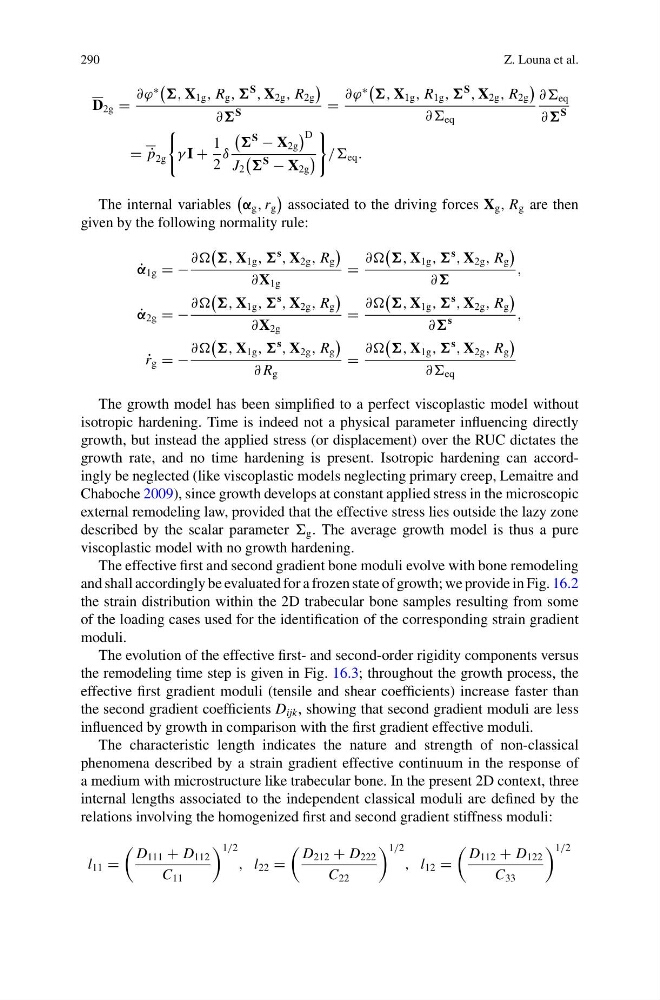
D 2g =
∂ϕ
∗
, X 1g , R g ,
S
, X 2g , R 2g
∂
S
=
∂ϕ
∗
, X 1g , R 1g ,
S
, X 2g , R 2g
∂∂ eq
∂∂ eq
∂
S
= ˙
p 2g
γ I +
1
2
δ
S
− X 2g
D
J 2
S
− X 2g
// eq .
The internal variables
α g , r g
associated to the driving forces X g , R g are then
given by the following normality rule:
˙
α 1g = −
∂∂
, X 1g ,
s
, X 2g , R g
∂X 1g
=
∂∂
, X 1g ,
s
, X 2g , R g
∂
,
˙
α 2g = −
∂∂
, X 1g ,
s
, X 2g , R g
∂X 2g
=
∂∂
, X 1g ,
s
, X 2g , R g
∂
s
,
˙
r g = −
∂∂
, X 1g ,
s
, X 2g , R g
∂ R g
=
∂∂
, X 1g ,
s
, X 2g , R g
∂∂ eq
The growth model has been simplified to a perfect viscoplastic model without
isotropic hardening. Time is indeed not a physical parameter influencing directly
growth, but instead the applied stress (or displacement) over the RUC dictates the
growth rate, and no time hardening is present. Isotropic hardening can accordingly be neglected (like viscoplastic models neglecting primary creep, Lemaitre and
Chaboche 2009), since growth develops at constant applied stress in the microscopic
external remodeling law, provided that the effective stress lies outside the lazy zone
described by the scalar parameter g . The average growth model is thus a pure
viscoplastic model with no growth hardening.
The effective first and second gradient bone moduli evolve with bone remodeling
and shall accordingly be evaluated for a frozen state of growth; we provide in Fig. 16.2
the strain distribution within the 2D trabecular bone samples resulting from some
of the loading cases used for the identification of the corresponding strain gradient
moduli.
The evolution of the effective first- and second-order rigidity components versus
the remodeling time step is given in Fig. 16.3; throughout the growth process, the
effective first gradient moduli (tensile and shear coefficients) increase faster than
the second gradient coefficients D ijk , showing that second gradient moduli are less
influenced by growth in comparison with the first gradient effective moduli.
The characteristic length indicates the nature and strength of non-classical
phenomena described by a strain gradient effective continuum in the response of
a medium with microstructure like trabecular bone. In the present 2D context, three
internal lengths associated to the independent classical moduli are defined by the
relations involving the homogenized first and second gradient stiffness moduli:
l 11 =
D 111 + D 112
C 11
1/2
, l 22 =
D 212 + D 222
C 22
1/2
, l 12 =
D 112 + D 122
C 33
1/2
Z. Louna et al.
D 2g =
∂ϕ
∗
, X 1g , R g ,
S
, X 2g , R 2g
∂
S
=
∂ϕ
∗
, X 1g , R 1g ,
S
, X 2g , R 2g
∂∂ eq
∂∂ eq
∂
S
= ˙
p 2g
γ I +
1
2
δ
S
− X 2g
D
J 2
S
− X 2g
// eq .
The internal variables
α g , r g
associated to the driving forces X g , R g are then
given by the following normality rule:
˙
α 1g = −
∂∂
, X 1g ,
s
, X 2g , R g
∂X 1g
=
∂∂
, X 1g ,
s
, X 2g , R g
∂
,
˙
α 2g = −
∂∂
, X 1g ,
s
, X 2g , R g
∂X 2g
=
∂∂
, X 1g ,
s
, X 2g , R g
∂
s
,
˙
r g = −
∂∂
, X 1g ,
s
, X 2g , R g
∂ R g
=
∂∂
, X 1g ,
s
, X 2g , R g
∂∂ eq
The growth model has been simplified to a perfect viscoplastic model without
isotropic hardening. Time is indeed not a physical parameter influencing directly
growth, but instead the applied stress (or displacement) over the RUC dictates the
growth rate, and no time hardening is present. Isotropic hardening can accordingly be neglected (like viscoplastic models neglecting primary creep, Lemaitre and
Chaboche 2009), since growth develops at constant applied stress in the microscopic
external remodeling law, provided that the effective stress lies outside the lazy zone
described by the scalar parameter g . The average growth model is thus a pure
viscoplastic model with no growth hardening.
The effective first and second gradient bone moduli evolve with bone remodeling
and shall accordingly be evaluated for a frozen state of growth; we provide in Fig. 16.2
the strain distribution within the 2D trabecular bone samples resulting from some
of the loading cases used for the identification of the corresponding strain gradient
moduli.
The evolution of the effective first- and second-order rigidity components versus
the remodeling time step is given in Fig. 16.3; throughout the growth process, the
effective first gradient moduli (tensile and shear coefficients) increase faster than
the second gradient coefficients D ijk , showing that second gradient moduli are less
influenced by growth in comparison with the first gradient effective moduli.
The characteristic length indicates the nature and strength of non-classical
phenomena described by a strain gradient effective continuum in the response of
a medium with microstructure like trabecular bone. In the present 2D context, three
internal lengths associated to the independent classical moduli are defined by the
relations involving the homogenized first and second gradient stiffness moduli:
l 11 =
D 111 + D 112
C 11
1/2
, l 22 =
D 212 + D 222
C 22
1/2
, l 12 =
D 112 + D 122
C 33
1/2