

288
Z. Louna et al.
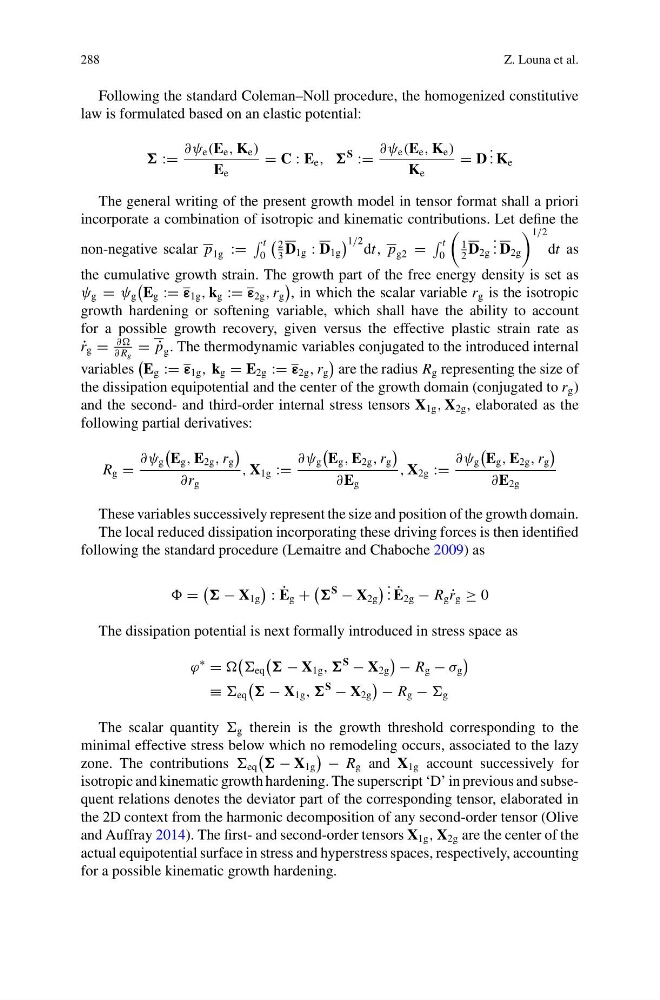
Following the standard Coleman–Noll procedure, the homogenized constitutive
law is formulated based on an elastic potential:
:=
∂ψ e (E e , K e )
E e
= C : E e ,
S
:=
∂ψ e (E e , K e )
K e
= D
. . . K e
The general writing of the present growth model in tensor format shall a priori
incorporate a combination of isotropic and kinematic contributions. Let define the
non-negative scalar p 1g :=
t
0
2
3
D 1g : D 1g
1/2 dt, p g2 =
t
0
1
2
D 2g
. . . D 2g
1/2
dt as
the cumulative growth strain. The growth part of the free energy density is set as
ψ g = ψ g
E g := ε 1g , k g := ε 2g , r g
, in which the scalar variable r g is the isotropic
growth hardening or softening variable, which shall have the ability to account
for a possible growth recovery, given versus the effective plastic strain rate as
˙
r g =
∂∂
∂ R g
= ˙
p g . The thermodynamic variables conjugated to the introduced internal
variables
E g := ε 1g , k g = E 2g := ε 2g , r g
are the radius R g representing the size of
the dissipation equipotential and the center of the growth domain (conjugated to r g )
and the second- and third-order internal stress tensors X 1g , X 2g , elaborated as the
following partial derivatives:
R g =
∂ψ g
E g , E 2g , r g
∂r g
, X 1g :=
∂ψ g
E g , E 2g , r g
∂E g
, X 2g :=
∂ψ g
E g , E 2g , r g
∂E 2g
These variables successively represent the size and position of the growth domain.
The local reduced dissipation incorporating these driving forces is then identified
following the standard procedure (Lemaitre and Chaboche 2009) as
=
− X 1g
: ˙
E g +
S
− X 2g
. . . ˙
E 2g − R g ˙
r g ≥ 0
The dissipation potential is next formally introduced in stress space as
ϕ
∗
=
eq
− X 1g ,
S
− X 2g
− R g − σ g
≡ eq
− X 1g ,
S
− X 2g
− R g − g
The scalar quantity g therein is the growth threshold corresponding to the
minimal effective stress below which no remodeling occurs, associated to the lazy
zone. The contributions eq
− X 1g
− R g and X 1g account successively for
isotropic and kinematic growth hardening. The superscript ‘D’ in previous and subsequent relations denotes the deviator part of the corresponding tensor, elaborated in
the 2D context from the harmonic decomposition of any second-order tensor (Olive
and Auffray 2014). The first- and second-order tensors X 1g , X 2g are the center of the
actual equipotential surface in stress and hyperstress spaces, respectively, accounting
for a possible kinematic growth hardening.
Z. Louna et al.
Following the standard Coleman–Noll procedure, the homogenized constitutive
law is formulated based on an elastic potential:
:=
∂ψ e (E e , K e )
E e
= C : E e ,
S
:=
∂ψ e (E e , K e )
K e
= D
. . . K e
The general writing of the present growth model in tensor format shall a priori
incorporate a combination of isotropic and kinematic contributions. Let define the
non-negative scalar p 1g :=
t
0
2
3
D 1g : D 1g
1/2 dt, p g2 =
t
0
1
2
D 2g
. . . D 2g
1/2
dt as
the cumulative growth strain. The growth part of the free energy density is set as
ψ g = ψ g
E g := ε 1g , k g := ε 2g , r g
, in which the scalar variable r g is the isotropic
growth hardening or softening variable, which shall have the ability to account
for a possible growth recovery, given versus the effective plastic strain rate as
˙
r g =
∂∂
∂ R g
= ˙
p g . The thermodynamic variables conjugated to the introduced internal
variables
E g := ε 1g , k g = E 2g := ε 2g , r g
are the radius R g representing the size of
the dissipation equipotential and the center of the growth domain (conjugated to r g )
and the second- and third-order internal stress tensors X 1g , X 2g , elaborated as the
following partial derivatives:
R g =
∂ψ g
E g , E 2g , r g
∂r g
, X 1g :=
∂ψ g
E g , E 2g , r g
∂E g
, X 2g :=
∂ψ g
E g , E 2g , r g
∂E 2g
These variables successively represent the size and position of the growth domain.
The local reduced dissipation incorporating these driving forces is then identified
following the standard procedure (Lemaitre and Chaboche 2009) as
=
− X 1g
: ˙
E g +
S
− X 2g
. . . ˙
E 2g − R g ˙
r g ≥ 0
The dissipation potential is next formally introduced in stress space as
ϕ
∗
=
eq
− X 1g ,
S
− X 2g
− R g − σ g
≡ eq
− X 1g ,
S
− X 2g
− R g − g
The scalar quantity g therein is the growth threshold corresponding to the
minimal effective stress below which no remodeling occurs, associated to the lazy
zone. The contributions eq
− X 1g
− R g and X 1g account successively for
isotropic and kinematic growth hardening. The superscript ‘D’ in previous and subsequent relations denotes the deviator part of the corresponding tensor, elaborated in
the 2D context from the harmonic decomposition of any second-order tensor (Olive
and Auffray 2014). The first- and second-order tensors X 1g , X 2g are the center of the
actual equipotential surface in stress and hyperstress spaces, respectively, accounting
for a possible kinematic growth hardening.