

16 Strain Gradient Models for Growing Solid Bodies
285
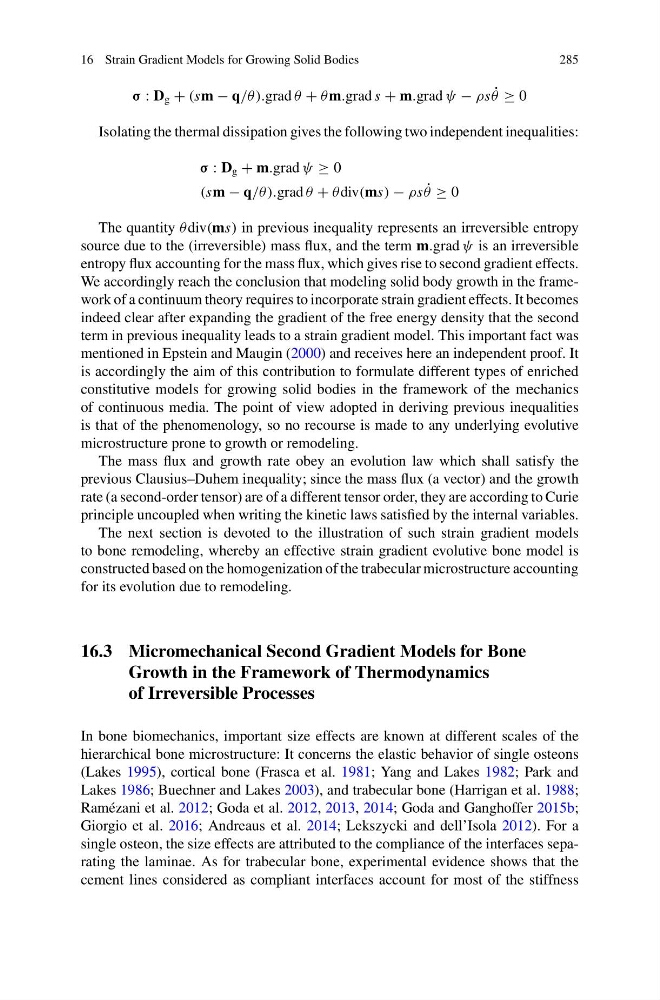
σ : D g + (sm − q/θ ).grad θ + θ m.grad s + m.grad ψ − ρs ˙
θ ≥ 0
Isolating the thermal dissipation gives the following two independent inequalities:
σ : D g + m.grad ψ ≥ 0
(sm − q/θ ).grad θ + θ div(ms) − ρs ˙
θ ≥ 0
The quantity θ div(ms) in previous inequality represents an irreversible entropy
source due to the (irreversible) mass flux, and the term m.grad ψ is an irreversible
entropy flux accounting for the mass flux, which gives rise to second gradient effects.
We accordingly reach the conclusion that modeling solid body growth in the framework of a continuum theory requires to incorporate strain gradient effects. It becomes
indeed clear after expanding the gradient of the free energy density that the second
term in previous inequality leads to a strain gradient model. This important fact was
mentioned in Epstein and Maugin (2000) and receives here an independent proof. It
is accordingly the aim of this contribution to formulate different types of enriched
constitutive models for growing solid bodies in the framework of the mechanics
of continuous media. The point of view adopted in deriving previous inequalities
is that of the phenomenology, so no recourse is made to any underlying evolutive
microstructure prone to growth or remodeling.
The mass flux and growth rate obey an evolution law which shall satisfy the
previous Clausius–Duhem inequality; since the mass flux (a vector) and the growth
rate (a second-order tensor) are of a different tensor order, they are according to Curie
principle uncoupled when writing the kinetic laws satisfied by the internal variables.
The next section is devoted to the illustration of such strain gradient models
to bone remodeling, whereby an effective strain gradient evolutive bone model is
constructed based on the homogenization of the trabecular microstructure accounting
for its evolution due to remodeling.
16.3 Micromechanical Second Gradient Models for Bone
Growth in the Framework of Thermodynamics
of Irreversible Processes
In bone biomechanics, important size effects are known at different scales of the
hierarchical bone microstructure: It concerns the elastic behavior of single osteons
(Lakes 1995), cortical bone (Frasca et al. 1981; Yang and Lakes 1982; Park and
Lakes 1986; Buechner and Lakes 2003), and trabecular bone (Harrigan et al. 1988;
Ramézani et al. 2012; Goda et al. 2012, 2013, 2014; Goda and Ganghoffer 2015b;
Giorgio et al. 2016; Andreaus et al. 2014; Lekszycki and dell’Isola 2012). For a
single osteon, the size effects are attributed to the compliance of the interfaces separating the laminae. As for trabecular bone, experimental evidence shows that the
cement lines considered as compliant interfaces account for most of the stiffness
285
σ : D g + (sm − q/θ ).grad θ + θ m.grad s + m.grad ψ − ρs ˙
θ ≥ 0
Isolating the thermal dissipation gives the following two independent inequalities:
σ : D g + m.grad ψ ≥ 0
(sm − q/θ ).grad θ + θ div(ms) − ρs ˙
θ ≥ 0
The quantity θ div(ms) in previous inequality represents an irreversible entropy
source due to the (irreversible) mass flux, and the term m.grad ψ is an irreversible
entropy flux accounting for the mass flux, which gives rise to second gradient effects.
We accordingly reach the conclusion that modeling solid body growth in the framework of a continuum theory requires to incorporate strain gradient effects. It becomes
indeed clear after expanding the gradient of the free energy density that the second
term in previous inequality leads to a strain gradient model. This important fact was
mentioned in Epstein and Maugin (2000) and receives here an independent proof. It
is accordingly the aim of this contribution to formulate different types of enriched
constitutive models for growing solid bodies in the framework of the mechanics
of continuous media. The point of view adopted in deriving previous inequalities
is that of the phenomenology, so no recourse is made to any underlying evolutive
microstructure prone to growth or remodeling.
The mass flux and growth rate obey an evolution law which shall satisfy the
previous Clausius–Duhem inequality; since the mass flux (a vector) and the growth
rate (a second-order tensor) are of a different tensor order, they are according to Curie
principle uncoupled when writing the kinetic laws satisfied by the internal variables.
The next section is devoted to the illustration of such strain gradient models
to bone remodeling, whereby an effective strain gradient evolutive bone model is
constructed based on the homogenization of the trabecular microstructure accounting
for its evolution due to remodeling.
16.3 Micromechanical Second Gradient Models for Bone
Growth in the Framework of Thermodynamics
of Irreversible Processes
In bone biomechanics, important size effects are known at different scales of the
hierarchical bone microstructure: It concerns the elastic behavior of single osteons
(Lakes 1995), cortical bone (Frasca et al. 1981; Yang and Lakes 1982; Park and
Lakes 1986; Buechner and Lakes 2003), and trabecular bone (Harrigan et al. 1988;
Ramézani et al. 2012; Goda et al. 2012, 2013, 2014; Goda and Ganghoffer 2015b;
Giorgio et al. 2016; Andreaus et al. 2014; Lekszycki and dell’Isola 2012). For a
single osteon, the size effects are attributed to the compliance of the interfaces separating the laminae. As for trabecular bone, experimental evidence shows that the
cement lines considered as compliant interfaces account for most of the stiffness