

284
Z. Louna et al.
ρ
Dv
Dt
= f + divσ + (m.∇)v ≡ p i
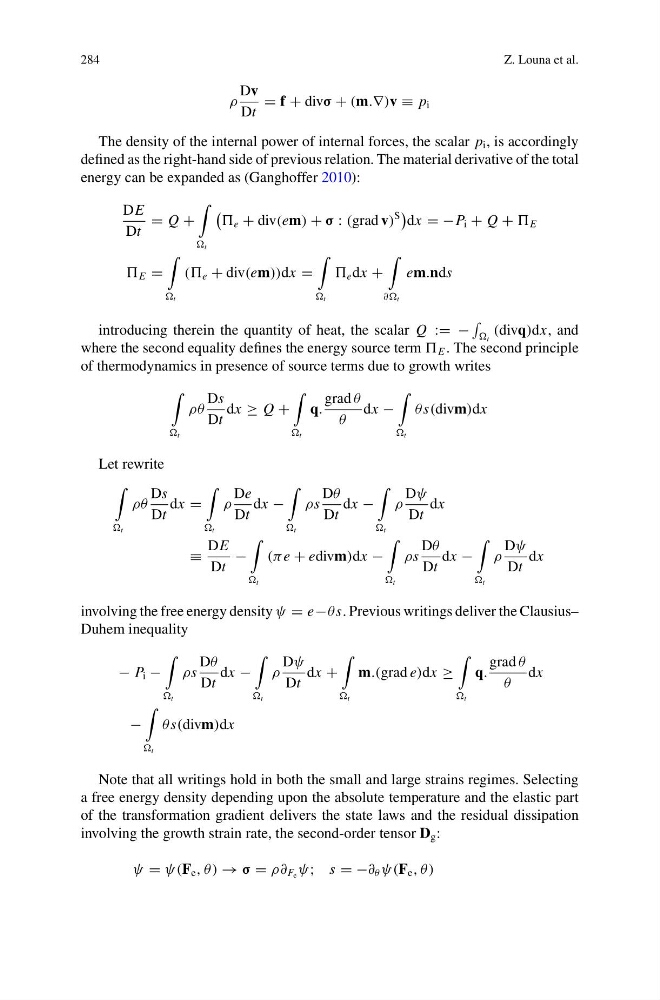
The density of the internal power of internal forces, the scalar p i , is accordingly
defined as the right-hand side of previous relation. The material derivative of the total
energy can be expanded as (Ganghoffer 2010):
DE
Dt
= Q +
t
e + div(em) + σ : (grad v)
S
dx = −P i + Q + E
E =
t
( e + div(em))dx =
t
e dx +
∂∂ t
em.nds
introducing therein the quantity of heat, the scalar Q := −
t
(divq)dx, and
where the second equality defines the energy source term E . The second principle
of thermodynamics in presence of source terms due to growth writes
t
ρθ
Ds
Dt
dx ≥ Q +
t
q.
grad θ
θ
dx −
t
θ s(divm)dx
Let rewrite
t
ρθ
Ds
Dt
dx =
t
ρ
De
Dt
dx −
t
ρs
Dθ
Dt
dx −
t
ρ
Dψ
Dt
dx
≡
DE
Dt
−
t
(π e + edivm)dx −
t
ρs
Dθ
Dt
dx −
t
ρ
Dψ
Dt
dx
involving the free energy density ψ = e−θ s. Previous writings deliver the Clausius–
Duhem inequality
− P i −
t
ρs
Dθ
Dt
dx −
t
ρ
Dψ
Dt
dx +
t
m.(grad e)dx ≥
t
q.
grad θ
θ
dx
−
t
θ s(divm)dx
Note that all writings hold in both the small and large strains regimes. Selecting
a free energy density depending upon the absolute temperature and the elastic part
of the transformation gradient delivers the state laws and the residual dissipation
involving the growth strain rate, the second-order tensor D g :
ψ = ψ(F e , θ) → σ = ρ∂ F e ψ; s = −∂ θ ψ(F e , θ)
Z. Louna et al.
ρ
Dv
Dt
= f + divσ + (m.∇)v ≡ p i
The density of the internal power of internal forces, the scalar p i , is accordingly
defined as the right-hand side of previous relation. The material derivative of the total
energy can be expanded as (Ganghoffer 2010):
DE
Dt
= Q +
t
e + div(em) + σ : (grad v)
S
dx = −P i + Q + E
E =
t
( e + div(em))dx =
t
e dx +
∂∂ t
em.nds
introducing therein the quantity of heat, the scalar Q := −
t
(divq)dx, and
where the second equality defines the energy source term E . The second principle
of thermodynamics in presence of source terms due to growth writes
t
ρθ
Ds
Dt
dx ≥ Q +
t
q.
grad θ
θ
dx −
t
θ s(divm)dx
Let rewrite
t
ρθ
Ds
Dt
dx =
t
ρ
De
Dt
dx −
t
ρs
Dθ
Dt
dx −
t
ρ
Dψ
Dt
dx
≡
DE
Dt
−
t
(π e + edivm)dx −
t
ρs
Dθ
Dt
dx −
t
ρ
Dψ
Dt
dx
involving the free energy density ψ = e−θ s. Previous writings deliver the Clausius–
Duhem inequality
− P i −
t
ρs
Dθ
Dt
dx −
t
ρ
Dψ
Dt
dx +
t
m.(grad e)dx ≥
t
q.
grad θ
θ
dx
−
t
θ s(divm)dx
Note that all writings hold in both the small and large strains regimes. Selecting
a free energy density depending upon the absolute temperature and the elastic part
of the transformation gradient delivers the state laws and the residual dissipation
involving the growth strain rate, the second-order tensor D g :
ψ = ψ(F e , θ) → σ = ρ∂ F e ψ; s = −∂ θ ψ(F e , θ)