

15 Homogenization-Based Mechanical Behavior Modeling of Composites …
263
4,5
6
7,5
9
10,5
12
13,5
15
16,5
18
19,5
21
0,4
0,5
0,6
0,7
0,8
0,9
1
1,1
1,2
1,3
1,4
1,5
f=60%
2C44, 2C66
2C55
Reuss lower bound = 4,86
η
5
10
15
20
25
30
35
0,4
0,5
0,6
0,7
0,8
0,9
1
1,1
1,2
1,3
1,4
f=60%
Y1,Y3
Reuss lower bound = 7,23
η
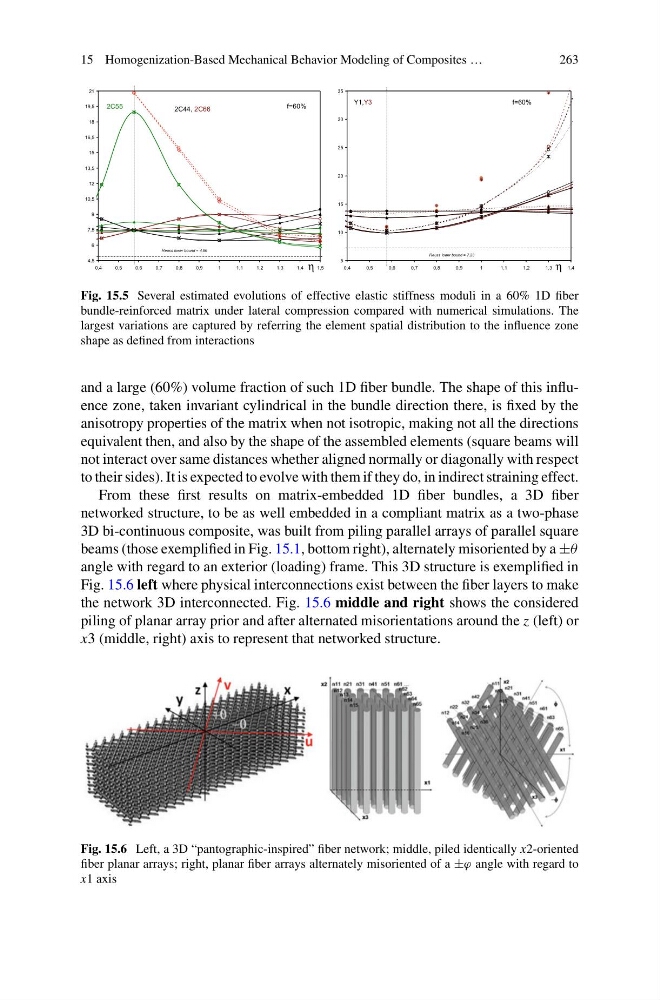
Fig. 15.5 Several estimated evolutions of effective elastic stiffness moduli in a 60% 1D fiber
bundle-reinforced matrix under lateral compression compared with numerical simulations. The
largest variations are captured by referring the element spatial distribution to the influence zone
shape as defined from interactions
and a large (60%) volume fraction of such 1D fiber bundle. The shape of this influence zone, taken invariant cylindrical in the bundle direction there, is fixed by the
anisotropy properties of the matrix when not isotropic, making not all the directions
equivalent then, and also by the shape of the assembled elements (square beams will
not interact over same distances whether aligned normally or diagonally with respect
to their sides). It is expected to evolve with them if they do, in indirect straining effect.
From these first results on matrix-embedded 1D fiber bundles, a 3D fiber
networked structure, to be as well embedded in a compliant matrix as a two-phase
3D bi-continuous composite, was built from piling parallel arrays of parallel square
beams (those exemplified in Fig. 15.1, bottom right), alternately misoriented by a ±θ
angle with regard to an exterior (loading) frame. This 3D structure is exemplified in
Fig. 15.6 left where physical interconnections exist between the fiber layers to make
the network 3D interconnected. Fig. 15.6 middle and right shows the considered
piling of planar array prior and after alternated misorientations around the z (left) or
x3 (middle, right) axis to represent that networked structure.
Fig. 15.6 Left, a 3D “pantographic-inspired” fiber network; middle, piled identically x2-oriented
fiber planar arrays; right, planar fiber arrays alternately misoriented of a ±ϕ angle with regard to
x1 axis
263
4,5
6
7,5
9
10,5
12
13,5
15
16,5
18
19,5
21
0,4
0,5
0,6
0,7
0,8
0,9
1
1,1
1,2
1,3
1,4
1,5
f=60%
2C44, 2C66
2C55
Reuss lower bound = 4,86
η
5
10
15
20
25
30
35
0,4
0,5
0,6
0,7
0,8
0,9
1
1,1
1,2
1,3
1,4
f=60%
Y1,Y3
Reuss lower bound = 7,23
η
Fig. 15.5 Several estimated evolutions of effective elastic stiffness moduli in a 60% 1D fiber
bundle-reinforced matrix under lateral compression compared with numerical simulations. The
largest variations are captured by referring the element spatial distribution to the influence zone
shape as defined from interactions
and a large (60%) volume fraction of such 1D fiber bundle. The shape of this influence zone, taken invariant cylindrical in the bundle direction there, is fixed by the
anisotropy properties of the matrix when not isotropic, making not all the directions
equivalent then, and also by the shape of the assembled elements (square beams will
not interact over same distances whether aligned normally or diagonally with respect
to their sides). It is expected to evolve with them if they do, in indirect straining effect.
From these first results on matrix-embedded 1D fiber bundles, a 3D fiber
networked structure, to be as well embedded in a compliant matrix as a two-phase
3D bi-continuous composite, was built from piling parallel arrays of parallel square
beams (those exemplified in Fig. 15.1, bottom right), alternately misoriented by a ±θ
angle with regard to an exterior (loading) frame. This 3D structure is exemplified in
Fig. 15.6 left where physical interconnections exist between the fiber layers to make
the network 3D interconnected. Fig. 15.6 middle and right shows the considered
piling of planar array prior and after alternated misorientations around the z (left) or
x3 (middle, right) axis to represent that networked structure.
Fig. 15.6 Left, a 3D “pantographic-inspired” fiber network; middle, piled identically x2-oriented
fiber planar arrays; right, planar fiber arrays alternately misoriented of a ±ϕ angle with regard to
x1 axis