

214
A. V. Basalin et al.
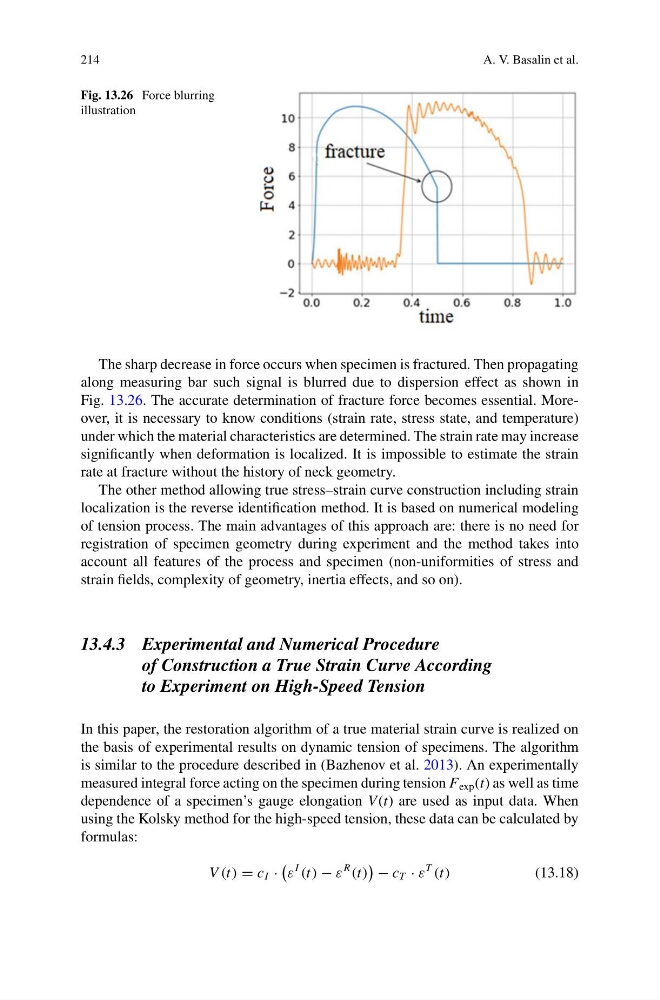
Fig. 13.26 Force blurring
illustration
The sharp decrease in force occurs when specimen is fractured. Then propagating
along measuring bar such signal is blurred due to dispersion effect as shown in
Fig. 13.26. The accurate determination of fracture force becomes essential. Moreover, it is necessary to know conditions (strain rate, stress state, and temperature)
under which the material characteristics are determined. The strain rate may increase
significantly when deformation is localized. It is impossible to estimate the strain
rate at fracture without the history of neck geometry.
The other method allowing true stress–strain curve construction including strain
localization is the reverse identification method. It is based on numerical modeling
of tension process. The main advantages of this approach are: there is no need for
registration of specimen geometry during experiment and the method takes into
account all features of the process and specimen (non-uniformities of stress and
strain fields, complexity of geometry, inertia effects, and so on).
13.4.3 Experimental and Numerical Procedure
of Construction a True Strain Curve According
to Experiment on High-Speed Tension
In this paper, the restoration algorithm of a true material strain curve is realized on
the basis of experimental results on dynamic tension of specimens. The algorithm
is similar to the procedure described in (Bazhenov et al. 2013). An experimentally
measured integral force acting on the specimen during tension F exp (t) as well as time
dependence of a specimen’s gauge elongation V (t) are used as input data. When
using the Kolsky method for the high-speed tension, these data can be calculated by
formulas:
V (t) = c I ·
ε
I
(t) − ε
R
(t)
− c T · ε
T
(t)
(13.18)
A. V. Basalin et al.
Fig. 13.26 Force blurring
illustration
The sharp decrease in force occurs when specimen is fractured. Then propagating
along measuring bar such signal is blurred due to dispersion effect as shown in
Fig. 13.26. The accurate determination of fracture force becomes essential. Moreover, it is necessary to know conditions (strain rate, stress state, and temperature)
under which the material characteristics are determined. The strain rate may increase
significantly when deformation is localized. It is impossible to estimate the strain
rate at fracture without the history of neck geometry.
The other method allowing true stress–strain curve construction including strain
localization is the reverse identification method. It is based on numerical modeling
of tension process. The main advantages of this approach are: there is no need for
registration of specimen geometry during experiment and the method takes into
account all features of the process and specimen (non-uniformities of stress and
strain fields, complexity of geometry, inertia effects, and so on).
13.4.3 Experimental and Numerical Procedure
of Construction a True Strain Curve According
to Experiment on High-Speed Tension
In this paper, the restoration algorithm of a true material strain curve is realized on
the basis of experimental results on dynamic tension of specimens. The algorithm
is similar to the procedure described in (Bazhenov et al. 2013). An experimentally
measured integral force acting on the specimen during tension F exp (t) as well as time
dependence of a specimen’s gauge elongation V (t) are used as input data. When
using the Kolsky method for the high-speed tension, these data can be calculated by
formulas:
V (t) = c I ·
ε
I
(t) − ε
R
(t)
− c T · ε
T
(t)
(13.18)