

194
A. V. Basalin et al.
13.3 High Strain Rate Tension Based on Measuring Bars
Techniques
Classical compressive SHPB method has good theoretical justification and it is fairly
well explored. But some practically important characteristics of materials cannot be
determined from this type of experiment, namely ultimate strength and ultimate
plastic strain. Moreover, deformation diagram may be stress state dependent, that is
the stress–strain curve obtained in tensile experiments may differ from compression
one. Therefore, determination of deformation diagram in tension is an important
independent problem.
Some schemes of high rate tensile testing which use measuring bars technique
can be found in works (Hauser 1966; Eskandari and Nemes 2000; Lindholm and
Yeakley 1968; Nicholas 1981; Caverzan et al. 2012; Jiang and Zhang 2006; Bragov
et al. 2018). The main difference of these schemes is the way they generate tension
pulse.
13.3.1 Schemes for Dynamic Tension Experiments
A number of schemes for dynamic tension experiments are proposed on the basis of
measuring bar technique.
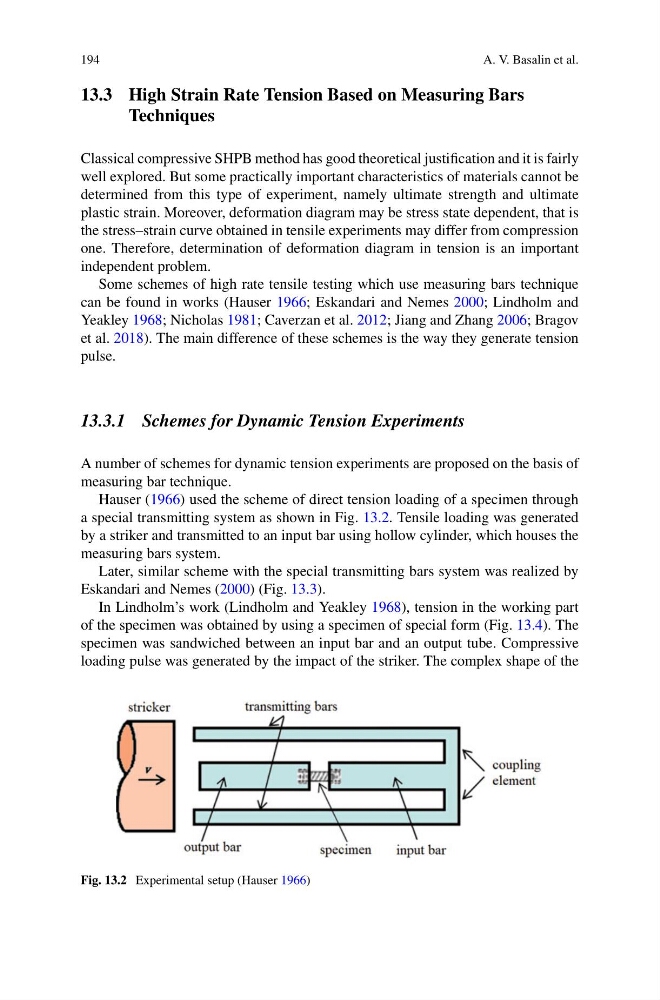
Hauser (1966) used the scheme of direct tension loading of a specimen through
a special transmitting system as shown in Fig. 13.2. Tensile loading was generated
by a striker and transmitted to an input bar using hollow cylinder, which houses the
measuring bars system.
Later, similar scheme with the special transmitting bars system was realized by
Eskandari and Nemes (2000) (Fig. 13.3).
In Lindholm’s work (Lindholm and Yeakley 1968), tension in the working part
of the specimen was obtained by using a specimen of special form (Fig. 13.4). The
specimen was sandwiched between an input bar and an output tube. Compressive
loading pulse was generated by the impact of the striker. The complex shape of the
Fig. 13.2 Experimental setup (Hauser 1966)
A. V. Basalin et al.
13.3 High Strain Rate Tension Based on Measuring Bars
Techniques
Classical compressive SHPB method has good theoretical justification and it is fairly
well explored. But some practically important characteristics of materials cannot be
determined from this type of experiment, namely ultimate strength and ultimate
plastic strain. Moreover, deformation diagram may be stress state dependent, that is
the stress–strain curve obtained in tensile experiments may differ from compression
one. Therefore, determination of deformation diagram in tension is an important
independent problem.
Some schemes of high rate tensile testing which use measuring bars technique
can be found in works (Hauser 1966; Eskandari and Nemes 2000; Lindholm and
Yeakley 1968; Nicholas 1981; Caverzan et al. 2012; Jiang and Zhang 2006; Bragov
et al. 2018). The main difference of these schemes is the way they generate tension
pulse.
13.3.1 Schemes for Dynamic Tension Experiments
A number of schemes for dynamic tension experiments are proposed on the basis of
measuring bar technique.
Hauser (1966) used the scheme of direct tension loading of a specimen through
a special transmitting system as shown in Fig. 13.2. Tensile loading was generated
by a striker and transmitted to an input bar using hollow cylinder, which houses the
measuring bars system.
Later, similar scheme with the special transmitting bars system was realized by
Eskandari and Nemes (2000) (Fig. 13.3).
In Lindholm’s work (Lindholm and Yeakley 1968), tension in the working part
of the specimen was obtained by using a specimen of special form (Fig. 13.4). The
specimen was sandwiched between an input bar and an output tube. Compressive
loading pulse was generated by the impact of the striker. The complex shape of the
Fig. 13.2 Experimental setup (Hauser 1966)