

13 High Strain Rate Tension Experiments Features …
193
pulses is determined by material properties of a specimen. The specimen exhibits
elastic–plastic deformation while the measuring bars elastic one. The data from the
strain gauges 3 and 4 allows us to calculate time histories of strain rate, strain, and
stress in the specimen by using the formulas proposed by Kolsky.
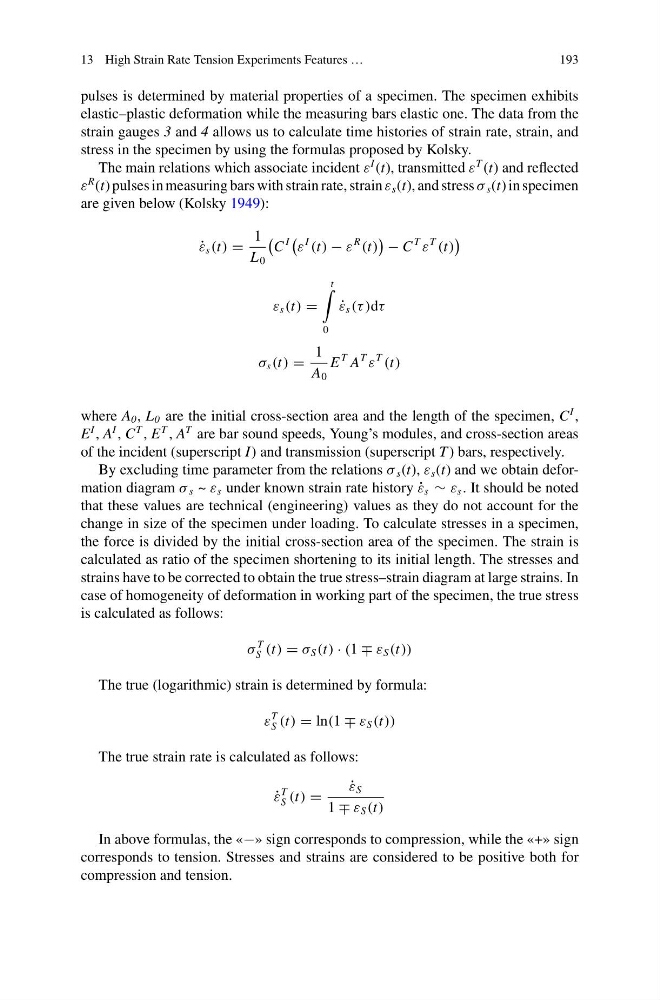
The main relations which associate incident ε
I (t), transmitted ε
T (t) and reflected
ε
R (t) pulses in measuring bars with strain rate, strain ε s (t), and stress σ s (t) in specimen
are given below (Kolsky 1949):
˙
ε s (t) =
1
L 0
C
I
ε
I
(t) − ε
R
(t)
− C
T
ε
T
(t)
ε s (t) =
t
0
˙
ε s (τ )dτ
σ s (t) =
1
A 0
E
T A
T
ε
T
(t)
where A 0 , L 0 are the initial cross-section area and the length of the specimen, C
I ,
E
I , A
I , C
T , E
T , A
T are bar sound speeds, Young’s modules, and cross-section areas
of the incident (superscript I) and transmission (superscript T ) bars, respectively.
By excluding time parameter from the relations σ s (t), ε s (t) and we obtain deformation diagram σ s ~ ε s under known strain rate history ˙
ε s ∼ ε s . It should be noted
that these values are technical (engineering) values as they do not account for the
change in size of the specimen under loading. To calculate stresses in a specimen,
the force is divided by the initial cross-section area of the specimen. The strain is
calculated as ratio of the specimen shortening to its initial length. The stresses and
strains have to be corrected to obtain the true stress–strain diagram at large strains. In
case of homogeneity of deformation in working part of the specimen, the true stress
is calculated as follows:
σ
T
S (t) = σ S (t) · (1 ∓ ε S (t))
The true (logarithmic) strain is determined by formula:
ε
T
S (t) = ln(1 ∓ ε S (t))
The true strain rate is calculated as follows:
˙
ε
T
S (t) =
˙
ε S
1 ∓ ε S (t)
In above formulas, the «−» sign corresponds to compression, while the «+» sign
corresponds to tension. Stresses and strains are considered to be positive both for
compression and tension.
193
pulses is determined by material properties of a specimen. The specimen exhibits
elastic–plastic deformation while the measuring bars elastic one. The data from the
strain gauges 3 and 4 allows us to calculate time histories of strain rate, strain, and
stress in the specimen by using the formulas proposed by Kolsky.
The main relations which associate incident ε
I (t), transmitted ε
T (t) and reflected
ε
R (t) pulses in measuring bars with strain rate, strain ε s (t), and stress σ s (t) in specimen
are given below (Kolsky 1949):
˙
ε s (t) =
1
L 0
C
I
ε
I
(t) − ε
R
(t)
− C
T
ε
T
(t)
ε s (t) =
t
0
˙
ε s (τ )dτ
σ s (t) =
1
A 0
E
T A
T
ε
T
(t)
where A 0 , L 0 are the initial cross-section area and the length of the specimen, C
I ,
E
I , A
I , C
T , E
T , A
T are bar sound speeds, Young’s modules, and cross-section areas
of the incident (superscript I) and transmission (superscript T ) bars, respectively.
By excluding time parameter from the relations σ s (t), ε s (t) and we obtain deformation diagram σ s ~ ε s under known strain rate history ˙
ε s ∼ ε s . It should be noted
that these values are technical (engineering) values as they do not account for the
change in size of the specimen under loading. To calculate stresses in a specimen,
the force is divided by the initial cross-section area of the specimen. The strain is
calculated as ratio of the specimen shortening to its initial length. The stresses and
strains have to be corrected to obtain the true stress–strain diagram at large strains. In
case of homogeneity of deformation in working part of the specimen, the true stress
is calculated as follows:
σ
T
S (t) = σ S (t) · (1 ∓ ε S (t))
The true (logarithmic) strain is determined by formula:
ε
T
S (t) = ln(1 ∓ ε S (t))
The true strain rate is calculated as follows:
˙
ε
T
S (t) =
˙
ε S
1 ∓ ε S (t)
In above formulas, the «−» sign corresponds to compression, while the «+» sign
corresponds to tension. Stresses and strains are considered to be positive both for
compression and tension.