

6
I. A. Volkov et al.
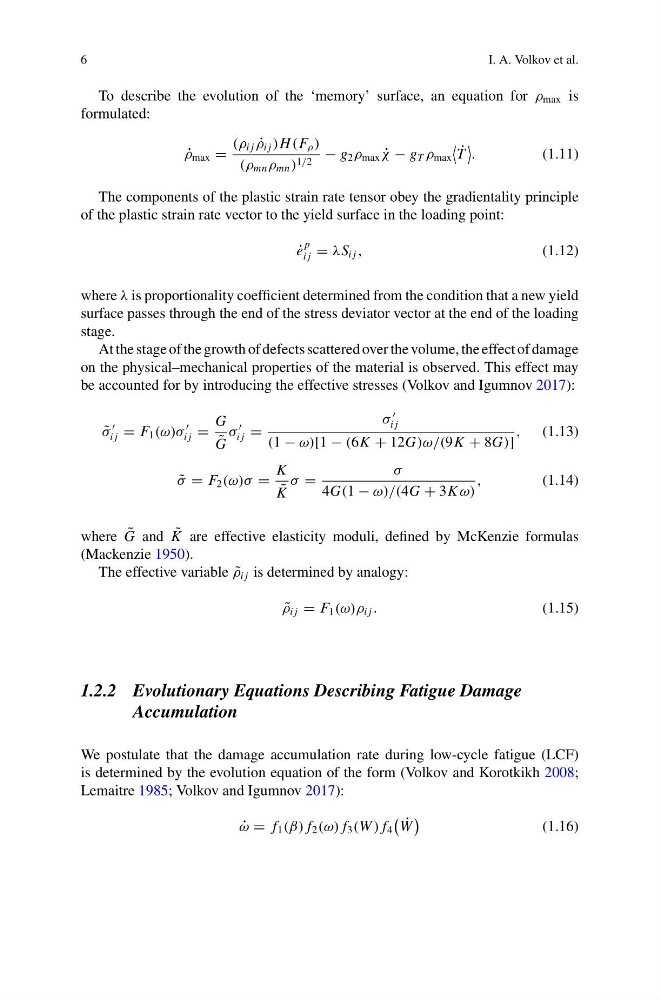
To describe the evolution of the ‘memory’ surface, an equation for ρ max is
formulated:
˙
ρ max =
(ρ i j ˙
ρ i j )H (F ρ )
(ρ mn ρ mn ) 1/2 − g 2 ρ max ˙
χ − g T ρ max
˙
T
.
(1.11)
The components of the plastic strain rate tensor obey the gradientality principle
of the plastic strain rate vector to the yield surface in the loading point:
˙
e
p
i j = λS i j ,
(1.12)
where λ is proportionality coefficient determined from the condition that a new yield
surface passes through the end of the stress deviator vector at the end of the loading
stage.
At the stage of the growth of defects scattered over the volume, the effect of damage
on the physical–mechanical properties of the material is observed. This effect may
be accounted for by introducing the effective stresses (Volkov and Igumnov 2017):
˜
σ
i j = F 1 (ω)σ
i j =
G
˜
G
σ
i j =
σ
i j
(1 − ω)[1 − (6K + 12G)ω/(9K + 8G)]
, (1.13)
˜
σ = F 2 (ω)σ =
K
˜
K
σ =
σ
4G(1 − ω)/(4G + 3K ω)
,
(1.14)
where ˜
G and ˜
K are effective elasticity moduli, defined by McKenzie formulas
(Mackenzie 1950).
The effective variable ˜
ρ i j is determined by analogy:
˜
ρ i j = F 1 (ω)ρ i j .
(1.15)
1.2.2 Evolutionary Equations Describing Fatigue Damage
Accumulation
We postulate that the damage accumulation rate during low-cycle fatigue (LCF)
is determined by the evolution equation of the form (Volkov and Korotkikh 2008;
Lemaitre 1985; Volkov and Igumnov 2017):
˙
ω = f 1 (β) f 2 (ω) f 3 (W ) f 4
˙
W
(1.16)
I. A. Volkov et al.
To describe the evolution of the ‘memory’ surface, an equation for ρ max is
formulated:
˙
ρ max =
(ρ i j ˙
ρ i j )H (F ρ )
(ρ mn ρ mn ) 1/2 − g 2 ρ max ˙
χ − g T ρ max
˙
T
.
(1.11)
The components of the plastic strain rate tensor obey the gradientality principle
of the plastic strain rate vector to the yield surface in the loading point:
˙
e
p
i j = λS i j ,
(1.12)
where λ is proportionality coefficient determined from the condition that a new yield
surface passes through the end of the stress deviator vector at the end of the loading
stage.
At the stage of the growth of defects scattered over the volume, the effect of damage
on the physical–mechanical properties of the material is observed. This effect may
be accounted for by introducing the effective stresses (Volkov and Igumnov 2017):
˜
σ
i j = F 1 (ω)σ
i j =
G
˜
G
σ
i j =
σ
i j
(1 − ω)[1 − (6K + 12G)ω/(9K + 8G)]
, (1.13)
˜
σ = F 2 (ω)σ =
K
˜
K
σ =
σ
4G(1 − ω)/(4G + 3K ω)
,
(1.14)
where ˜
G and ˜
K are effective elasticity moduli, defined by McKenzie formulas
(Mackenzie 1950).
The effective variable ˜
ρ i j is determined by analogy:
˜
ρ i j = F 1 (ω)ρ i j .
(1.15)
1.2.2 Evolutionary Equations Describing Fatigue Damage
Accumulation
We postulate that the damage accumulation rate during low-cycle fatigue (LCF)
is determined by the evolution equation of the form (Volkov and Korotkikh 2008;
Lemaitre 1985; Volkov and Igumnov 2017):
˙
ω = f 1 (β) f 2 (ω) f 3 (W ) f 4
˙
W
(1.16)