

1 Modeling Fatigue Life of Structural Alloys Under Block Asymmetric Loading
7
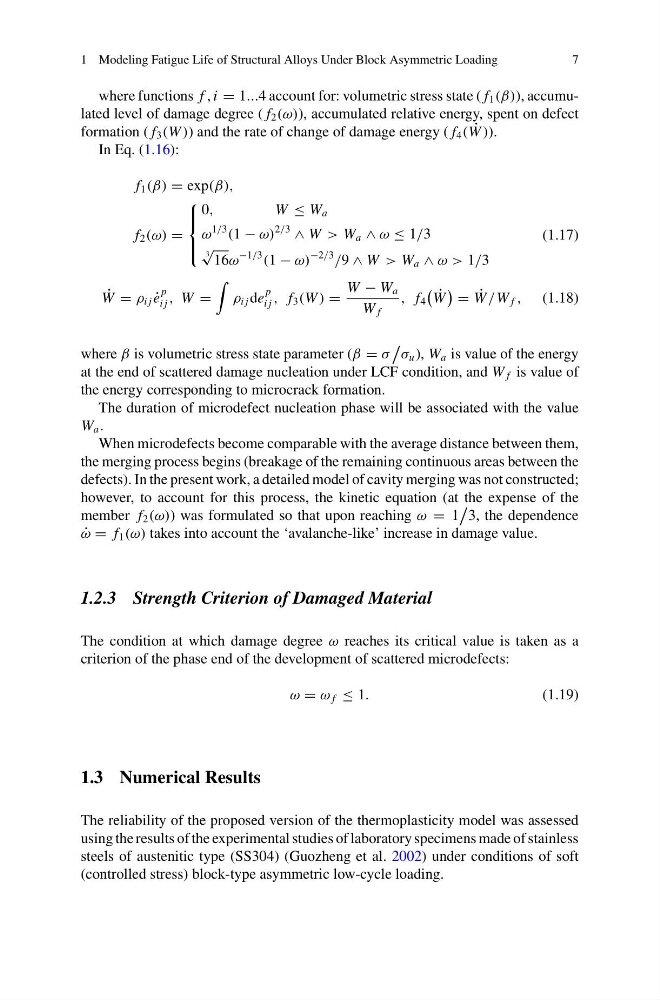
where functions f , i = 1...4 account for: volumetric stress state ( f 1 (β)), accumulated level of damage degree ( f 2 (ω)), accumulated relative energy, spent on defect
formation ( f 3 (W )) and the rate of change of damage energy ( f 4 ( ˙
W )).
In Eq. (1.16):
f 1 (β) = exp(β),
f 2 (ω) =
⎧
⎪ ⎨
⎪ ⎩
0,
W ≤ W a
ω
1/3
(1 − ω)
2/3
∧ W > W a ∧ ω ≤ 1/3
3
√
16ω
−1/3
(1 − ω)
−2/3
/9 ∧ W > W a ∧ ω > 1/3
(1.17)
˙
W = ρ i j ˙
e
p
i j , W =
ρ i j de
p
i j , f 3 (W ) =
W − W a
W f
, f 4
˙
W
= ˙
W /W f , (1.18)
where β is volumetric stress state parameter (β = σ
σ u ), W a is value of the energy
at the end of scattered damage nucleation under LCF condition, and W f is value of
the energy corresponding to microcrack formation.
The duration of microdefect nucleation phase will be associated with the value
W a .
When microdefects become comparable with the average distance between them,
the merging process begins (breakage of the remaining continuous areas between the
defects). In the present work, a detailed model of cavity merging was not constructed;
however, to account for this process, the kinetic equation (at the expense of the
member f 2 (ω)) was formulated so that upon reaching ω = 1
3, the dependence
˙
ω = f 1 (ω) takes into account the ‘avalanche-like’ increase in damage value.
1.2.3 Strength Criterion of Damaged Material
The condition at which damage degree ω reaches its critical value is taken as a
criterion of the phase end of the development of scattered microdefects:
ω = ω f ≤ 1.
(1.19)
1.3 Numerical Results
The reliability of the proposed version of the thermoplasticity model was assessed
using the results of the experimental studies of laboratory specimens made of stainless
steels of austenitic type (SS304) (Guozheng et al. 2002) under conditions of soft
(controlled stress) block-type asymmetric low-cycle loading.
7
where functions f , i = 1...4 account for: volumetric stress state ( f 1 (β)), accumulated level of damage degree ( f 2 (ω)), accumulated relative energy, spent on defect
formation ( f 3 (W )) and the rate of change of damage energy ( f 4 ( ˙
W )).
In Eq. (1.16):
f 1 (β) = exp(β),
f 2 (ω) =
⎧
⎪ ⎨
⎪ ⎩
0,
W ≤ W a
ω
1/3
(1 − ω)
2/3
∧ W > W a ∧ ω ≤ 1/3
3
√
16ω
−1/3
(1 − ω)
−2/3
/9 ∧ W > W a ∧ ω > 1/3
(1.17)
˙
W = ρ i j ˙
e
p
i j , W =
ρ i j de
p
i j , f 3 (W ) =
W − W a
W f
, f 4
˙
W
= ˙
W /W f , (1.18)
where β is volumetric stress state parameter (β = σ
σ u ), W a is value of the energy
at the end of scattered damage nucleation under LCF condition, and W f is value of
the energy corresponding to microcrack formation.
The duration of microdefect nucleation phase will be associated with the value
W a .
When microdefects become comparable with the average distance between them,
the merging process begins (breakage of the remaining continuous areas between the
defects). In the present work, a detailed model of cavity merging was not constructed;
however, to account for this process, the kinetic equation (at the expense of the
member f 2 (ω)) was formulated so that upon reaching ω = 1
3, the dependence
˙
ω = f 1 (ω) takes into account the ‘avalanche-like’ increase in damage value.
1.2.3 Strength Criterion of Damaged Material
The condition at which damage degree ω reaches its critical value is taken as a
criterion of the phase end of the development of scattered microdefects:
ω = ω f ≤ 1.
(1.19)
1.3 Numerical Results
The reliability of the proposed version of the thermoplasticity model was assessed
using the results of the experimental studies of laboratory specimens made of stainless
steels of austenitic type (SS304) (Guozheng et al. 2002) under conditions of soft
(controlled stress) block-type asymmetric low-cycle loading.