

180
L. Igumnov et al.
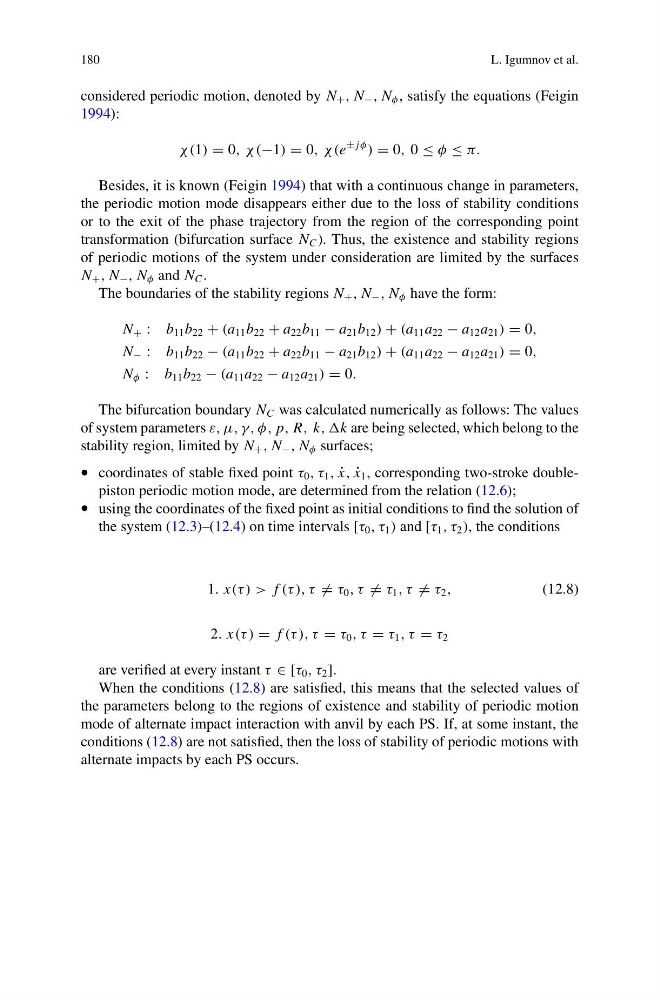
considered periodic motion, denoted by N + , N − , N φ , satisfy the equations (Feigin
1994):
χ(1) = 0, χ(−1) = 0, χ(e
± jφ
) = 0, 0 ≤ φ ≤ π.
Besides, it is known (Feigin 1994) that with a continuous change in parameters,
the periodic motion mode disappears either due to the loss of stability conditions
or to the exit of the phase trajectory from the region of the corresponding point
transformation (bifurcation surface N C ). Thus, the existence and stability regions
of periodic motions of the system under consideration are limited by the surfaces
N + , N − , N φ and N C .
The boundaries of the stability regions N + , N − , N φ have the form:
N + : b 11 b 22 + (a 11 b 22 + a 22 b 11 − a 21 b 12 ) + (a 11 a 22 − a 12 a 21 ) = 0,
N − : b 11 b 22 − (a 11 b 22 + a 22 b 11 − a 21 b 12 ) + (a 11 a 22 − a 12 a 21 ) = 0,
N φ : b 11 b 22 − (a 11 a 22 − a 12 a 21 ) = 0.
The bifurcation boundary N C was calculated numerically as follows: The values
of system parameters ε, μ, γ , φ, p, R, k, ,k are being selected, which belong to the
stability region, limited by N + , N − , N φ surfaces;
• coordinates of stable fixed point τ 0 , τ 1 , ˙
x, ˙
x 1 , corresponding two-stroke doublepiston periodic motion mode, are determined from the relation (12.6);
• using the coordinates of the fixed point as initial conditions to find the solution of
the system (12.3)–(12.4) on time intervals [τ 0 , τ 1 ) and [τ 1 , τ 2 ), the conditions
1. x(τ ) > f (τ ), τ = τ 0 , τ = τ 1 , τ = τ 2 ,
(12.8)
2. x(τ ) = f (τ ), τ = τ 0 , τ = τ 1 , τ = τ 2
are verified at every instant τ ∈ [τ 0 , τ 2 ].
When the conditions (12.8) are satisfied, this means that the selected values of
the parameters belong to the regions of existence and stability of periodic motion
mode of alternate impact interaction with anvil by each PS. If, at some instant, the
conditions (12.8) are not satisfied, then the loss of stability of periodic motions with
alternate impacts by each PS occurs.
L. Igumnov et al.
considered periodic motion, denoted by N + , N − , N φ , satisfy the equations (Feigin
1994):
χ(1) = 0, χ(−1) = 0, χ(e
± jφ
) = 0, 0 ≤ φ ≤ π.
Besides, it is known (Feigin 1994) that with a continuous change in parameters,
the periodic motion mode disappears either due to the loss of stability conditions
or to the exit of the phase trajectory from the region of the corresponding point
transformation (bifurcation surface N C ). Thus, the existence and stability regions
of periodic motions of the system under consideration are limited by the surfaces
N + , N − , N φ and N C .
The boundaries of the stability regions N + , N − , N φ have the form:
N + : b 11 b 22 + (a 11 b 22 + a 22 b 11 − a 21 b 12 ) + (a 11 a 22 − a 12 a 21 ) = 0,
N − : b 11 b 22 − (a 11 b 22 + a 22 b 11 − a 21 b 12 ) + (a 11 a 22 − a 12 a 21 ) = 0,
N φ : b 11 b 22 − (a 11 a 22 − a 12 a 21 ) = 0.
The bifurcation boundary N C was calculated numerically as follows: The values
of system parameters ε, μ, γ , φ, p, R, k, ,k are being selected, which belong to the
stability region, limited by N + , N − , N φ surfaces;
• coordinates of stable fixed point τ 0 , τ 1 , ˙
x, ˙
x 1 , corresponding two-stroke doublepiston periodic motion mode, are determined from the relation (12.6);
• using the coordinates of the fixed point as initial conditions to find the solution of
the system (12.3)–(12.4) on time intervals [τ 0 , τ 1 ) and [τ 1 , τ 2 ), the conditions
1. x(τ ) > f (τ ), τ = τ 0 , τ = τ 1 , τ = τ 2 ,
(12.8)
2. x(τ ) = f (τ ), τ = τ 0 , τ = τ 1 , τ = τ 2
are verified at every instant τ ∈ [τ 0 , τ 2 ].
When the conditions (12.8) are satisfied, this means that the selected values of
the parameters belong to the regions of existence and stability of periodic motion
mode of alternate impact interaction with anvil by each PS. If, at some instant, the
conditions (12.8) are not satisfied, then the loss of stability of periodic motions with
alternate impacts by each PS occurs.