

12 The Dynamics of Eccentric Vibration Mechanism (Part 2)
177
dx
dτ
+
= −R
dx
dτ
−
+ (1 + R)
d f (τ )
dτ
, x = f (τ ),
(12.4)
where f (τ ) = max τ { f 1 (τ ), f 2 (τ )}.
12.3 The Phase Space
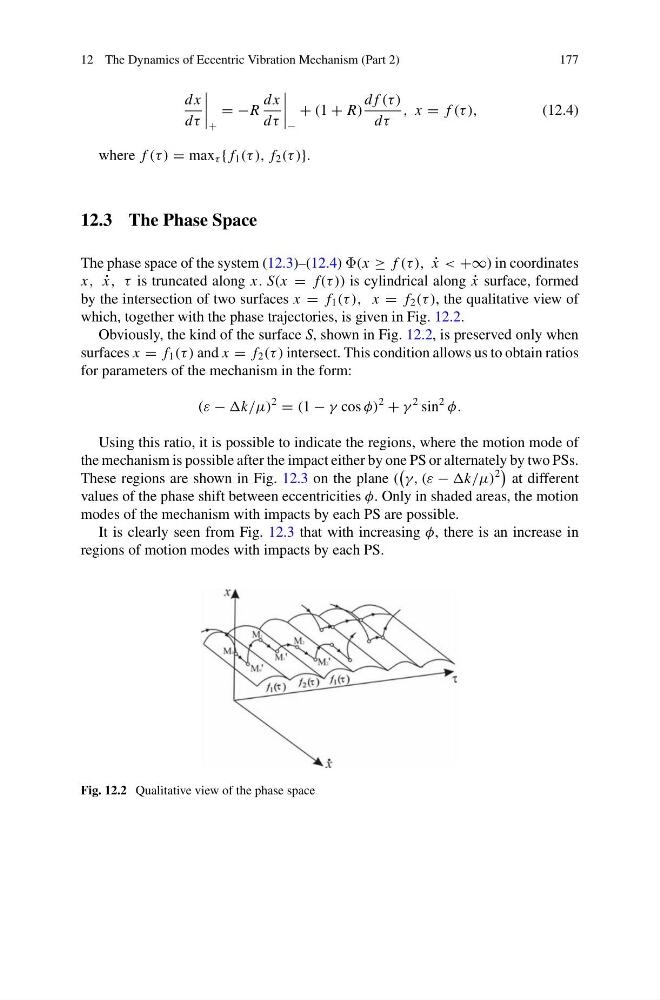
The phase space of the system (12.3)–(12.4) F(x ≥ f (τ ), ˙
x < +∞) in coordinates
x, ˙
x, τ is truncated along x. S(x = f(τ )) is cylindrical along ˙
x surface, formed
by the intersection of two surfaces x = f 1 (τ ), x = f 2 (τ ), the qualitative view of
which, together with the phase trajectories, is given in Fig. 12.2.
Obviously, the kind of the surface S, shown in Fig. 12.2, is preserved only when
surfaces x = f 1 (τ ) and x = f 2 (τ ) intersect. This condition allows us to obtain ratios
for parameters of the mechanism in the form:
(ε − k/μ)
2
= (1 − γ cos φ)
2
+ γ
2 sin
2
φ.
Using this ratio, it is possible to indicate the regions, where the motion mode of
the mechanism is possible after the impact either by one PS or alternately by two PSs.
These regions are shown in Fig. 12.3 on the plane (
γ, (ε − k/μ)
2
at different
values of the phase shift between eccentricities φ. Only in shaded areas, the motion
modes of the mechanism with impacts by each PS are possible.
It is clearly seen from Fig. 12.3 that with increasing φ, there is an increase in
regions of motion modes with impacts by each PS.
Fig. 12.2 Qualitative view of the phase space
177
dx
dτ
+
= −R
dx
dτ
−
+ (1 + R)
d f (τ )
dτ
, x = f (τ ),
(12.4)
where f (τ ) = max τ { f 1 (τ ), f 2 (τ )}.
12.3 The Phase Space
The phase space of the system (12.3)–(12.4) F(x ≥ f (τ ), ˙
x < +∞) in coordinates
x, ˙
x, τ is truncated along x. S(x = f(τ )) is cylindrical along ˙
x surface, formed
by the intersection of two surfaces x = f 1 (τ ), x = f 2 (τ ), the qualitative view of
which, together with the phase trajectories, is given in Fig. 12.2.
Obviously, the kind of the surface S, shown in Fig. 12.2, is preserved only when
surfaces x = f 1 (τ ) and x = f 2 (τ ) intersect. This condition allows us to obtain ratios
for parameters of the mechanism in the form:
(ε − k/μ)
2
= (1 − γ cos φ)
2
+ γ
2 sin
2
φ.
Using this ratio, it is possible to indicate the regions, where the motion mode of
the mechanism is possible after the impact either by one PS or alternately by two PSs.
These regions are shown in Fig. 12.3 on the plane (
γ, (ε − k/μ)
2
at different
values of the phase shift between eccentricities φ. Only in shaded areas, the motion
modes of the mechanism with impacts by each PS are possible.
It is clearly seen from Fig. 12.3 that with increasing φ, there is an increase in
regions of motion modes with impacts by each PS.
Fig. 12.2 Qualitative view of the phase space