

176
L. Igumnov et al.
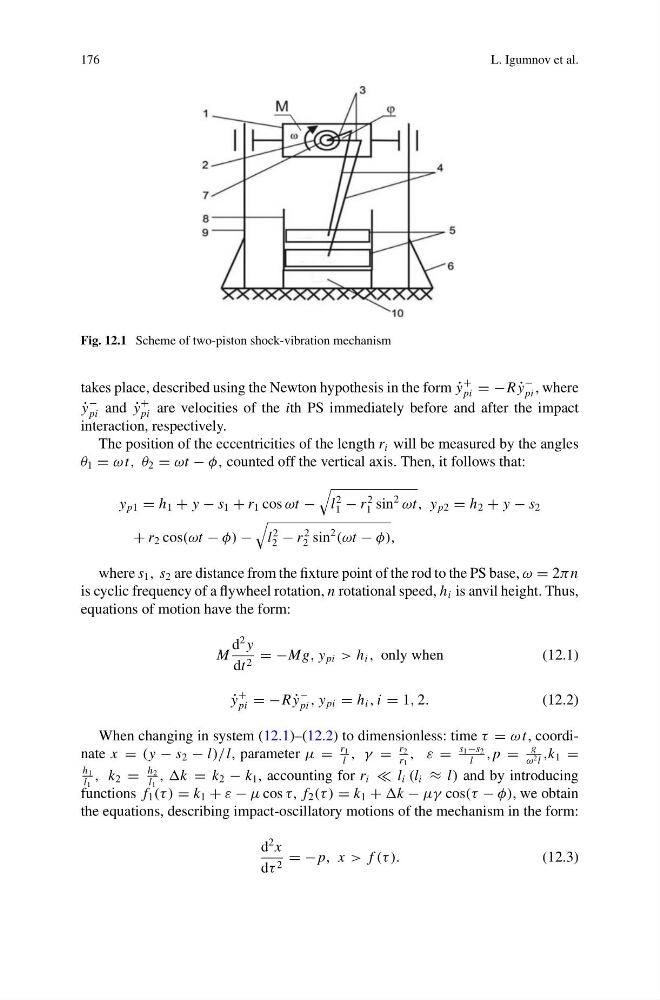
Fig. 12.1 Scheme of two-piston shock-vibration mechanism
takes place, described using the Newton hypothesis in the form ˙
y
+
pi = −R ˙
y
−
pi , where
˙
y
−
pi and ˙
y
+
pi are velocities of the ith PS immediately before and after the impact
interaction, respectively.
The position of the eccentricities of the length r i will be measured by the angles
θ 1 = ω t, θ 2 = ωt − φ, counted off the vertical axis. Then, it follows that:
y p1 = h 1 + y − s 1 + r 1 cos ωt −
l
2
1 − r
2
1 sin
2
ωt, y p2 = h 2 + y − s 2
+ r 2 cos(ωt − φ) −
l
2
2 − r
2
2 sin
2
(ωt − φ),
where s 1 , s 2 are distance from the fixture point of the rod to the PS base, ω = 2π n
is cyclic frequency of a flywheel rotation, n rotational speed, h i is anvil height. Thus,
equations of motion have the form:
M
d
2 y
dt 2 = −Mg, y pi > h i , only when
(12.1)
˙
y
+
pi = −R ˙
y
−
pi , y pi = h i , i = 1, 2.
(12.2)
When changing in system (12.1)–(12.2) to dimensionless: time τ = ω t, coordinate x = (y − s 2 − l)/l, parameter μ =
r 1
l
, γ =
r 2
r 1
, ε =
s 1 −s 2
l
, p =
g
ω 2 l
,k 1 =
h 1
l 1
, k 2 =
h 2
l 1
, k = k 2 − k 1 , accounting for r i l i (l i ≈ l) and by introducing
functions f 1 (τ ) = k 1 + ε − μ cos τ, f 2 (τ ) = k 1 + k − μγ cos(τ − φ), we obtain
the equations, describing impact-oscillatory motions of the mechanism in the form:
d
2 x
dτ 2 = −p, x > f (τ ).
(12.3)
L. Igumnov et al.
Fig. 12.1 Scheme of two-piston shock-vibration mechanism
takes place, described using the Newton hypothesis in the form ˙
y
+
pi = −R ˙
y
−
pi , where
˙
y
−
pi and ˙
y
+
pi are velocities of the ith PS immediately before and after the impact
interaction, respectively.
The position of the eccentricities of the length r i will be measured by the angles
θ 1 = ω t, θ 2 = ωt − φ, counted off the vertical axis. Then, it follows that:
y p1 = h 1 + y − s 1 + r 1 cos ωt −
l
2
1 − r
2
1 sin
2
ωt, y p2 = h 2 + y − s 2
+ r 2 cos(ωt − φ) −
l
2
2 − r
2
2 sin
2
(ωt − φ),
where s 1 , s 2 are distance from the fixture point of the rod to the PS base, ω = 2π n
is cyclic frequency of a flywheel rotation, n rotational speed, h i is anvil height. Thus,
equations of motion have the form:
M
d
2 y
dt 2 = −Mg, y pi > h i , only when
(12.1)
˙
y
+
pi = −R ˙
y
−
pi , y pi = h i , i = 1, 2.
(12.2)
When changing in system (12.1)–(12.2) to dimensionless: time τ = ω t, coordinate x = (y − s 2 − l)/l, parameter μ =
r 1
l
, γ =
r 2
r 1
, ε =
s 1 −s 2
l
, p =
g
ω 2 l
,k 1 =
h 1
l 1
, k 2 =
h 2
l 1
, k = k 2 − k 1 , accounting for r i l i (l i ≈ l) and by introducing
functions f 1 (τ ) = k 1 + ε − μ cos τ, f 2 (τ ) = k 1 + k − μγ cos(τ − φ), we obtain
the equations, describing impact-oscillatory motions of the mechanism in the form:
d
2 x
dτ 2 = −p, x > f (τ ).
(12.3)