

132
N. A. Abrosimov et al.
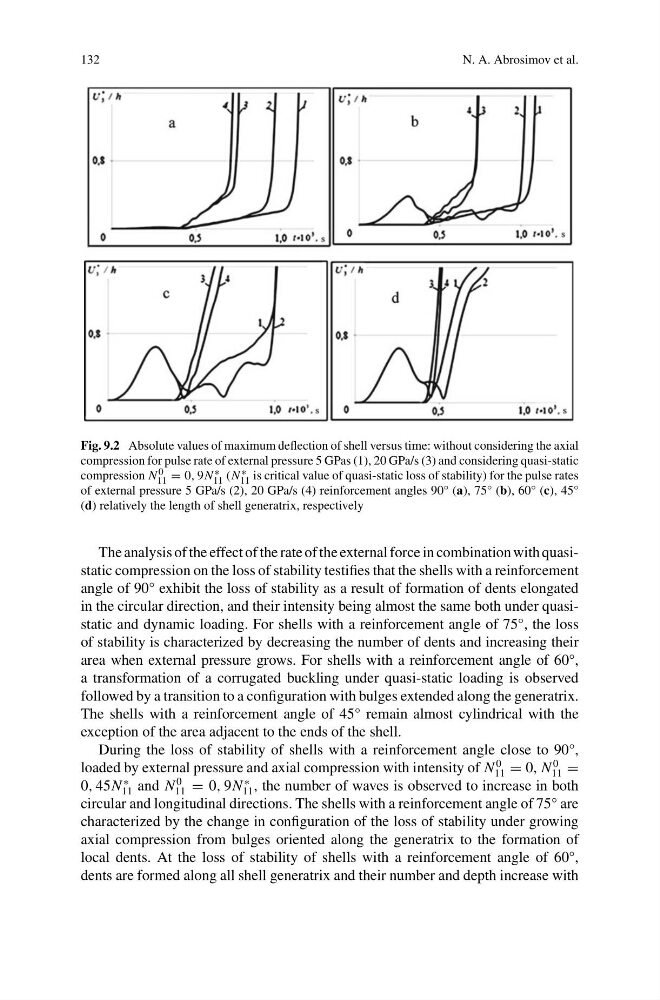
Fig. 9.2 Absolute values of maximum deflection of shell versus time: without considering the axial
compression for pulse rate of external pressure 5 GPas (1), 20 GPa/s (3) and considering quasi-static
compression N 0
11 = 0, 9N ∗
11 (N ∗
11 is critical value of quasi-static loss of stability) for the pulse rates
of external pressure 5 GPa/s (2), 20 GPa/s (4) reinforcement angles 90° (a), 75° (b), 60° (c), 45°
(d) relatively the length of shell generatrix, respectively
The analysis of the effect of the rate of the external force in combination with quasistatic compression on the loss of stability testifies that the shells with a reinforcement
angle of 90° exhibit the loss of stability as a result of formation of dents elongated
in the circular direction, and their intensity being almost the same both under quasistatic and dynamic loading. For shells with a reinforcement angle of 75°, the loss
of stability is characterized by decreasing the number of dents and increasing their
area when external pressure grows. For shells with a reinforcement angle of 60°,
a transformation of a corrugated buckling under quasi-static loading is observed
followed by a transition to a configuration with bulges extended along the generatrix.
The shells with a reinforcement angle of 45° remain almost cylindrical with the
exception of the area adjacent to the ends of the shell.
During the loss of stability of shells with a reinforcement angle close to 90°,
loaded by external pressure and axial compression with intensity of N
0
11 = 0, N
0
11 =
0, 45N
∗
11 and N
0
11 = 0, 9N
∗
11 , the number of waves is observed to increase in both
circular and longitudinal directions. The shells with a reinforcement angle of 75° are
characterized by the change in configuration of the loss of stability under growing
axial compression from bulges oriented along the generatrix to the formation of
local dents. At the loss of stability of shells with a reinforcement angle of 60°,
dents are formed along all shell generatrix and their number and depth increase with
N. A. Abrosimov et al.
Fig. 9.2 Absolute values of maximum deflection of shell versus time: without considering the axial
compression for pulse rate of external pressure 5 GPas (1), 20 GPa/s (3) and considering quasi-static
compression N 0
11 = 0, 9N ∗
11 (N ∗
11 is critical value of quasi-static loss of stability) for the pulse rates
of external pressure 5 GPa/s (2), 20 GPa/s (4) reinforcement angles 90° (a), 75° (b), 60° (c), 45°
(d) relatively the length of shell generatrix, respectively
The analysis of the effect of the rate of the external force in combination with quasistatic compression on the loss of stability testifies that the shells with a reinforcement
angle of 90° exhibit the loss of stability as a result of formation of dents elongated
in the circular direction, and their intensity being almost the same both under quasistatic and dynamic loading. For shells with a reinforcement angle of 75°, the loss
of stability is characterized by decreasing the number of dents and increasing their
area when external pressure grows. For shells with a reinforcement angle of 60°,
a transformation of a corrugated buckling under quasi-static loading is observed
followed by a transition to a configuration with bulges extended along the generatrix.
The shells with a reinforcement angle of 45° remain almost cylindrical with the
exception of the area adjacent to the ends of the shell.
During the loss of stability of shells with a reinforcement angle close to 90°,
loaded by external pressure and axial compression with intensity of N
0
11 = 0, N
0
11 =
0, 45N
∗
11 and N
0
11 = 0, 9N
∗
11 , the number of waves is observed to increase in both
circular and longitudinal directions. The shells with a reinforcement angle of 75° are
characterized by the change in configuration of the loss of stability under growing
axial compression from bulges oriented along the generatrix to the formation of
local dents. At the loss of stability of shells with a reinforcement angle of 60°,
dents are formed along all shell generatrix and their number and depth increase with