

9 Computer Simulation of the Process of Loss of Stability …
133
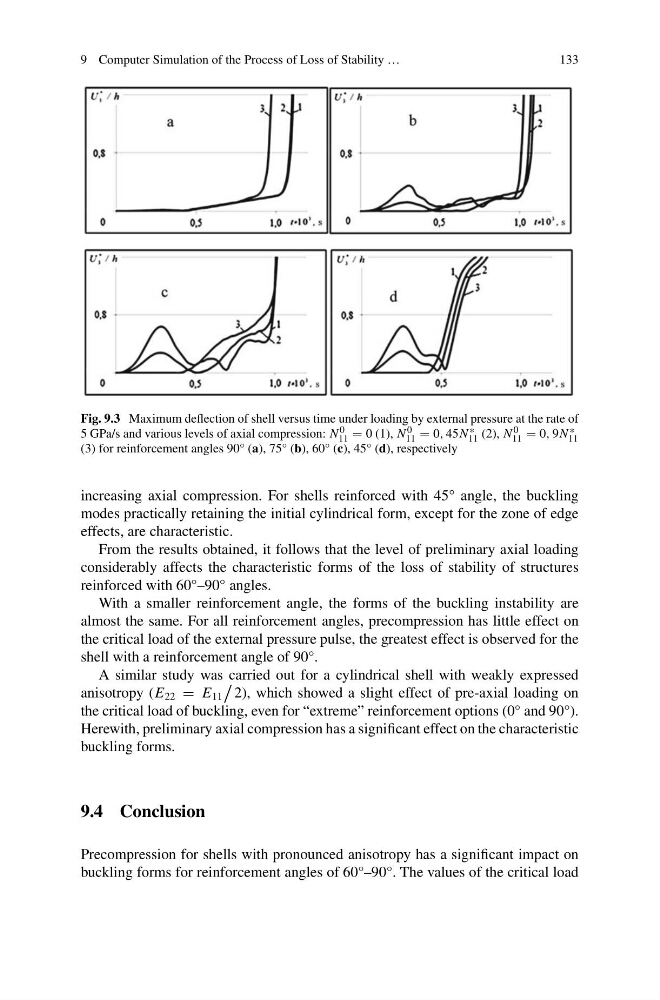
Fig. 9.3 Maximum deflection of shell versus time under loading by external pressure at the rate of
5 GPa/s and various levels of axial compression: N 0
11 = 0 (1), N 0
11 = 0, 45N ∗
11 (2), N 0
11 = 0, 9N ∗
11
(3) for reinforcement angles 90° (a), 75° (b), 60° (c), 45° (d), respectively
increasing axial compression. For shells reinforced with 45° angle, the buckling
modes practically retaining the initial cylindrical form, except for the zone of edge
effects, are characteristic.
From the results obtained, it follows that the level of preliminary axial loading
considerably affects the characteristic forms of the loss of stability of structures
reinforced with 60°–90° angles.
With a smaller reinforcement angle, the forms of the buckling instability are
almost the same. For all reinforcement angles, precompression has little effect on
the critical load of the external pressure pulse, the greatest effect is observed for the
shell with a reinforcement angle of 90°.
A similar study was carried out for a cylindrical shell with weakly expressed
anisotropy (E 22 = E 11
2), which showed a slight effect of pre-axial loading on
the critical load of buckling, even for “extreme” reinforcement options (0° and 90°).
Herewith, preliminary axial compression has a significant effect on the characteristic
buckling forms.
9.4 Conclusion
Precompression for shells with pronounced anisotropy has a significant impact on
buckling forms for reinforcement angles of 60°–90°. The values of the critical load
133
Fig. 9.3 Maximum deflection of shell versus time under loading by external pressure at the rate of
5 GPa/s and various levels of axial compression: N 0
11 = 0 (1), N 0
11 = 0, 45N ∗
11 (2), N 0
11 = 0, 9N ∗
11
(3) for reinforcement angles 90° (a), 75° (b), 60° (c), 45° (d), respectively
increasing axial compression. For shells reinforced with 45° angle, the buckling
modes practically retaining the initial cylindrical form, except for the zone of edge
effects, are characteristic.
From the results obtained, it follows that the level of preliminary axial loading
considerably affects the characteristic forms of the loss of stability of structures
reinforced with 60°–90° angles.
With a smaller reinforcement angle, the forms of the buckling instability are
almost the same. For all reinforcement angles, precompression has little effect on
the critical load of the external pressure pulse, the greatest effect is observed for the
shell with a reinforcement angle of 90°.
A similar study was carried out for a cylindrical shell with weakly expressed
anisotropy (E 22 = E 11
2), which showed a slight effect of pre-axial loading on
the critical load of buckling, even for “extreme” reinforcement options (0° and 90°).
Herewith, preliminary axial compression has a significant effect on the characteristic
buckling forms.
9.4 Conclusion
Precompression for shells with pronounced anisotropy has a significant impact on
buckling forms for reinforcement angles of 60°–90°. The values of the critical load