

9 Computer Simulation of the Process of Loss of Stability …
129
S is the internal surface of the shell, Γ i is shell boundaries along the lines α 2 (i =
1,2), F 3 is the load along the coordinate axis α 3 , index «o» denotes the force applied
to the ends of the shell, ρ is the density of shell material, and h is shell thickness.
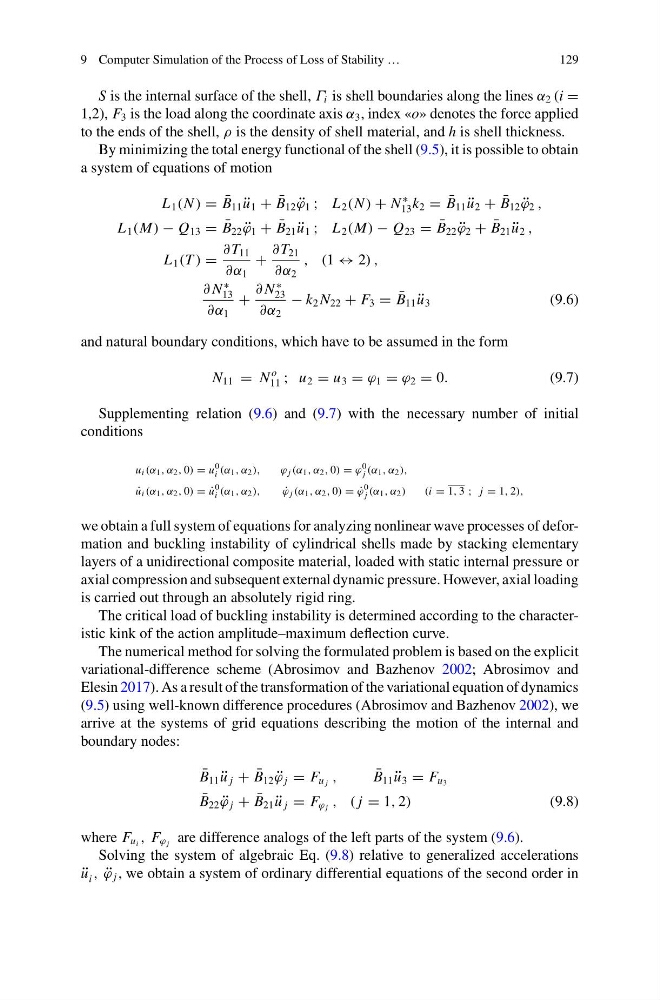
By minimizing the total energy functional of the shell (9.5), it is possible to obtain
a system of equations of motion
L 1 (N ) = ¯
B 11 ¨
u 1 + ¯
B 12 ¨
ϕ 1 ; L 2 (N ) + N
∗
13 k 2 = ¯
B 11 ¨
u 2 + ¯
B 12 ¨
ϕ 2 ,
L 1 (M) − Q 13 = ¯
B 22 ¨
ϕ 1 + ¯
B 21 ¨
u 1 ; L 2 (M) − Q 23 = ¯
B 22 ¨
ϕ 2 + ¯
B 21 ¨
u 2 ,
L 1 (T ) =
∂ T 11
∂α 1
+
∂ T 21
∂α 2
, (1 ↔ 2) ,
∂ N
∗
13
∂α 1
+
∂ N
∗
23
∂α 2
− k 2 N 22 + F 3 = ¯
B 11 ¨
u 3
(9.6)
and natural boundary conditions, which have to be assumed in the form
N 11 = N
o
11 ; u 2 = u 3 = ϕ 1 = ϕ 2 = 0.
(9.7)
Supplementing relation (9.6) and (9.7) with the necessary number of initial
conditions
u i (α 1 , α 2 , 0) = u
0
i (α 1 , α 2 ),
ϕ j (α 1 , α 2 , 0) = ϕ
0
j (α 1 , α 2 ),
˙
u i (α 1 , α 2 , 0) = ˙
u
0
i (α 1 , α 2 ),
˙
ϕ j (α 1 , α 2 , 0) = ˙
ϕ
0
j (α 1 , α 2 )
(i = 1, 3 ; j = 1, 2),
we obtain a full system of equations for analyzing nonlinear wave processes of deformation and buckling instability of cylindrical shells made by stacking elementary
layers of a unidirectional composite material, loaded with static internal pressure or
axial compression and subsequent external dynamic pressure. However, axial loading
is carried out through an absolutely rigid ring.
The critical load of buckling instability is determined according to the characteristic kink of the action amplitude–maximum deflection curve.
The numerical method for solving the formulated problem is based on the explicit
variational-difference scheme (Abrosimov and Bazhenov 2002; Abrosimov and
Elesin 2017). As a result of the transformation of the variational equation of dynamics
(9.5) using well-known difference procedures (Abrosimov and Bazhenov 2002), we
arrive at the systems of grid equations describing the motion of the internal and
boundary nodes:
¯
B 11 ¨
u j + ¯
B 12 ¨
ϕ j = F u j ,
¯
B 11 ¨
u 3 = F u 3
¯
B 22 ¨
ϕ j + ¯
B 21 ¨
u j = F ϕ j , (j = 1, 2)
(9.8)
where F u i , F ϕ j are difference analogs of the left parts of the system (9.6).
Solving the system of algebraic Eq. (9.8) relative to generalized accelerations
¨
u i , ¨
ϕ j , we obtain a system of ordinary differential equations of the second order in
129
S is the internal surface of the shell, Γ i is shell boundaries along the lines α 2 (i =
1,2), F 3 is the load along the coordinate axis α 3 , index «o» denotes the force applied
to the ends of the shell, ρ is the density of shell material, and h is shell thickness.
By minimizing the total energy functional of the shell (9.5), it is possible to obtain
a system of equations of motion
L 1 (N ) = ¯
B 11 ¨
u 1 + ¯
B 12 ¨
ϕ 1 ; L 2 (N ) + N
∗
13 k 2 = ¯
B 11 ¨
u 2 + ¯
B 12 ¨
ϕ 2 ,
L 1 (M) − Q 13 = ¯
B 22 ¨
ϕ 1 + ¯
B 21 ¨
u 1 ; L 2 (M) − Q 23 = ¯
B 22 ¨
ϕ 2 + ¯
B 21 ¨
u 2 ,
L 1 (T ) =
∂ T 11
∂α 1
+
∂ T 21
∂α 2
, (1 ↔ 2) ,
∂ N
∗
13
∂α 1
+
∂ N
∗
23
∂α 2
− k 2 N 22 + F 3 = ¯
B 11 ¨
u 3
(9.6)
and natural boundary conditions, which have to be assumed in the form
N 11 = N
o
11 ; u 2 = u 3 = ϕ 1 = ϕ 2 = 0.
(9.7)
Supplementing relation (9.6) and (9.7) with the necessary number of initial
conditions
u i (α 1 , α 2 , 0) = u
0
i (α 1 , α 2 ),
ϕ j (α 1 , α 2 , 0) = ϕ
0
j (α 1 , α 2 ),
˙
u i (α 1 , α 2 , 0) = ˙
u
0
i (α 1 , α 2 ),
˙
ϕ j (α 1 , α 2 , 0) = ˙
ϕ
0
j (α 1 , α 2 )
(i = 1, 3 ; j = 1, 2),
we obtain a full system of equations for analyzing nonlinear wave processes of deformation and buckling instability of cylindrical shells made by stacking elementary
layers of a unidirectional composite material, loaded with static internal pressure or
axial compression and subsequent external dynamic pressure. However, axial loading
is carried out through an absolutely rigid ring.
The critical load of buckling instability is determined according to the characteristic kink of the action amplitude–maximum deflection curve.
The numerical method for solving the formulated problem is based on the explicit
variational-difference scheme (Abrosimov and Bazhenov 2002; Abrosimov and
Elesin 2017). As a result of the transformation of the variational equation of dynamics
(9.5) using well-known difference procedures (Abrosimov and Bazhenov 2002), we
arrive at the systems of grid equations describing the motion of the internal and
boundary nodes:
¯
B 11 ¨
u j + ¯
B 12 ¨
ϕ j = F u j ,
¯
B 11 ¨
u 3 = F u 3
¯
B 22 ¨
ϕ j + ¯
B 21 ¨
u j = F ϕ j , (j = 1, 2)
(9.8)
where F u i , F ϕ j are difference analogs of the left parts of the system (9.6).
Solving the system of algebraic Eq. (9.8) relative to generalized accelerations
¨
u i , ¨
ϕ j , we obtain a system of ordinary differential equations of the second order in