

128
N. A. Abrosimov et al.
σ = (σ 11 + σ 22 + σ 33 )/3,
3
i, j=1
S i j S i j = 2
3 σ
2
∗ ,
S i j = σ i j − σ δ i j − ρ i j , ρ i j = 2ge
i j , e
i j =
t
0
˙
e i j dt,
(9.4)
where E is the elastic modulus; ν is Poisson ratio; e
i j , e
i j are the elastic and plastic
components of the strain tensor; δ i j is the Kronecker tensor; σ ∗ , g are the yield stress
and hardening modulus of the material; ˙
γ is a scalar parameter.
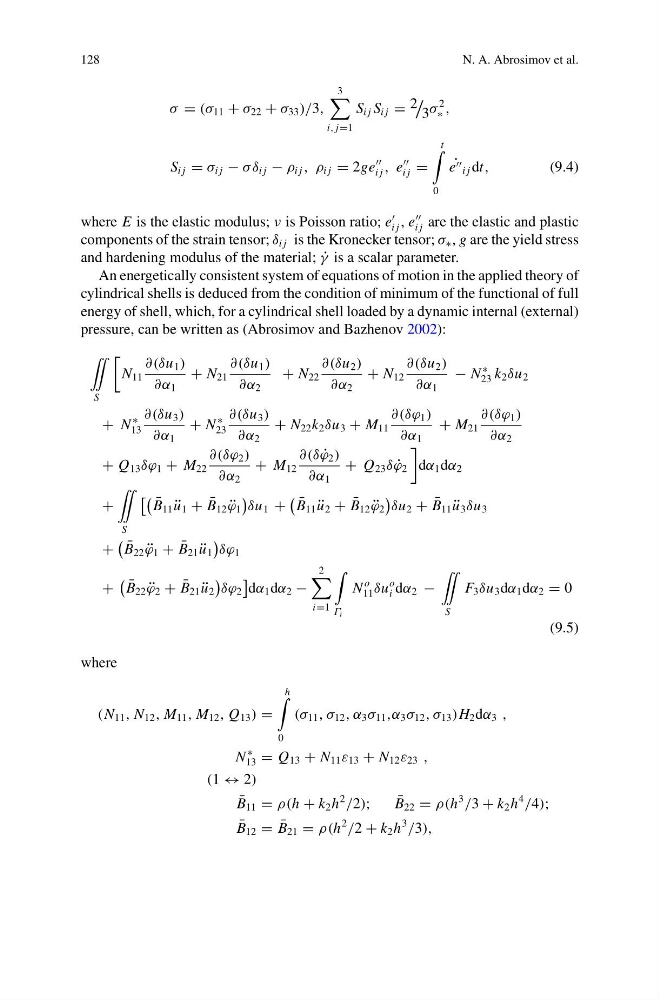
An energetically consistent system of equations of motion in the applied theory of
cylindrical shells is deduced from the condition of minimum of the functional of full
energy of shell, which, for a cylindrical shell loaded by a dynamic internal (external)
pressure, can be written as (Abrosimov and Bazhenov 2002):
¨
S
N 11
∂(δu 1 )
∂α 1
+ N 21
∂(δu 1 )
∂α 2
+ N 22
∂(δu 2 )
∂α 2
+ N 12
∂(δu 2 )
∂α 1
− N
∗
23 k 2 δu 2
+ N
∗
13
∂(δu 3 )
∂α 1
+ N
∗
23
∂(δu 3 )
∂α 2
+ N 22 k 2 δu 3 + M 11
∂(δϕ 1 )
∂α 1
+ M 21
∂(δϕ 1 )
∂α 2
+ Q 13 δϕ 1 + M 22
∂(δϕ 2 )
∂α 2
+ M 12
∂(δ ˙
ϕ 2 )
∂α 1
+ Q 23 δ ˙
ϕ 2
dα 1 dα 2
+
¨
S
¯
B 11 ¨
u 1 + ¯
B 12 ¨
ϕ 1
δu 1 +
¯
B 11 ¨
u 2 + ¯
B 12 ¨
ϕ 2
δu 2 + ¯
B 11 ¨
u 3 δu 3
+
¯
B 22 ¨
ϕ 1 + ¯
B 21 ¨
u 1
δϕ 1
+
¯
B 22 ¨
ϕ 2 + ¯
B 21 ¨
u 2
δϕ 2
dα 1 dα 2 −
2
i=1
Γ i
N
o
11 δu
o
i dα 2 −
¨
S
F 3 δu 3 dα 1 dα 2 = 0
(9.5)
where
(N 11 , N 12 , M 11 , M 12 , Q 13 ) =
h
0
(σ 11 , σ 12 , α 3 σ 11 ,α 3 σ 12 , σ 13 )H 2 dα 3 ,
N
∗
13 = Q 13 + N 11 ε 13 + N 12 ε 23 ,
(1 ↔ 2)
¯
B 11 = ρ(h + k 2 h
2
/2);
¯
B 22 = ρ(h
3
/3 + k 2 h
4
/4);
¯
B 12 = ¯
B 21 = ρ(h
2
/2 + k 2 h
3
/3),
N. A. Abrosimov et al.
σ = (σ 11 + σ 22 + σ 33 )/3,
3
i, j=1
S i j S i j = 2
3 σ
2
∗ ,
S i j = σ i j − σ δ i j − ρ i j , ρ i j = 2ge
i j , e
i j =
t
0
˙
e i j dt,
(9.4)
where E is the elastic modulus; ν is Poisson ratio; e
i j , e
i j are the elastic and plastic
components of the strain tensor; δ i j is the Kronecker tensor; σ ∗ , g are the yield stress
and hardening modulus of the material; ˙
γ is a scalar parameter.
An energetically consistent system of equations of motion in the applied theory of
cylindrical shells is deduced from the condition of minimum of the functional of full
energy of shell, which, for a cylindrical shell loaded by a dynamic internal (external)
pressure, can be written as (Abrosimov and Bazhenov 2002):
¨
S
N 11
∂(δu 1 )
∂α 1
+ N 21
∂(δu 1 )
∂α 2
+ N 22
∂(δu 2 )
∂α 2
+ N 12
∂(δu 2 )
∂α 1
− N
∗
23 k 2 δu 2
+ N
∗
13
∂(δu 3 )
∂α 1
+ N
∗
23
∂(δu 3 )
∂α 2
+ N 22 k 2 δu 3 + M 11
∂(δϕ 1 )
∂α 1
+ M 21
∂(δϕ 1 )
∂α 2
+ Q 13 δϕ 1 + M 22
∂(δϕ 2 )
∂α 2
+ M 12
∂(δ ˙
ϕ 2 )
∂α 1
+ Q 23 δ ˙
ϕ 2
dα 1 dα 2
+
¨
S
¯
B 11 ¨
u 1 + ¯
B 12 ¨
ϕ 1
δu 1 +
¯
B 11 ¨
u 2 + ¯
B 12 ¨
ϕ 2
δu 2 + ¯
B 11 ¨
u 3 δu 3
+
¯
B 22 ¨
ϕ 1 + ¯
B 21 ¨
u 1
δϕ 1
+
¯
B 22 ¨
ϕ 2 + ¯
B 21 ¨
u 2
δϕ 2
dα 1 dα 2 −
2
i=1
Γ i
N
o
11 δu
o
i dα 2 −
¨
S
F 3 δu 3 dα 1 dα 2 = 0
(9.5)
where
(N 11 , N 12 , M 11 , M 12 , Q 13 ) =
h
0
(σ 11 , σ 12 , α 3 σ 11 ,α 3 σ 12 , σ 13 )H 2 dα 3 ,
N
∗
13 = Q 13 + N 11 ε 13 + N 12 ε 23 ,
(1 ↔ 2)
¯
B 11 = ρ(h + k 2 h
2
/2);
¯
B 22 = ρ(h
3
/3 + k 2 h
4
/4);
¯
B 12 = ¯
B 21 = ρ(h
2
/2 + k 2 h
3
/3),