

9 Computer Simulation of the Process of Loss of Stability …
127
k 2 α 3 , H 3 = 1, principal curvatures k 1 = 0, k 2 = 1/R where R is radius of the
internal surface of the shell.
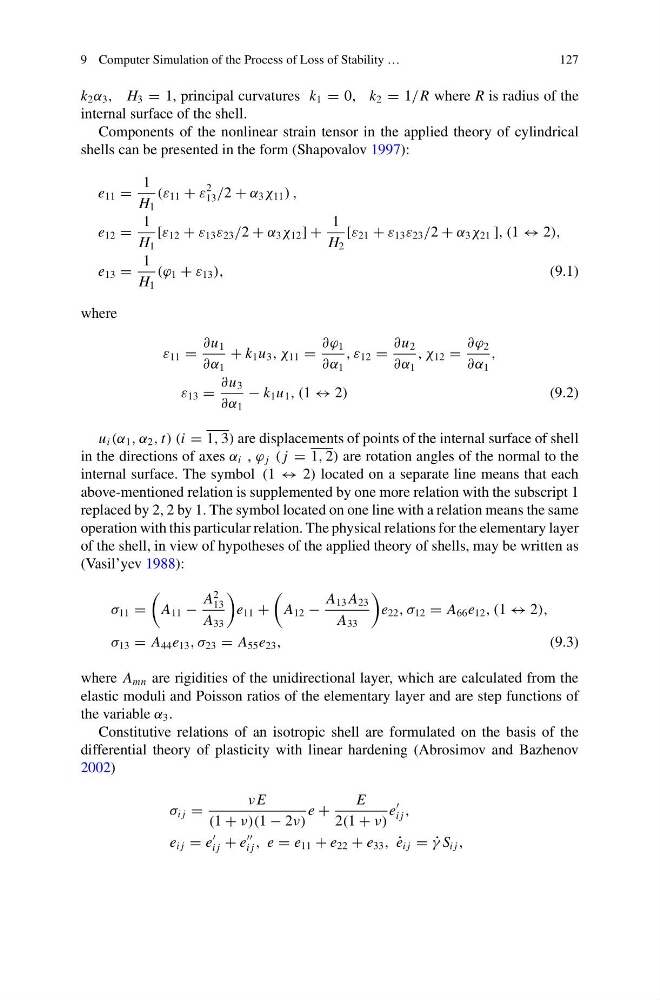
Components of the nonlinear strain tensor in the applied theory of cylindrical
shells can be presented in the form (Shapovalov 1997):
e 11 =
1
H 1
(ε 11 + ε
2
13 /2 + α 3 χ 11 ) ,
e 12 =
1
H 1
[ε 12 + ε 13 ε 23 /2 + α 3 χ 12 ] +
1
H 2
[ε 21 + ε 13 ε 23 /2 + α 3 χ 21 ], (1 ↔ 2),
e 13 =
1
H 1
(ϕ 1 + ε 13 ),
(9.1)
where
ε 11 =
∂u 1
∂α 1
+ k 1 u 3 , χ 11 =
∂ϕ 1
∂α 1
, ε 12 =
∂u 2
∂α 1
, χ 12 =
∂ϕ 2
∂α 1
,
ε 13 =
∂u 3
∂α 1
− k 1 u 1 , (1 ↔ 2)
(9.2)
u i (α 1 , α 2 , t) (i = 1, 3) are displacements of points of the internal surface of shell
in the directions of axes α i , ϕ j ( j = 1, 2) are rotation angles of the normal to the
internal surface. The symbol (1 ↔ 2) located on a separate line means that each
above-mentioned relation is supplemented by one more relation with the subscript 1
replaced by 2, 2 by 1. The symbol located on one line with a relation means the same
operation with this particular relation. The physical relations for the elementary layer
of the shell, in view of hypotheses of the applied theory of shells, may be written as
(Vasil’yev 1988):
σ 11 =
A 11 −
A
2
13
A 33
e 11 +
A 12 −
A 13 A 23
A 33
e 22 , σ 12 = A 66 e 12 , (1 ↔ 2),
σ 13 = A 44 e 13 , σ 23 = A 55 e 23 ,
(9.3)
where A mn are rigidities of the unidirectional layer, which are calculated from the
elastic moduli and Poisson ratios of the elementary layer and are step functions of
the variable α 3 .
Constitutive relations of an isotropic shell are formulated on the basis of the
differential theory of plasticity with linear hardening (Abrosimov and Bazhenov
2002)
σ i j =
ν E
(1 + ν)(1 − 2ν)
e +
E
2(1 + ν)
e
i j ,
e i j = e
i j + e
i j , e = e 11 + e 22 + e 33 , ˙
e i j = ˙
γ S i j ,
127
k 2 α 3 , H 3 = 1, principal curvatures k 1 = 0, k 2 = 1/R where R is radius of the
internal surface of the shell.
Components of the nonlinear strain tensor in the applied theory of cylindrical
shells can be presented in the form (Shapovalov 1997):
e 11 =
1
H 1
(ε 11 + ε
2
13 /2 + α 3 χ 11 ) ,
e 12 =
1
H 1
[ε 12 + ε 13 ε 23 /2 + α 3 χ 12 ] +
1
H 2
[ε 21 + ε 13 ε 23 /2 + α 3 χ 21 ], (1 ↔ 2),
e 13 =
1
H 1
(ϕ 1 + ε 13 ),
(9.1)
where
ε 11 =
∂u 1
∂α 1
+ k 1 u 3 , χ 11 =
∂ϕ 1
∂α 1
, ε 12 =
∂u 2
∂α 1
, χ 12 =
∂ϕ 2
∂α 1
,
ε 13 =
∂u 3
∂α 1
− k 1 u 1 , (1 ↔ 2)
(9.2)
u i (α 1 , α 2 , t) (i = 1, 3) are displacements of points of the internal surface of shell
in the directions of axes α i , ϕ j ( j = 1, 2) are rotation angles of the normal to the
internal surface. The symbol (1 ↔ 2) located on a separate line means that each
above-mentioned relation is supplemented by one more relation with the subscript 1
replaced by 2, 2 by 1. The symbol located on one line with a relation means the same
operation with this particular relation. The physical relations for the elementary layer
of the shell, in view of hypotheses of the applied theory of shells, may be written as
(Vasil’yev 1988):
σ 11 =
A 11 −
A
2
13
A 33
e 11 +
A 12 −
A 13 A 23
A 33
e 22 , σ 12 = A 66 e 12 , (1 ↔ 2),
σ 13 = A 44 e 13 , σ 23 = A 55 e 23 ,
(9.3)
where A mn are rigidities of the unidirectional layer, which are calculated from the
elastic moduli and Poisson ratios of the elementary layer and are step functions of
the variable α 3 .
Constitutive relations of an isotropic shell are formulated on the basis of the
differential theory of plasticity with linear hardening (Abrosimov and Bazhenov
2002)
σ i j =
ν E
(1 + ν)(1 − 2ν)
e +
E
2(1 + ν)
e
i j ,
e i j = e
i j + e
i j , e = e 11 + e 22 + e 33 , ˙
e i j = ˙
γ S i j ,