

C hapter 3 the Design Context
70
3.4 the Design anD
DeVelopMent proCess
the overall Development process
Typical product development processes may be generally thought
of as occurring in several broad steps: definition of design needs or
requirements, concept development, concept and preliminary
design, design development, preproduction prototyping and evaluation, and production design. The design process does not necessarily march so literally from one step to another without a backward
look. Good design work often comes from processes characterized
as being the result of convergent back and forth iterations. Wellreceived design proposals are typically those that both meet functional requirements and have the kinds of design appeal with
respect to both visual and user interface qualities that have long
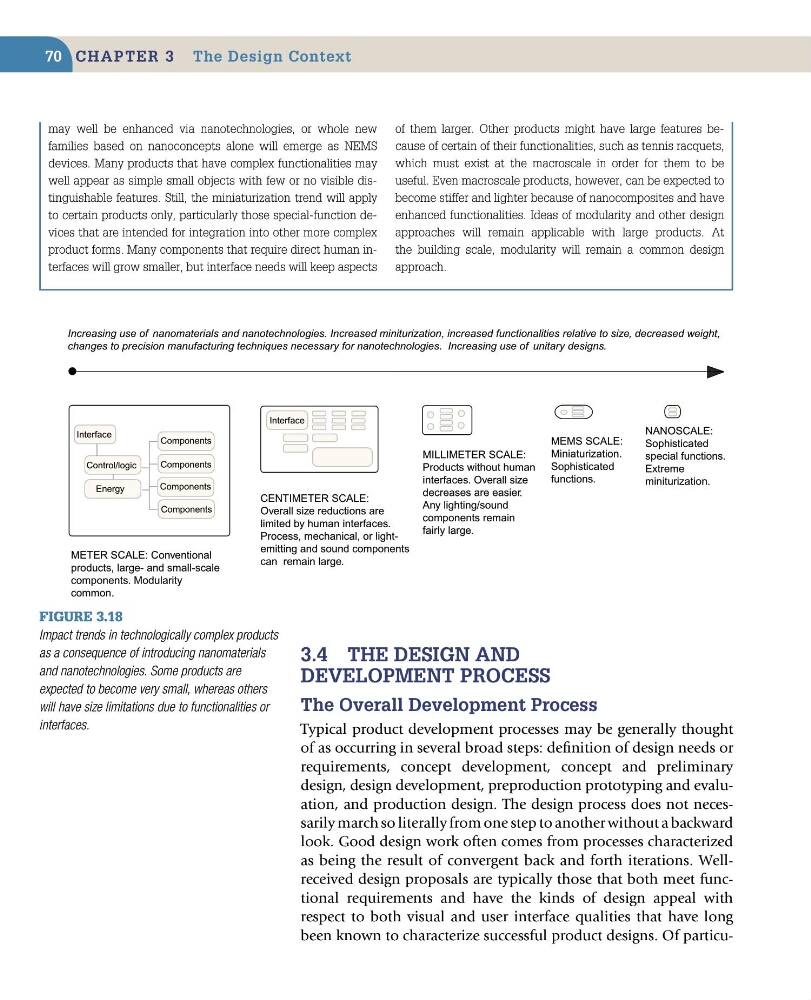
been known to characterize successful product designs. Of particumay well be enhanced via nanotechnologies, or whole new
families based on nanoconcepts alone will emerge as NEMS
devices. Many products that have complex functionalities may
well appear as simple small objects with few or no visible distinguishable features. Still, the miniaturization trend will apply
to certain products only, particularly those special-function devices that are intended for integration into other more complex
product forms. Many components that require direct human interfaces will grow smaller, but interface needs will keep aspects
of them larger. Other products might have large features because of certain of their functionalities, such as tennis racquets,
which must exist at the macroscale in order for them to be
useful. Even macroscale products, however, can be expected to
become stiffer and lighter because of nanocomposites and have
enhanced functionalities. Ideas of modularity and other design
approaches will remain applicable with large products. At
the building scale, modularity will remain a common design
approach.
Figure 3.18
Impact trends in technologically complex products
as a consequence of introducing nanomaterials
and nanotechnologies. Some products are
expected to become very small, whereas others
will have size limitations due to functionalities or
interfaces.
Interface
MEMS SCALE:
Miniaturization.
Sophisticated
functions.
NANOSCALE:
Sophisticated
special functions.
Extreme
miniturization.
MILLIMETER SCALE:
Products without human
interfaces. Overall size
decreases are easier.
Any lighting/sound
components remain
fairly large.
METER SCALE: Conventional
products, large- and small-scale
components. Modularity
common.
Increasing use of nanomaterials and nanotechnologies. Increased miniturization, increased functionalities relative to size, decreased weight,
changes to precision manufacturing techniques necessary for nanotechnologies. Increasing use of unitary designs.
Interface
Control/logic
Components
Energy
Components
Components
Components
CENTIMETER SCALE:
Overall size reductions are
limited by human interfaces.
Process, mechanical, or lightemitting and sound components
can remain large.
70
3.4 the Design anD
DeVelopMent proCess
the overall Development process
Typical product development processes may be generally thought
of as occurring in several broad steps: definition of design needs or
requirements, concept development, concept and preliminary
design, design development, preproduction prototyping and evaluation, and production design. The design process does not necessarily march so literally from one step to another without a backward
look. Good design work often comes from processes characterized
as being the result of convergent back and forth iterations. Wellreceived design proposals are typically those that both meet functional requirements and have the kinds of design appeal with
respect to both visual and user interface qualities that have long
been known to characterize successful product designs. Of particumay well be enhanced via nanotechnologies, or whole new
families based on nanoconcepts alone will emerge as NEMS
devices. Many products that have complex functionalities may
well appear as simple small objects with few or no visible distinguishable features. Still, the miniaturization trend will apply
to certain products only, particularly those special-function devices that are intended for integration into other more complex
product forms. Many components that require direct human interfaces will grow smaller, but interface needs will keep aspects
of them larger. Other products might have large features because of certain of their functionalities, such as tennis racquets,
which must exist at the macroscale in order for them to be
useful. Even macroscale products, however, can be expected to
become stiffer and lighter because of nanocomposites and have
enhanced functionalities. Ideas of modularity and other design
approaches will remain applicable with large products. At
the building scale, modularity will remain a common design
approach.
Figure 3.18
Impact trends in technologically complex products
as a consequence of introducing nanomaterials
and nanotechnologies. Some products are
expected to become very small, whereas others
will have size limitations due to functionalities or
interfaces.
Interface
MEMS SCALE:
Miniaturization.
Sophisticated
functions.
NANOSCALE:
Sophisticated
special functions.
Extreme
miniturization.
MILLIMETER SCALE:
Products without human
interfaces. Overall size
decreases are easier.
Any lighting/sound
components remain
fairly large.
METER SCALE: Conventional
products, large- and small-scale
components. Modularity
common.
Increasing use of nanomaterials and nanotechnologies. Increased miniturization, increased functionalities relative to size, decreased weight,
changes to precision manufacturing techniques necessary for nanotechnologies. Increasing use of unitary designs.
Interface
Control/logic
Components
Energy
Components
Components
Components
CENTIMETER SCALE:
Overall size reductions are
limited by human interfaces.
Process, mechanical, or lightemitting and sound components
can remain large.