

69
is most optimal for the performance of the whole design. Following this objective can result in tight designs with little redundancy and high performance. Shapes can become highly complex
and derivative of the need to integrate all systems together (normally in a closely packed arrangement). These same holistic
design strategies often make replacement of components difficult
in a unitary design and correspondingly can potentially make
upgrades and maintenance concerns much more difficult as well.
Whole units may well have to be replaced for even simple
upgrades (albeit this is already a common trend in microelectronics and other fields that has proven acceptable to the
market).
For many products there have been increasing pushes toward
smallness. This is particularly true for sensors, chips, and other
electronic devices that are commonly integrated into some larger
product form. This push has long been under way and has led to
some remarkable technological developments in the form of
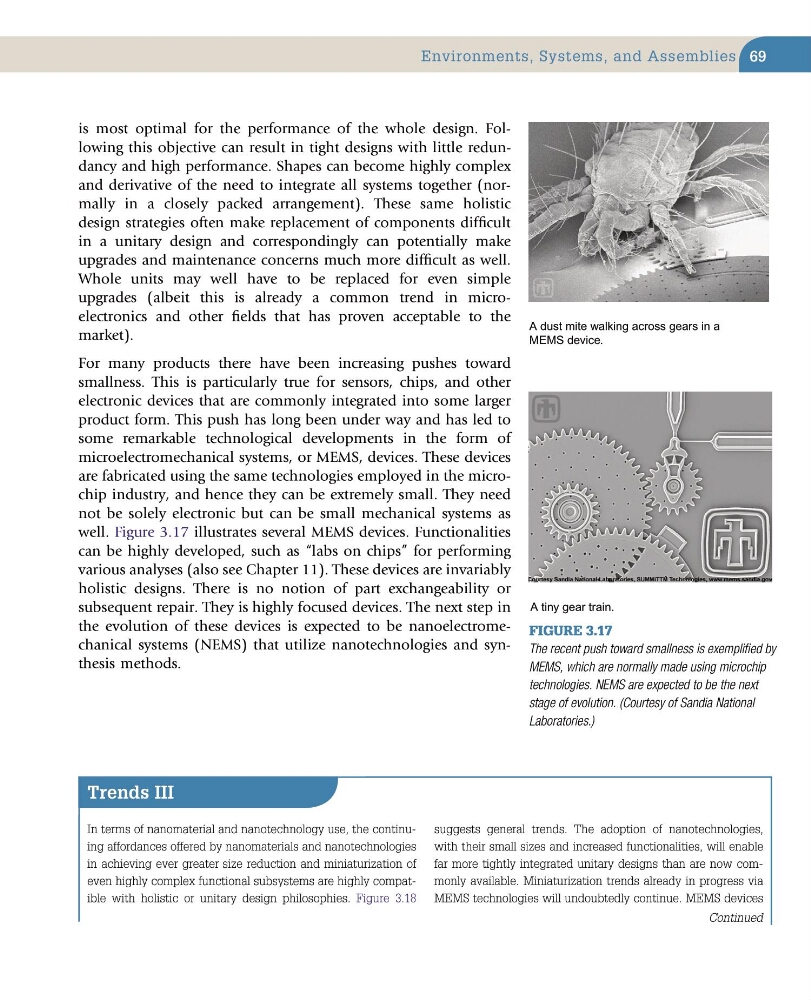
microelectromechanical systems, or MEMS, devices. These devices
are fabricated using the same technologies employed in the microchip industry, and hence they can be extremely small. They need
not be solely electronic but can be small mechanical systems as
well. Figure 3.17 illustrates several MEMS devices. Functionalities
can be highly developed, such as “labs on chips” for performing
various analyses (also see Chapter 11). These devices are invariably
holistic designs. There is no notion of part exchangeability or
subsequent repair. They is highly focused devices. The next step in
the evolution of these devices is expected to be nanoelectromechanical systems (NEMS) that utilize nanotechnologies and synthesis methods.
Figure 3.17
The recent push toward smallness is exemplified by
MEMS, which are normally made using microchip
technologies. NEMS are expected to be the next
stage of evolution. (Courtesy of Sandia National
Laboratories.)
A dust mite walking across gears in a
MEMS device.
A tiny gear train.
In terms of nanomaterial and nanotechnology use, the continuing affordances offered by nanomaterials and nanotechnologies
in achieving ever greater size reduction and miniaturization of
even highly complex functional subsystems are highly compatible with holistic or unitary design philosophies. Figure 3.18
suggests general trends. The adoption of nanotechnologies,
with their small sizes and increased functionalities, will enable
far more tightly integrated unitary designs than are now commonly available. Miniaturization trends already in progress via
MEMS technologies will undoubtedly continue. MEMS devices
trends iii
Continued
Environments, Systems, and Assemblies
is most optimal for the performance of the whole design. Following this objective can result in tight designs with little redundancy and high performance. Shapes can become highly complex
and derivative of the need to integrate all systems together (normally in a closely packed arrangement). These same holistic
design strategies often make replacement of components difficult
in a unitary design and correspondingly can potentially make
upgrades and maintenance concerns much more difficult as well.
Whole units may well have to be replaced for even simple
upgrades (albeit this is already a common trend in microelectronics and other fields that has proven acceptable to the
market).
For many products there have been increasing pushes toward
smallness. This is particularly true for sensors, chips, and other
electronic devices that are commonly integrated into some larger
product form. This push has long been under way and has led to
some remarkable technological developments in the form of
microelectromechanical systems, or MEMS, devices. These devices
are fabricated using the same technologies employed in the microchip industry, and hence they can be extremely small. They need
not be solely electronic but can be small mechanical systems as
well. Figure 3.17 illustrates several MEMS devices. Functionalities
can be highly developed, such as “labs on chips” for performing
various analyses (also see Chapter 11). These devices are invariably
holistic designs. There is no notion of part exchangeability or
subsequent repair. They is highly focused devices. The next step in
the evolution of these devices is expected to be nanoelectromechanical systems (NEMS) that utilize nanotechnologies and synthesis methods.
Figure 3.17
The recent push toward smallness is exemplified by
MEMS, which are normally made using microchip
technologies. NEMS are expected to be the next
stage of evolution. (Courtesy of Sandia National
Laboratories.)
A dust mite walking across gears in a
MEMS device.
A tiny gear train.
In terms of nanomaterial and nanotechnology use, the continuing affordances offered by nanomaterials and nanotechnologies
in achieving ever greater size reduction and miniaturization of
even highly complex functional subsystems are highly compatible with holistic or unitary design philosophies. Figure 3.18
suggests general trends. The adoption of nanotechnologies,
with their small sizes and increased functionalities, will enable
far more tightly integrated unitary designs than are now commonly available. Miniaturization trends already in progress via
MEMS technologies will undoubtedly continue. MEMS devices
trends iii
Continued
Environments, Systems, and Assemblies