

C hapter 3 the Design Context
68
use of a prespecified dimensional array (typically in the form of
integral multiples of given dimensions) that serves to define the
sizes and locations of all parts and subassemblies (locations of
connection or interface points are often predefined as well). This
latter physically based approach is widely used in many diverse
fields. In building design, this approach is widely used in
connection with prefabricated building elements, whereas in
electronics the same conceptual approach is used to structure the
sizes and shapes of electronic devices to go on larger circuit
boards. This physically based notion of modular design is
extremely important when it comes to manufacturing and
assembly and can literally define the maximum “envelope” and
location of “connectivity” points that a designer of any component must respect. In many physical approaches, there is often
a literal supporting physical infrastructure (e.g., the board with
the holes in largely modularly designed electronic devices) that
provides a rationalized support system. Connective systems that
are usually primarily functionally defined are used to link one
module to another.
This modular approach clearly places a premium on the potential
positive benefits associated with design ease and rationality, the
potential for easy product variety and upgrades (vis-à-vis module
interchangeability capabilities), direct maintenance (in the form
of access and component replaceability), and straightforward
manufacturing and assembly. The whole must obviously be made
to work functionally. However, there is nothing implicit in the
modular approach that a priori guarantees ideal part or component
locations with respect to functional or use issues. In poor modular
designs, there can be high redundancy, the need for additional
support and infrastructure elements, and sometimes a loss in ideal
performance.
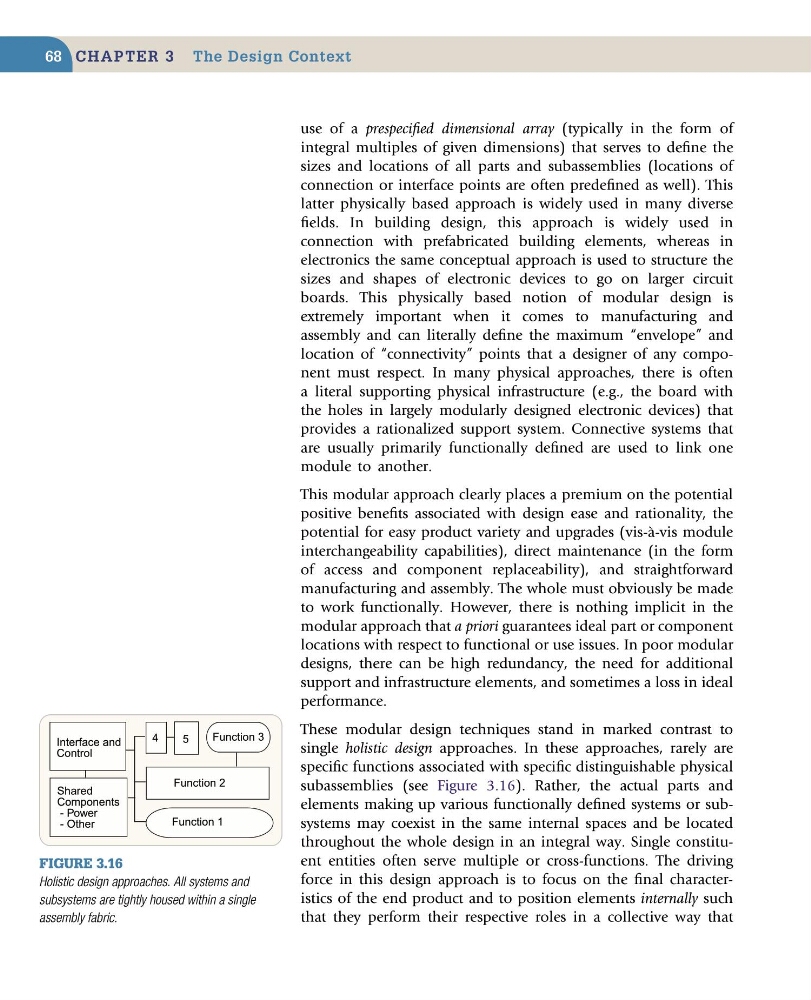
These modular design techniques stand in marked contrast to
single holistic design approaches. In these approaches, rarely are
specific functions associated with specific distinguishable physical
subassemblies (see Figure 3.16). Rather, the actual parts and
elements making up various functionally defined systems or subsystems may coexist in the same internal spaces and be located
throughout the whole design in an integral way. Single constituent entities often serve multiple or cross-functions. The driving
force in this design approach is to focus on the final characteristics of the end product and to position elements internally such
that they perform their respective roles in a collective way that
Figure 3.16
Holistic design approaches. All systems and
subsystems are tightly housed within a single
assembly fabric.
Function 1
Function 2
Function 3
4
5
Shared
Components
- Power
- Other
Interface and
Control
68
use of a prespecified dimensional array (typically in the form of
integral multiples of given dimensions) that serves to define the
sizes and locations of all parts and subassemblies (locations of
connection or interface points are often predefined as well). This
latter physically based approach is widely used in many diverse
fields. In building design, this approach is widely used in
connection with prefabricated building elements, whereas in
electronics the same conceptual approach is used to structure the
sizes and shapes of electronic devices to go on larger circuit
boards. This physically based notion of modular design is
extremely important when it comes to manufacturing and
assembly and can literally define the maximum “envelope” and
location of “connectivity” points that a designer of any component must respect. In many physical approaches, there is often
a literal supporting physical infrastructure (e.g., the board with
the holes in largely modularly designed electronic devices) that
provides a rationalized support system. Connective systems that
are usually primarily functionally defined are used to link one
module to another.
This modular approach clearly places a premium on the potential
positive benefits associated with design ease and rationality, the
potential for easy product variety and upgrades (vis-à-vis module
interchangeability capabilities), direct maintenance (in the form
of access and component replaceability), and straightforward
manufacturing and assembly. The whole must obviously be made
to work functionally. However, there is nothing implicit in the
modular approach that a priori guarantees ideal part or component
locations with respect to functional or use issues. In poor modular
designs, there can be high redundancy, the need for additional
support and infrastructure elements, and sometimes a loss in ideal
performance.
These modular design techniques stand in marked contrast to
single holistic design approaches. In these approaches, rarely are
specific functions associated with specific distinguishable physical
subassemblies (see Figure 3.16). Rather, the actual parts and
elements making up various functionally defined systems or subsystems may coexist in the same internal spaces and be located
throughout the whole design in an integral way. Single constituent entities often serve multiple or cross-functions. The driving
force in this design approach is to focus on the final characteristics of the end product and to position elements internally such
that they perform their respective roles in a collective way that
Figure 3.16
Holistic design approaches. All systems and
subsystems are tightly housed within a single
assembly fabric.
Function 1
Function 2
Function 3
4
5
Shared
Components
- Power
- Other
Interface and
Control