

67
unitary and Modular Design approaches to
systems and assemblies
Determining appropriate relationships between functionally
driven and physically driven design responses is one of the major
tasks of a designer. There are design choices that can be
made about how specific functions may be assigned to particular
physical parts or subassemblies, or, alternatively, distributed
among several. Pursuing one or another direction has dramatic
implications on the resulting qualities of the design and the
way it is ultimately produced. Here we look at consequences of
carrying one or the other of these approaches to an extreme. The
broad distinction introduced here is between two general design
approaches. In the first approach, holistic designs evolve from a
systemic arrangement of discrete but interactive modules
that house particular functions and/or that have particular
standardized geometries. In the second approach, the overall
design is carefully built up as a single whole and without subassemblies or components that are easily or necessarily distinguishable as such.
First, it is useful to consider what is meant by the term module
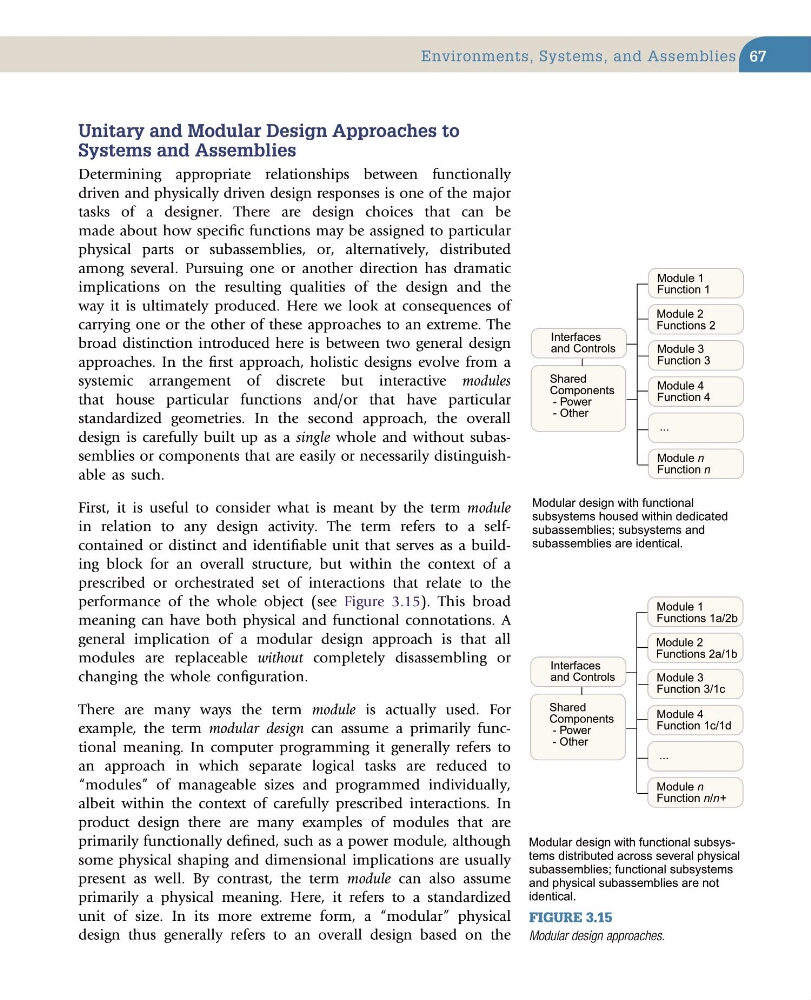
in relation to any design activity. The term refers to a selfcontained or distinct and identifiable unit that serves as a building block for an overall structure, but within the context of a
prescribed or orchestrated set of interactions that relate to the
performance of the whole object (see Figure 3.15). This broad
meaning can have both physical and functional connotations. A
general implication of a modular design approach is that all
modules are replaceable without completely disassembling or
changing the whole configuration.
There are many ways the term module is actually used. For
example, the term modular design can assume a primarily functional meaning. In computer programming it generally refers to
an approach in which separate logical tasks are reduced to
“modules” of manageable sizes and programmed individually,
albeit within the context of carefully prescribed interactions. In
product design there are many examples of modules that are
primarily functionally defined, such as a power module, although
some physical shaping and dimensional implications are usually
present as well. By contrast, the term module can also assume
primarily a physical meaning. Here, it refers to a standardized
unit of size. In its more extreme form, a “modular” physical
design thus generally refers to an overall design based on the
Figure 3.15
Modular design approaches.
Module 1
Functions 1a/2b
Module 2
Functions 2a/1b
Module 3
Function 3/1c
Module 4
Function 1c/1d
Module n
Function n/n+
...
Interfaces
and Controls
Shared
Components
- Power
- Other
Module 1
Function 1
Module 2
Functions 2
Module 3
Function 3
Module 4
Function 4
Module n
Function n
...
Interfaces
and Controls
Shared
Components
- Power
- Other
Modular design with functional
subsystems housed within dedicated
subassemblies; subsystems and
subassemblies are identical.
Modular design with functional subsystems distributed across several physical
subassemblies; functional subsystems
and physical subassemblies are not
identical.
Environments, Systems, and Assemblies
unitary and Modular Design approaches to
systems and assemblies
Determining appropriate relationships between functionally
driven and physically driven design responses is one of the major
tasks of a designer. There are design choices that can be
made about how specific functions may be assigned to particular
physical parts or subassemblies, or, alternatively, distributed
among several. Pursuing one or another direction has dramatic
implications on the resulting qualities of the design and the
way it is ultimately produced. Here we look at consequences of
carrying one or the other of these approaches to an extreme. The
broad distinction introduced here is between two general design
approaches. In the first approach, holistic designs evolve from a
systemic arrangement of discrete but interactive modules
that house particular functions and/or that have particular
standardized geometries. In the second approach, the overall
design is carefully built up as a single whole and without subassemblies or components that are easily or necessarily distinguishable as such.
First, it is useful to consider what is meant by the term module
in relation to any design activity. The term refers to a selfcontained or distinct and identifiable unit that serves as a building block for an overall structure, but within the context of a
prescribed or orchestrated set of interactions that relate to the
performance of the whole object (see Figure 3.15). This broad
meaning can have both physical and functional connotations. A
general implication of a modular design approach is that all
modules are replaceable without completely disassembling or
changing the whole configuration.
There are many ways the term module is actually used. For
example, the term modular design can assume a primarily functional meaning. In computer programming it generally refers to
an approach in which separate logical tasks are reduced to
“modules” of manageable sizes and programmed individually,
albeit within the context of carefully prescribed interactions. In
product design there are many examples of modules that are
primarily functionally defined, such as a power module, although
some physical shaping and dimensional implications are usually
present as well. By contrast, the term module can also assume
primarily a physical meaning. Here, it refers to a standardized
unit of size. In its more extreme form, a “modular” physical
design thus generally refers to an overall design based on the
Figure 3.15
Modular design approaches.
Module 1
Functions 1a/2b
Module 2
Functions 2a/1b
Module 3
Function 3/1c
Module 4
Function 1c/1d
Module n
Function n/n+
...
Interfaces
and Controls
Shared
Components
- Power
- Other
Module 1
Function 1
Module 2
Functions 2
Module 3
Function 3
Module 4
Function 4
Module n
Function n
...
Interfaces
and Controls
Shared
Components
- Power
- Other
Modular design with functional
subsystems housed within dedicated
subassemblies; subsystems and
subassemblies are identical.
Modular design with functional subsystems distributed across several physical
subassemblies; functional subsystems
and physical subassemblies are not
identical.
Environments, Systems, and Assemblies