

C hapter 3 the Design Context
66
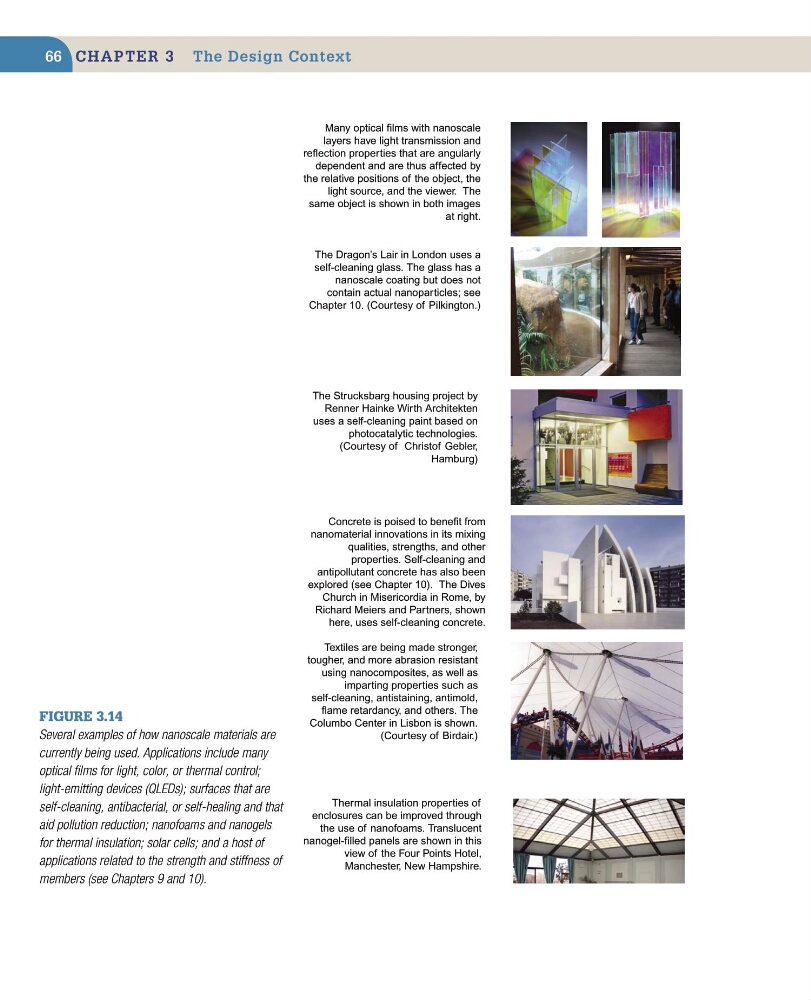
Figure 3.14
Several examples of how nanoscale materials are
currently being used. Applications include many
optical films for light, color, or thermal control;
light-emitting devices (QLEDs); surfaces that are
self-cleaning, antibacterial, or self-healing and that
aid pollution reduction; nanofoams and nanogels
for thermal insulation; solar cells; and a host of
applications related to the strength and stiffness of
members (see Chapters 9 and 10).
Many optical films with nanoscale
layers have light transmission and
reflection properties that are angularly
dependent and are thus affected by
the relative positions of the object, the
light source, and the viewer. The
same object is shown in both images
at right.
The Dragon’s Lair in London uses a
self-cleaning glass. The glass has a
nanoscale coating but does not
contain actual nanoparticles; see
Chapter 10. (Courtesy of Pilkington.)
The Strucksbarg housing project by
Renner Hainke Wirth Architekten
uses a self-cleaning paint based on
photocatalytic technologies.
(Courtesy of Christof Gebler,
Hamburg)
Concrete is poised to benefit from
nanomaterial innovations in its mixing
qualities, strengths, and other
properties. Self-cleaning and
antipollutant concrete has also been
explored (see Chapter 10). The Dives
Church in Misericordia in Rome, by
Richard Meiers and Partners, shown
here, uses self-cleaning concrete.
Textiles are being made stronger,
tougher, and more abrasion resistant
using nanocomposites, as well as
imparting properties such as
self-cleaning, antistaining, antimold,
flame retardancy, and others. The
Columbo Center in Lisbon is shown.
(Courtesy of Birdair.)
Thermal insulation properties of
enclosures can be improved through
the use of nanofoams. Translucent
nanogel-filled panels are shown in this
view of the Four Points Hotel,
Manchester, New Hampshire.
66
Figure 3.14
Several examples of how nanoscale materials are
currently being used. Applications include many
optical films for light, color, or thermal control;
light-emitting devices (QLEDs); surfaces that are
self-cleaning, antibacterial, or self-healing and that
aid pollution reduction; nanofoams and nanogels
for thermal insulation; solar cells; and a host of
applications related to the strength and stiffness of
members (see Chapters 9 and 10).
Many optical films with nanoscale
layers have light transmission and
reflection properties that are angularly
dependent and are thus affected by
the relative positions of the object, the
light source, and the viewer. The
same object is shown in both images
at right.
The Dragon’s Lair in London uses a
self-cleaning glass. The glass has a
nanoscale coating but does not
contain actual nanoparticles; see
Chapter 10. (Courtesy of Pilkington.)
The Strucksbarg housing project by
Renner Hainke Wirth Architekten
uses a self-cleaning paint based on
photocatalytic technologies.
(Courtesy of Christof Gebler,
Hamburg)
Concrete is poised to benefit from
nanomaterial innovations in its mixing
qualities, strengths, and other
properties. Self-cleaning and
antipollutant concrete has also been
explored (see Chapter 10). The Dives
Church in Misericordia in Rome, by
Richard Meiers and Partners, shown
here, uses self-cleaning concrete.
Textiles are being made stronger,
tougher, and more abrasion resistant
using nanocomposites, as well as
imparting properties such as
self-cleaning, antistaining, antimold,
flame retardancy, and others. The
Columbo Center in Lisbon is shown.
(Courtesy of Birdair.)
Thermal insulation properties of
enclosures can be improved through
the use of nanofoams. Translucent
nanogel-filled panels are shown in this
view of the Four Points Hotel,
Manchester, New Hampshire.