

65
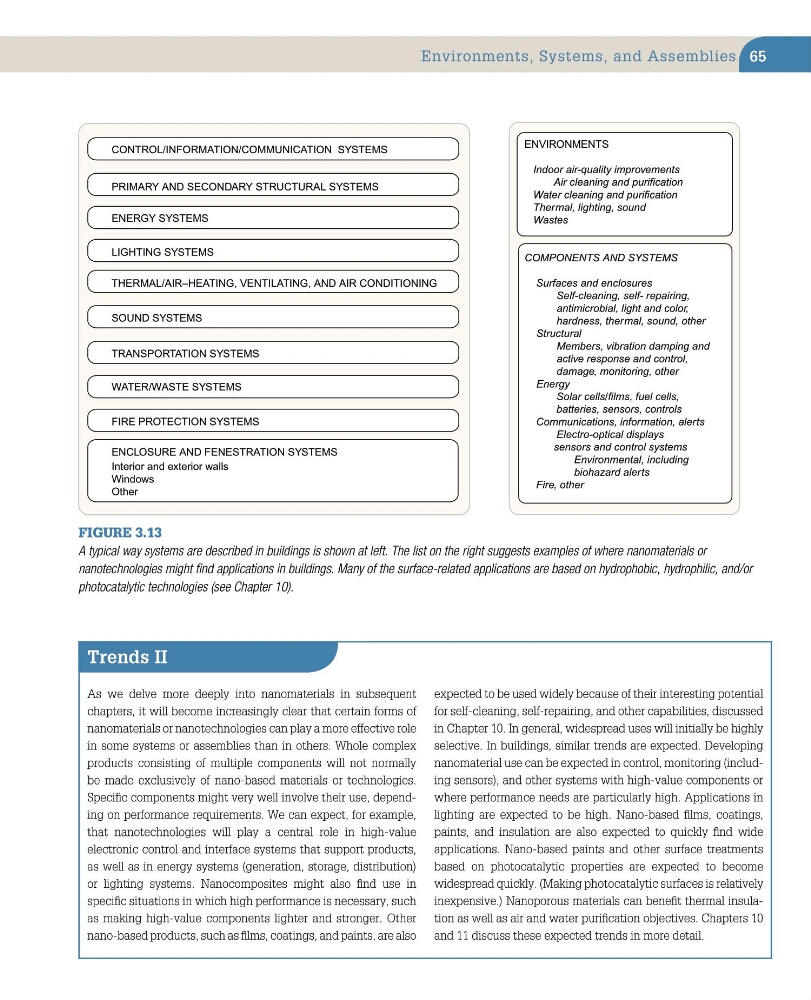
Figure 3.13
A typical way systems are described in buildings is shown at left. The list on the right suggests examples of where nanomaterials or
nanotechnologies might find applications in buildings. Many of the surface-related applications are based on hydrophobic, hydrophilic, and/or
photocatalytic technologies (see Chapter 10).
PRIMARY AND SECONDARY STRUCTURAL SYSTEMS
ENERGY SYSTEMS
THERMAL/AIR–HEATING, VENTILATING, AND AIR CONDITIONING
Interior and exterior walls
Windows
Other
ENCLOSURE AND FENESTRATION SYSTEMS
LIGHTING SYSTEMS
WATER/WASTE SYSTEMS
FIRE PROTECTION SYSTEMS
TRANSPORTATION SYSTEMS
CONTROL/INFORMATION/COMMUNICATION SYSTEMS
SOUND SYSTEMS
ENVIRONMENTS
Indoor air-quality improvements
Air cleaning and purification
Water cleaning and purification
Thermal, lighting, sound
Wastes
COMPONENTS AND SYSTEMS
Surfaces and enclosures
Self-cleaning, self- repairing,
antimicrobial, light and color,
hardness, thermal, sound, other
Structural
Members, vibration damping and
active response and control,
damage, monitoring, other
Energy
Solar cells/films, fuel cells,
batteries, sensors, controls
Communications, information, alerts
Electro-optical displays
sensors and control systems
Environmental, including
biohazard alerts
Fire, other
As we delve more deeply into nanomaterials in subsequent
chapters, it will become increasingly clear that certain forms of
nano materials or nanotechnologies can play a more effective role
in some systems or assemblies than in others. Whole complex
products consisting of multiple components will not normally
be made exclusively of nano-based materials or technologies.
Specific components might very well involve their use, depending on performance requirements. We can expect, for example,
that nanotechnologies will play a central role in high-value
electronic control and interface systems that support products,
as well as in energy systems (generation, storage, distribution)
or lighting systems. Nanocomposites might also find use in
specific situations in which high performance is necessary, such
as making high-value components lighter and stronger. Other
nano-based products, such as films, coatings, and paints, are also
expected to be used widely because of their interesting potential
for self-cleaning, self-repairing, and other capabilities, discussed
in Chapter 10. In general, widespread uses will initially be highly
selective. In buildings, similar trends are expected. Developing
nanomaterial use can be expected in control, monitoring (including sensors), and other systems with high-value components or
where performance needs are particularly high. Applications in
lighting are expected to be high. Nano-based films, coatings,
paints, and insulation are also expected to quickly find wide
applications. Nano-based paints and other surface treatments
based on photocatalytic properties are expected to become
widespread quickly. (Making photocatalytic surfaces is relatively
inexpensive.) Nanoporous materials can benefit thermal insulation as well as air and water purification objectives. Chapters 10
and 11 discuss these expected trends in more detail.
trends ii
Environments, Systems, and Assemblies
Figure 3.13
A typical way systems are described in buildings is shown at left. The list on the right suggests examples of where nanomaterials or
nanotechnologies might find applications in buildings. Many of the surface-related applications are based on hydrophobic, hydrophilic, and/or
photocatalytic technologies (see Chapter 10).
PRIMARY AND SECONDARY STRUCTURAL SYSTEMS
ENERGY SYSTEMS
THERMAL/AIR–HEATING, VENTILATING, AND AIR CONDITIONING
Interior and exterior walls
Windows
Other
ENCLOSURE AND FENESTRATION SYSTEMS
LIGHTING SYSTEMS
WATER/WASTE SYSTEMS
FIRE PROTECTION SYSTEMS
TRANSPORTATION SYSTEMS
CONTROL/INFORMATION/COMMUNICATION SYSTEMS
SOUND SYSTEMS
ENVIRONMENTS
Indoor air-quality improvements
Air cleaning and purification
Water cleaning and purification
Thermal, lighting, sound
Wastes
COMPONENTS AND SYSTEMS
Surfaces and enclosures
Self-cleaning, self- repairing,
antimicrobial, light and color,
hardness, thermal, sound, other
Structural
Members, vibration damping and
active response and control,
damage, monitoring, other
Energy
Solar cells/films, fuel cells,
batteries, sensors, controls
Communications, information, alerts
Electro-optical displays
sensors and control systems
Environmental, including
biohazard alerts
Fire, other
As we delve more deeply into nanomaterials in subsequent
chapters, it will become increasingly clear that certain forms of
nano materials or nanotechnologies can play a more effective role
in some systems or assemblies than in others. Whole complex
products consisting of multiple components will not normally
be made exclusively of nano-based materials or technologies.
Specific components might very well involve their use, depending on performance requirements. We can expect, for example,
that nanotechnologies will play a central role in high-value
electronic control and interface systems that support products,
as well as in energy systems (generation, storage, distribution)
or lighting systems. Nanocomposites might also find use in
specific situations in which high performance is necessary, such
as making high-value components lighter and stronger. Other
nano-based products, such as films, coatings, and paints, are also
expected to be used widely because of their interesting potential
for self-cleaning, self-repairing, and other capabilities, discussed
in Chapter 10. In general, widespread uses will initially be highly
selective. In buildings, similar trends are expected. Developing
nanomaterial use can be expected in control, monitoring (including sensors), and other systems with high-value components or
where performance needs are particularly high. Applications in
lighting are expected to be high. Nano-based films, coatings,
paints, and insulation are also expected to quickly find wide
applications. Nano-based paints and other surface treatments
based on photocatalytic properties are expected to become
widespread quickly. (Making photocatalytic surfaces is relatively
inexpensive.) Nanoporous materials can benefit thermal insulation as well as air and water purification objectives. Chapters 10
and 11 discuss these expected trends in more detail.
trends ii
Environments, Systems, and Assemblies