

C hapter 3 the Design Context
46
the synthetic material came almost immediately to be associated
with exciting new technological advances and wonderful new
emerging lifestyles that allowed broad connectivity to the world at
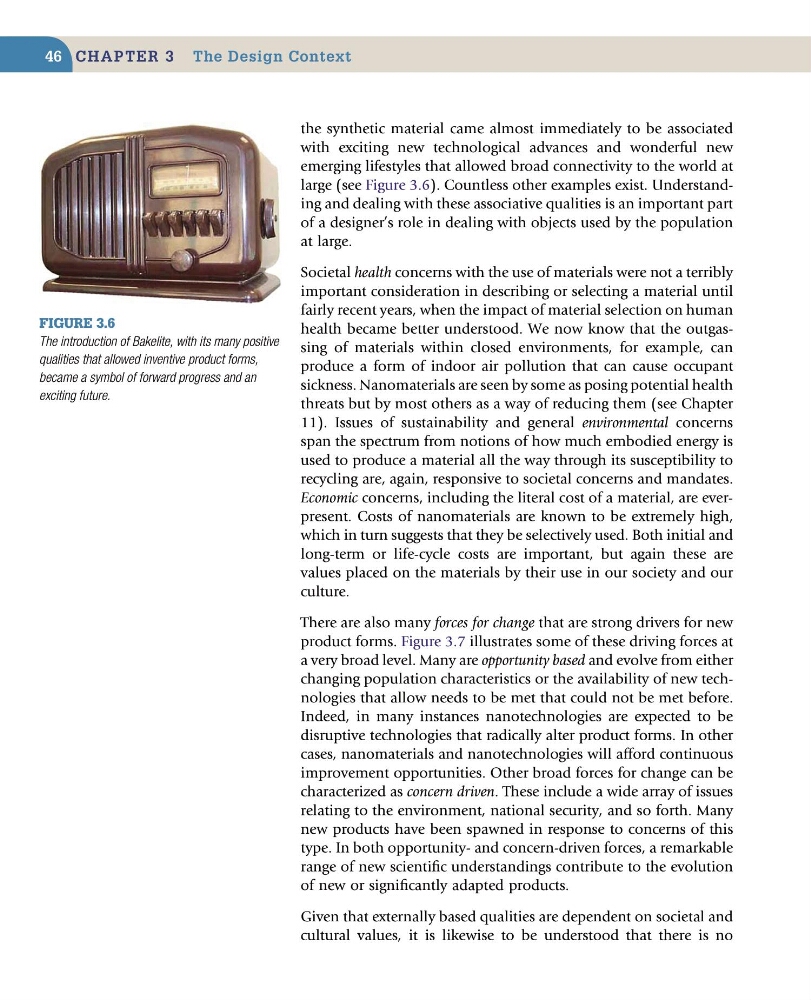
large (see Figure 3.6). Countless other examples exist. Understanding and dealing with these associative qualities is an important part
of a designer’s role in dealing with objects used by the population
at large.
Societal health concerns with the use of materials were not a terribly
important consideration in describing or selecting a material until
fairly recent years, when the impact of material selection on human
health became better understood. We now know that the outgassing of materials within closed environments, for example, can
produce a form of indoor air pollution that can cause occupant
sickness. Nanomaterials are seen by some as posing potential health
threats but by most others as a way of reducing them (see Chapter
11). Issues of sustainability and general environmental concerns
span the spectrum from notions of how much embodied energy is
used to produce a material all the way through its susceptibility to
recycling are, again, responsive to societal concerns and mandates.
Economic concerns, including the literal cost of a material, are everpresent. Costs of nanomaterials are known to be extremely high,
which in turn suggests that they be selectively used. Both initial and
long-term or life-cycle costs are important, but again these are
values placed on the materials by their use in our society and our
culture.
There are also many forces for change that are strong drivers for new
product forms. Figure 3.7 illustrates some of these driving forces at
a very broad level. Many are opportunity based and evolve from either
changing population characteristics or the availability of new technologies that allow needs to be met that could not be met before.
Indeed, in many instances nanotechnologies are expected to be
disruptive technologies that radically alter product forms. In other
cases, nanomaterials and nanotechnologies will afford continuous
improvement opportunities. Other broad forces for change can be
characterized as concern driven. These include a wide array of issues
relating to the environment, national security, and so forth. Many
new products have been spawned in response to concerns of this
type. In both opportunity- and concern-driven forces, a remarkable
range of new scientific understandings contribute to the evolution
of new or significantly adapted products.
Given that externally based qualities are dependent on societal and
cultural values, it is likewise to be understood that there is no
Figure 3.6
The introduction of Bakelite, with its many positive
qualities that allowed inventive product forms,
became a symbol of forward progress and an
exciting future.
46
the synthetic material came almost immediately to be associated
with exciting new technological advances and wonderful new
emerging lifestyles that allowed broad connectivity to the world at
large (see Figure 3.6). Countless other examples exist. Understanding and dealing with these associative qualities is an important part
of a designer’s role in dealing with objects used by the population
at large.
Societal health concerns with the use of materials were not a terribly
important consideration in describing or selecting a material until
fairly recent years, when the impact of material selection on human
health became better understood. We now know that the outgassing of materials within closed environments, for example, can
produce a form of indoor air pollution that can cause occupant
sickness. Nanomaterials are seen by some as posing potential health
threats but by most others as a way of reducing them (see Chapter
11). Issues of sustainability and general environmental concerns
span the spectrum from notions of how much embodied energy is
used to produce a material all the way through its susceptibility to
recycling are, again, responsive to societal concerns and mandates.
Economic concerns, including the literal cost of a material, are everpresent. Costs of nanomaterials are known to be extremely high,
which in turn suggests that they be selectively used. Both initial and
long-term or life-cycle costs are important, but again these are
values placed on the materials by their use in our society and our
culture.
There are also many forces for change that are strong drivers for new
product forms. Figure 3.7 illustrates some of these driving forces at
a very broad level. Many are opportunity based and evolve from either
changing population characteristics or the availability of new technologies that allow needs to be met that could not be met before.
Indeed, in many instances nanotechnologies are expected to be
disruptive technologies that radically alter product forms. In other
cases, nanomaterials and nanotechnologies will afford continuous
improvement opportunities. Other broad forces for change can be
characterized as concern driven. These include a wide array of issues
relating to the environment, national security, and so forth. Many
new products have been spawned in response to concerns of this
type. In both opportunity- and concern-driven forces, a remarkable
range of new scientific understandings contribute to the evolution
of new or significantly adapted products.
Given that externally based qualities are dependent on societal and
cultural values, it is likewise to be understood that there is no
Figure 3.6
The introduction of Bakelite, with its many positive
qualities that allowed inventive product forms,
became a symbol of forward progress and an
exciting future.