

47
uniform agreement on the relative importance of these different
qualities, as is evidenced by the intense societal debates that still
occur over recycling. Though reuse of materials has been accepted
as a value by broad segments of our society, anyone can still go into
any store and buy products that are fundamentally designed to be
cast away after use, made from materials deliberately chosen with
disposability rather than recycling in mind. These societal debates
are ultimately played out in very specific material choices. It is the
outcome of these debates over broad societal and cultural values,
however, that provides impetus for some of the greatest forces for
change in the development and selection of materials.
Design Focus
In thinking in more detail about how to use nanomaterials in a
design context, a first consideration is simply to define what is being
designed. In general, this book broadly addresses common products for everyday use as well as in architecture and related works.
In this section, we briefly review the characteristics of each field
separately. Ultimately, however, we will see that there are marked
similarities in the basic design processes and issues present in
each of these fields, despite the fact that there are also dramatic
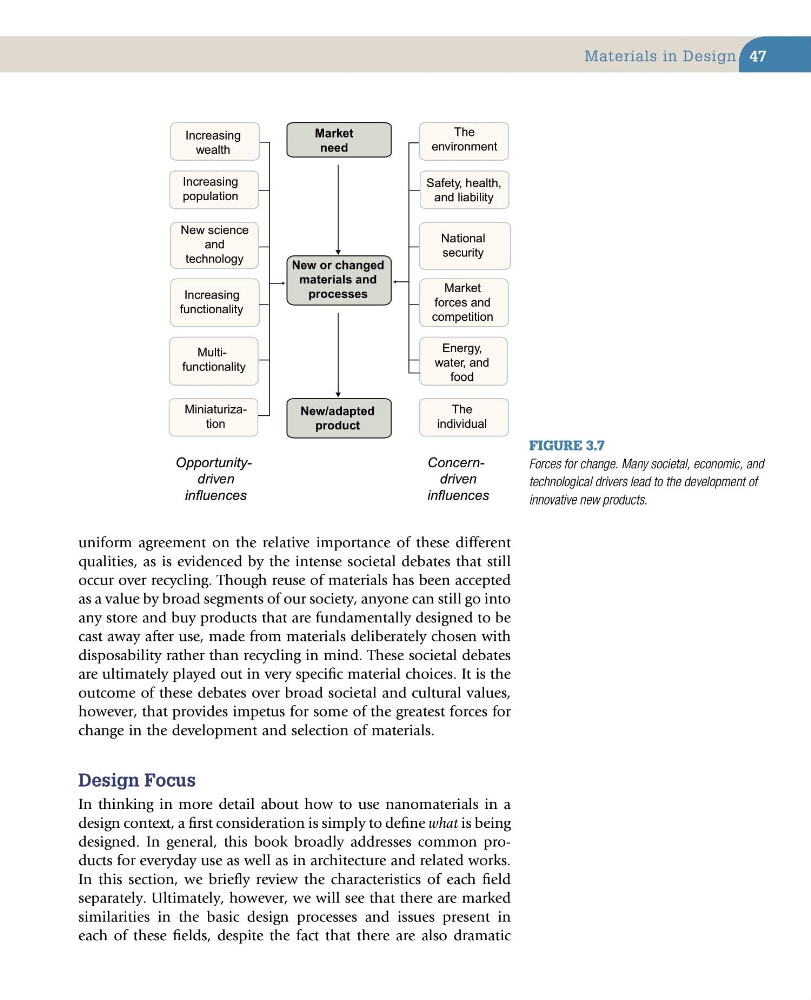
Figure 3.7
Forces for change. Many societal, economic, and
technological drivers lead to the development of
innovative new products.
New or changed
materials and
processes
New/adapted
product
Market
need
Market
forces and
competition
New science
and
technology
The
environment
Increasing
wealth
National
security
Energy,
water, and
food
Increasing
functionality
The
individual
Miniaturization
Increasing
population
Safety, health,
and liability
Multifunctionality
Opportunitydriven
influences
Concerndriven
influences
Materials in Design
uniform agreement on the relative importance of these different
qualities, as is evidenced by the intense societal debates that still
occur over recycling. Though reuse of materials has been accepted
as a value by broad segments of our society, anyone can still go into
any store and buy products that are fundamentally designed to be
cast away after use, made from materials deliberately chosen with
disposability rather than recycling in mind. These societal debates
are ultimately played out in very specific material choices. It is the
outcome of these debates over broad societal and cultural values,
however, that provides impetus for some of the greatest forces for
change in the development and selection of materials.
Design Focus
In thinking in more detail about how to use nanomaterials in a
design context, a first consideration is simply to define what is being
designed. In general, this book broadly addresses common products for everyday use as well as in architecture and related works.
In this section, we briefly review the characteristics of each field
separately. Ultimately, however, we will see that there are marked
similarities in the basic design processes and issues present in
each of these fields, despite the fact that there are also dramatic
Figure 3.7
Forces for change. Many societal, economic, and
technological drivers lead to the development of
innovative new products.
New or changed
materials and
processes
New/adapted
product
Market
need
Market
forces and
competition
New science
and
technology
The
environment
Increasing
wealth
National
security
Energy,
water, and
food
Increasing
functionality
The
individual
Miniaturization
Increasing
population
Safety, health,
and liability
Multifunctionality
Opportunitydriven
influences
Concerndriven
influences
Materials in Design