

45
touching a surface might be enhanced using nanomaterials to
modify the thermal conductivity and/or specific heat of the surface
material.
The associative qualities of a material are placed on it by both its
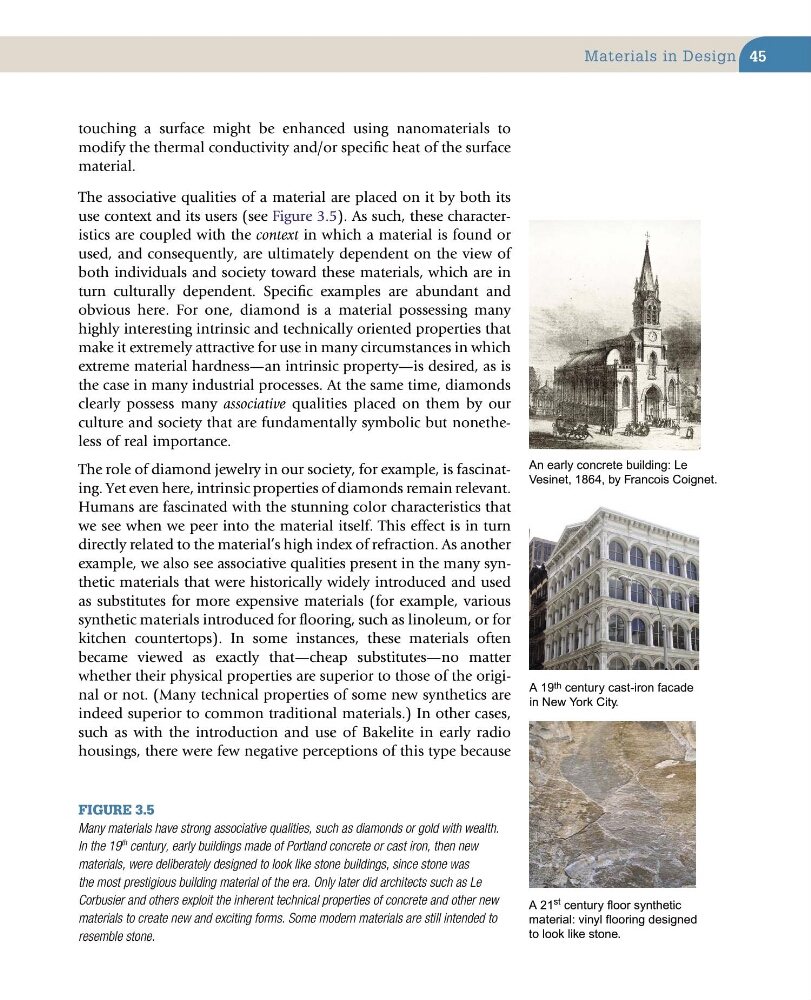
use context and its users (see Figure 3.5). As such, these characteristics are coupled with the context in which a material is found or
used, and consequently, are ultimately dependent on the view of
both individuals and society toward these materials, which are in
turn culturally dependent. Specific examples are abundant and
obvious here. For one, diamond is a material possessing many
highly interesting intrinsic and technically oriented properties that
make it extremely attractive for use in many circumstances in which
extreme material hardness—an intrinsic property—is desired, as is
the case in many industrial processes. At the same time, diamonds
clearly possess many associative qualities placed on them by our
culture and society that are fundamentally symbolic but nonetheless of real importance.
The role of diamond jewelry in our society, for example, is fascinating. Yet even here, intrinsic properties of diamonds remain relevant.
Humans are fascinated with the stunning color characteristics that
we see when we peer into the material itself. This effect is in turn
directly related to the material’s high index of refraction. As another
example, we also see associative qualities present in the many synthetic materials that were historically widely introduced and used
as substitutes for more expensive materials (for example, various
synthetic materials introduced for flooring, such as linoleum, or for
kitchen countertops). In some instances, these materials often
became viewed as exactly that—cheap substitutes—no matter
whether their physical properties are superior to those of the original or not. (Many technical properties of some new synthetics are
indeed superior to common traditional materials.) In other cases,
such as with the introduction and use of Bakelite in early radio
housings, there were few negative perceptions of this type because
Figure 3.5
Many materials have strong associative qualities, such as diamonds or gold with wealth.
In the 19
th century, early buildings made of Portland concrete or cast iron, then new
materials, were deliberately designed to look like stone buildings, since stone was
the most prestigious building material of the era. Only later did architects such as Le
Corbusier and others exploit the inherent technical properties of concrete and other new
materials to create new and exciting forms. Some modern materials are still intended to
resemble stone.
A 21
st century floor synthetic
material: vinyl flooring designed
to look like stone.
An early concrete building: Le
Vesinet, 1864, by Francois Coignet.
A 19 th century cast-iron facade
in New York City.
Materials in Design
touching a surface might be enhanced using nanomaterials to
modify the thermal conductivity and/or specific heat of the surface
material.
The associative qualities of a material are placed on it by both its
use context and its users (see Figure 3.5). As such, these characteristics are coupled with the context in which a material is found or
used, and consequently, are ultimately dependent on the view of
both individuals and society toward these materials, which are in
turn culturally dependent. Specific examples are abundant and
obvious here. For one, diamond is a material possessing many
highly interesting intrinsic and technically oriented properties that
make it extremely attractive for use in many circumstances in which
extreme material hardness—an intrinsic property—is desired, as is
the case in many industrial processes. At the same time, diamonds
clearly possess many associative qualities placed on them by our
culture and society that are fundamentally symbolic but nonetheless of real importance.
The role of diamond jewelry in our society, for example, is fascinating. Yet even here, intrinsic properties of diamonds remain relevant.
Humans are fascinated with the stunning color characteristics that
we see when we peer into the material itself. This effect is in turn
directly related to the material’s high index of refraction. As another
example, we also see associative qualities present in the many synthetic materials that were historically widely introduced and used
as substitutes for more expensive materials (for example, various
synthetic materials introduced for flooring, such as linoleum, or for
kitchen countertops). In some instances, these materials often
became viewed as exactly that—cheap substitutes—no matter
whether their physical properties are superior to those of the original or not. (Many technical properties of some new synthetics are
indeed superior to common traditional materials.) In other cases,
such as with the introduction and use of Bakelite in early radio
housings, there were few negative perceptions of this type because
Figure 3.5
Many materials have strong associative qualities, such as diamonds or gold with wealth.
In the 19
th century, early buildings made of Portland concrete or cast iron, then new
materials, were deliberately designed to look like stone buildings, since stone was
the most prestigious building material of the era. Only later did architects such as Le
Corbusier and others exploit the inherent technical properties of concrete and other new
materials to create new and exciting forms. Some modern materials are still intended to
resemble stone.
A 21
st century floor synthetic
material: vinyl flooring designed
to look like stone.
An early concrete building: Le
Vesinet, 1864, by Francois Coignet.
A 19 th century cast-iron facade
in New York City.
Materials in Design