

C hapter 3 the Design Context
44
other measures related to the mechanical, optical, thermal, and
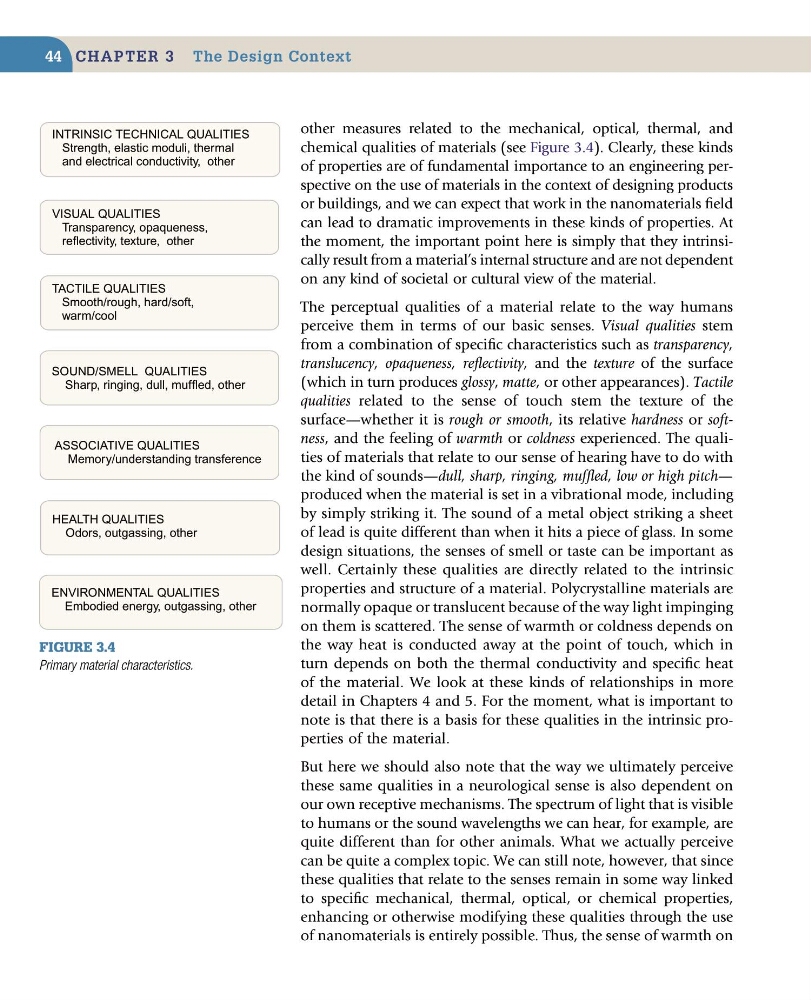
chemical qualities of materials (see Figure 3.4). Clearly, these kinds
of properties are of fundamental importance to an engineering perspective on the use of materials in the context of designing products
or buildings, and we can expect that work in the nanomaterials field
can lead to dramatic improvements in these kinds of properties. At
the moment, the important point here is simply that they intrinsically result from a material’s internal structure and are not dependent
on any kind of societal or cultural view of the material.
The perceptual qualities of a material relate to the way humans
perceive them in terms of our basic senses. Visual qualities stem
from a combination of specific characteristics such as transparency,
translucency, opaqueness, reflectivity, and the texture of the surface
(which in turn produces glossy, matte, or other appearances). Tactile
qualities related to the sense of touch stem the texture of the
surface—whether it is rough or smooth, its relative hardness or softness, and the feeling of warmth or coldness experienced. The qualities of materials that relate to our sense of hearing have to do with
the kind of sounds—dull, sharp, ringing, muffled, low or high pitch—
produced when the material is set in a vibrational mode, including
by simply striking it. The sound of a metal object striking a sheet
of lead is quite different than when it hits a piece of glass. In some
design situations, the senses of smell or taste can be important as
well. Certainly these qualities are directly related to the intrinsic
properties and structure of a material. Polycrystalline materials are
normally opaque or translucent because of the way light impinging
on them is scattered. The sense of warmth or coldness depends on
the way heat is conducted away at the point of touch, which in
turn depends on both the thermal conductivity and specific heat
of the material. We look at these kinds of relationships in more
detail in Chapters 4 and 5. For the moment, what is important to
note is that there is a basis for these qualities in the intrinsic properties of the material.
But here we should also note that the way we ultimately perceive
these same qualities in a neurological sense is also dependent on
our own receptive mechanisms. The spectrum of light that is visible
to humans or the sound wavelengths we can hear, for example, are
quite different than for other animals. What we actually perceive
can be quite a complex topic. We can still note, however, that since
these qualities that relate to the senses remain in some way linked
to specific mechanical, thermal, optical, or chemical properties,
enhancing or otherwise modifying these qualities through the use
of nanomaterials is entirely possible. Thus, the sense of warmth on
Figure 3.4
Primary material characteristics.
INTRINSIC TECHNICAL QUALITIES
Strength, elastic moduli, thermal
and electrical conductivity, other
TACTILE QUALITIES
Smooth/rough, hard/soft,
warm/cool
VISUAL QUALITIES
Transparency, opaqueness,
reflectivity, texture, other
ENVIRONMENTAL QUALITIES
Embodied energy, outgassing, other
HEALTH QUALITIES
Odors, outgassing, other
ASSOCIATIVE QUALITIES
Memory/understanding transference
SOUND/SMELL QUALITIES
Sharp, ringing, dull, muffled, other
44
other measures related to the mechanical, optical, thermal, and
chemical qualities of materials (see Figure 3.4). Clearly, these kinds
of properties are of fundamental importance to an engineering perspective on the use of materials in the context of designing products
or buildings, and we can expect that work in the nanomaterials field
can lead to dramatic improvements in these kinds of properties. At
the moment, the important point here is simply that they intrinsically result from a material’s internal structure and are not dependent
on any kind of societal or cultural view of the material.
The perceptual qualities of a material relate to the way humans
perceive them in terms of our basic senses. Visual qualities stem
from a combination of specific characteristics such as transparency,
translucency, opaqueness, reflectivity, and the texture of the surface
(which in turn produces glossy, matte, or other appearances). Tactile
qualities related to the sense of touch stem the texture of the
surface—whether it is rough or smooth, its relative hardness or softness, and the feeling of warmth or coldness experienced. The qualities of materials that relate to our sense of hearing have to do with
the kind of sounds—dull, sharp, ringing, muffled, low or high pitch—
produced when the material is set in a vibrational mode, including
by simply striking it. The sound of a metal object striking a sheet
of lead is quite different than when it hits a piece of glass. In some
design situations, the senses of smell or taste can be important as
well. Certainly these qualities are directly related to the intrinsic
properties and structure of a material. Polycrystalline materials are
normally opaque or translucent because of the way light impinging
on them is scattered. The sense of warmth or coldness depends on
the way heat is conducted away at the point of touch, which in
turn depends on both the thermal conductivity and specific heat
of the material. We look at these kinds of relationships in more
detail in Chapters 4 and 5. For the moment, what is important to
note is that there is a basis for these qualities in the intrinsic properties of the material.
But here we should also note that the way we ultimately perceive
these same qualities in a neurological sense is also dependent on
our own receptive mechanisms. The spectrum of light that is visible
to humans or the sound wavelengths we can hear, for example, are
quite different than for other animals. What we actually perceive
can be quite a complex topic. We can still note, however, that since
these qualities that relate to the senses remain in some way linked
to specific mechanical, thermal, optical, or chemical properties,
enhancing or otherwise modifying these qualities through the use
of nanomaterials is entirely possible. Thus, the sense of warmth on
Figure 3.4
Primary material characteristics.
INTRINSIC TECHNICAL QUALITIES
Strength, elastic moduli, thermal
and electrical conductivity, other
TACTILE QUALITIES
Smooth/rough, hard/soft,
warm/cool
VISUAL QUALITIES
Transparency, opaqueness,
reflectivity, texture, other
ENVIRONMENTAL QUALITIES
Embodied energy, outgassing, other
HEALTH QUALITIES
Odors, outgassing, other
ASSOCIATIVE QUALITIES
Memory/understanding transference
SOUND/SMELL QUALITIES
Sharp, ringing, dull, muffled, other