

523
12.5 a closIng comment
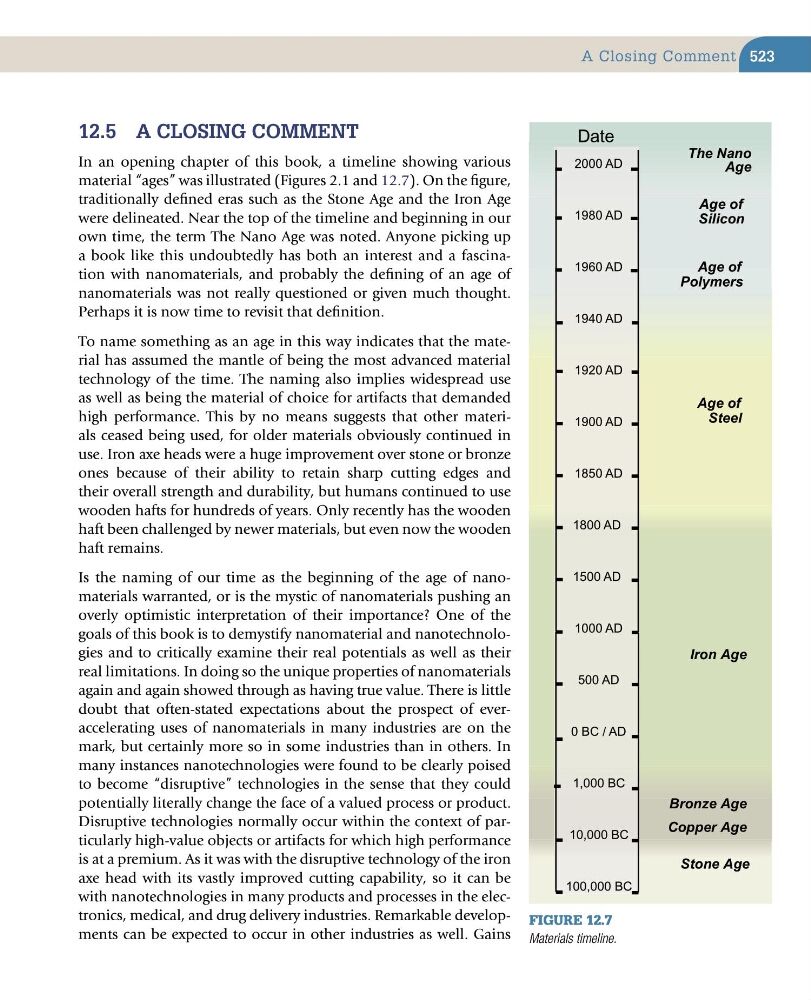
In an opening chapter of this book, a timeline showing various
material “ages” was illustrated (Figures 2.1 and 12.7). On the figure,
traditionally defined eras such as the Stone Age and the Iron Age
were delineated. Near the top of the timeline and beginning in our
own time, the term The Nano Age was noted. Anyone picking up
a book like this undoubtedly has both an interest and a fascination with nanomaterials, and probably the defining of an age of
nanomaterials was not really questioned or given much thought.
Perhaps it is now time to revisit that definition.
To name something as an age in this way indicates that the material has assumed the mantle of being the most advanced material
technology of the time. The naming also implies widespread use
as well as being the material of choice for artifacts that demanded
high performance. This by no means suggests that other materials ceased being used, for older materials obviously continued in
use. Iron axe heads were a huge improvement over stone or bronze
ones because of their ability to retain sharp cutting edges and
their overall strength and durability, but humans continued to use
wooden hafts for hundreds of years. Only recently has the wooden
haft been challenged by newer materials, but even now the wooden
haft remains.
Is the naming of our time as the beginning of the age of nanomaterials warranted, or is the mystic of nanomaterials pushing an
overly optimistic interpretation of their importance? One of the
goals of this book is to demystify nanomaterial and nanotechnologies and to critically examine their real potentials as well as their
real limitations. In doing so the unique properties of nanomaterials
again and again showed through as having true value. There is little
doubt that oftenstated expectations about the prospect of everaccelerating uses of nanomaterials in many industries are on the
mark, but certainly more so in some industries than in others. In
many instances nanotechnologies were found to be clearly poised
to become “disruptive” technologies in the sense that they could
potentially literally change the face of a valued process or product.
Disruptive technologies normally occur within the context of particularly highvalue objects or artifacts for which high performance
is at a premium. As it was with the disruptive technology of the iron
axe head with its vastly improved cutting capability, so it can be
with nanotechnologies in many products and processes in the electronics, medical, and drug delivery industries. Remarkable developments can be expected to occur in other industries as well. Gains
Figure 12.7
Materials timeline.
Date
100,000 BC
10,000 BC
1,000 BC
0 BC / AD
1000 AD
500 AD
1500 AD
1800 AD
1900 AD
1850 AD
1920 AD
1940 AD
1960 AD
1980 AD
2000 AD
Copper Age
Bronze Age
Iron Age
Age of
Steel
Age of
Silicon
Age of
Polymers
Stone Age
The Nano
Age
A Closing Comment
12.5 a closIng comment
In an opening chapter of this book, a timeline showing various
material “ages” was illustrated (Figures 2.1 and 12.7). On the figure,
traditionally defined eras such as the Stone Age and the Iron Age
were delineated. Near the top of the timeline and beginning in our
own time, the term The Nano Age was noted. Anyone picking up
a book like this undoubtedly has both an interest and a fascination with nanomaterials, and probably the defining of an age of
nanomaterials was not really questioned or given much thought.
Perhaps it is now time to revisit that definition.
To name something as an age in this way indicates that the material has assumed the mantle of being the most advanced material
technology of the time. The naming also implies widespread use
as well as being the material of choice for artifacts that demanded
high performance. This by no means suggests that other materials ceased being used, for older materials obviously continued in
use. Iron axe heads were a huge improvement over stone or bronze
ones because of their ability to retain sharp cutting edges and
their overall strength and durability, but humans continued to use
wooden hafts for hundreds of years. Only recently has the wooden
haft been challenged by newer materials, but even now the wooden
haft remains.
Is the naming of our time as the beginning of the age of nanomaterials warranted, or is the mystic of nanomaterials pushing an
overly optimistic interpretation of their importance? One of the
goals of this book is to demystify nanomaterial and nanotechnologies and to critically examine their real potentials as well as their
real limitations. In doing so the unique properties of nanomaterials
again and again showed through as having true value. There is little
doubt that oftenstated expectations about the prospect of everaccelerating uses of nanomaterials in many industries are on the
mark, but certainly more so in some industries than in others. In
many instances nanotechnologies were found to be clearly poised
to become “disruptive” technologies in the sense that they could
potentially literally change the face of a valued process or product.
Disruptive technologies normally occur within the context of particularly highvalue objects or artifacts for which high performance
is at a premium. As it was with the disruptive technology of the iron
axe head with its vastly improved cutting capability, so it can be
with nanotechnologies in many products and processes in the electronics, medical, and drug delivery industries. Remarkable developments can be expected to occur in other industries as well. Gains
Figure 12.7
Materials timeline.
Date
100,000 BC
10,000 BC
1,000 BC
0 BC / AD
1000 AD
500 AD
1500 AD
1800 AD
1900 AD
1850 AD
1920 AD
1940 AD
1960 AD
1980 AD
2000 AD
Copper Age
Bronze Age
Iron Age
Age of
Steel
Age of
Silicon
Age of
Polymers
Stone Age
The Nano
Age
A Closing Comment