

chaPter 12 the Broader context
524
will be selective, however, since not all products will see dramatic
changes in their character or basic use of materials. The equivalent
of the wooden haft will remain with us.
In many applications across several industries, truly disruptive
technologies associated with the use of nanomaterials and nanotechnologies might not occur at all; rather the term continuous
improvement is perhaps a better way of couching potential impacts.
This couching by no means detracts from the importance of nanomaterial and nanotechnology contributions within these contexts.
Many valuable and highly functioning technologies have reached
mature stages of development where forward progress has slowed
and where nanomaterials and nanotechnologies can help achieve
new levels of development.
Another aspect of the question of the appropriateness of naming a
material age is whether impacts have a long life. Might nanomaterials and nanotechnologies be here today and gone tomorrow? In an
earlier discussion on the possible evolutionary path of computing
“chips” that are so essential to our technological world as we know
it, nanotechnologies were argued as being the next major step
forward in increasing speed and computing power while always
decreasing in size. Yet in the same discussion it was noted that
within a time frame of 20 to 30 years, chips based on ideas of “electron spin” would come to the fore, thus driving the size scale even
further downward from the nanoscale to the atomic scale. Does
this negate the idea of a nanomaterials age if anticipated nearterm
technologies might be described in other terms?
This is a difficult question, since predicting the technological future
has long known to be a risky enterprise at best. It does appear that
some technologies will indeed move further down the size scale
into the molecular and atomic scale. Many chemical and biological processes and actions already operate on this scale, to be sure,
and there is every expectation that further developments will occur
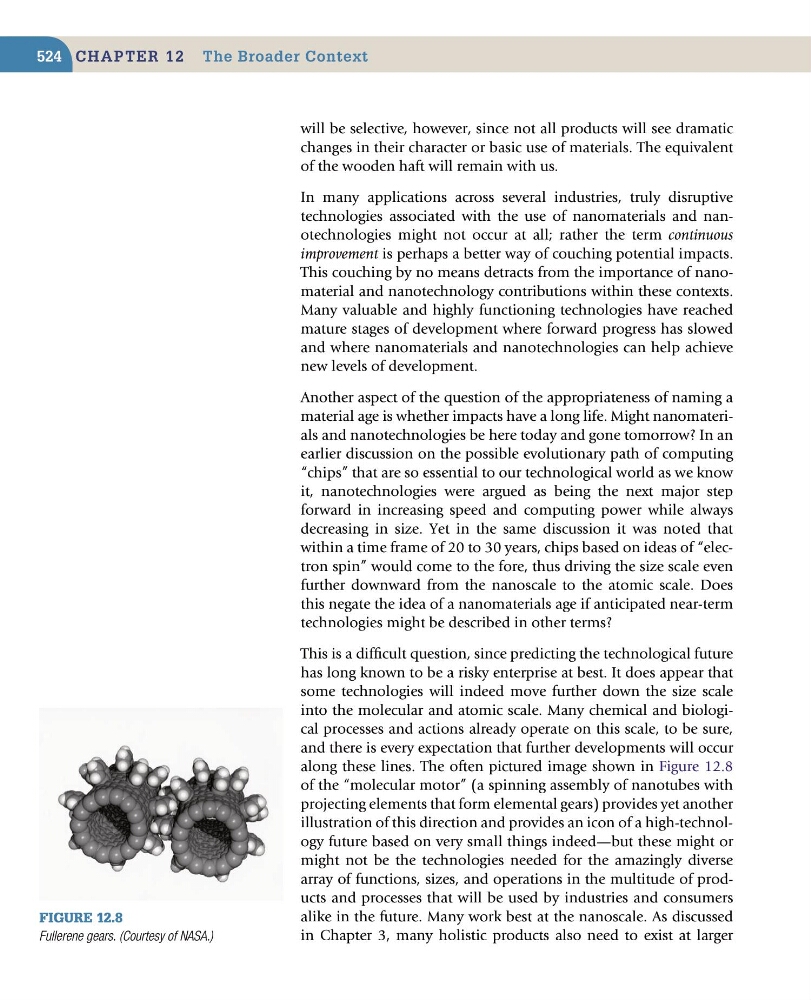
along these lines. The often pictured image shown in Figure 12.8
of the “molecular motor” (a spinning assembly of nanotubes with
projecting elements that form elemental gears) provides yet another
illustration of this direction and provides an icon of a hightechnology future based on very small things indeed—but these might or
might not be the technologies needed for the amazingly diverse
array of functions, sizes, and operations in the multitude of products and processes that will be used by industries and consumers
alike in the future. Many work best at the nanoscale. As discussed
in Chapter 3, many holistic products also need to exist at larger
Figure 12.8
Fullerene gears. (Courtesy of NASA.)
524
will be selective, however, since not all products will see dramatic
changes in their character or basic use of materials. The equivalent
of the wooden haft will remain with us.
In many applications across several industries, truly disruptive
technologies associated with the use of nanomaterials and nanotechnologies might not occur at all; rather the term continuous
improvement is perhaps a better way of couching potential impacts.
This couching by no means detracts from the importance of nanomaterial and nanotechnology contributions within these contexts.
Many valuable and highly functioning technologies have reached
mature stages of development where forward progress has slowed
and where nanomaterials and nanotechnologies can help achieve
new levels of development.
Another aspect of the question of the appropriateness of naming a
material age is whether impacts have a long life. Might nanomaterials and nanotechnologies be here today and gone tomorrow? In an
earlier discussion on the possible evolutionary path of computing
“chips” that are so essential to our technological world as we know
it, nanotechnologies were argued as being the next major step
forward in increasing speed and computing power while always
decreasing in size. Yet in the same discussion it was noted that
within a time frame of 20 to 30 years, chips based on ideas of “electron spin” would come to the fore, thus driving the size scale even
further downward from the nanoscale to the atomic scale. Does
this negate the idea of a nanomaterials age if anticipated nearterm
technologies might be described in other terms?
This is a difficult question, since predicting the technological future
has long known to be a risky enterprise at best. It does appear that
some technologies will indeed move further down the size scale
into the molecular and atomic scale. Many chemical and biological processes and actions already operate on this scale, to be sure,
and there is every expectation that further developments will occur
along these lines. The often pictured image shown in Figure 12.8
of the “molecular motor” (a spinning assembly of nanotubes with
projecting elements that form elemental gears) provides yet another
illustration of this direction and provides an icon of a hightechnology future based on very small things indeed—but these might or
might not be the technologies needed for the amazingly diverse
array of functions, sizes, and operations in the multitude of products and processes that will be used by industries and consumers
alike in the future. Many work best at the nanoscale. As discussed
in Chapter 3, many holistic products also need to exist at larger
Figure 12.8
Fullerene gears. (Courtesy of NASA.)